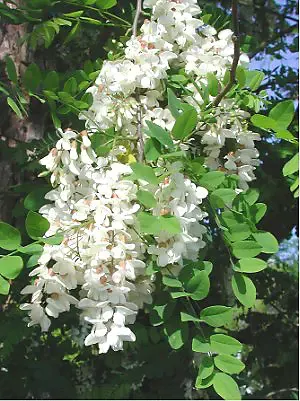
© Pollinator at English Wikipedia · CC BY-SA 3.0 · Commons
Robinia pseudoacacia
Toxic🐾Gewöhnliche Robinie · (Robinia pseudoacacia)
Legume family (Fabaceae)
Description
Robinia pseudoacacia, commonly known as black locust, is a medium-sized hardwood deciduous tree, belonging to the tribe Robinieae of the legume family. Another common name is false acacia, a literal translation of the specific name.
🌿 Risk of confusion — read before wild-harvesting!
Bark, roots, young shoots, leaves and seeds are toxic (lectin robin/phasin, flavonol glycoside robinin, wystin). Only fully opened flowers are considered edible in folk cuisine - and only deep-fried or otherwise heated, not raw. Do not confuse seedlings/suckers with edible wild greens. Do not use wood shavings, sawdust, wood chips or fallen leaves of Robinia in horse, cattle or rabbit stables - even small amounts of bark can be lethal. Educate children about toxicity - the sweet pea-like pods are particularly tempting.
CONTRAINDICATED during pregnancy
No therapeutic use of bark or seed preparations in pregnancy (toxic lectins). Deep-fried flower fritters in household amounts are considered safe, but moderation is advised.
- RawFlowerExternalFolk medicine
Robinia is the most important nectar source for so-called 'acacia honey' - botanically actually black-locust honey, since true acacia (Acacia) is a different genus. The honey is pale, mild, liquid (crystallises very slowly due to high fructose content) and is regarded as a premium beekeeping product. Yields of 500-1000 kg honey per hectare of Robinia stand are possible in good weather.
Preparation & dosage
[#src_wikipedia_de_robinie] [#src_wikipedia_en_blacklocust] [#src_pfaf_robinia]
- RawWhole plantExternalFolk medicine
Used in park and street-tree planting since the 17th century (introduced to Europe in 1601 by Jean Robin, court gardener to Henry IV) as a robust, fast-growing shade tree tolerant of drought and urban climate. Cultivars such as 'Umbraculifera' (mop-head locust) and 'Frisia' (yellow-leaved) are established street trees. Caution: root suckers and invasive behaviour in semi-natural areas.
[#src_wikipedia_de_robinie] [#src_wikipedia_en_blacklocust] [#src_cabi_robinia]
- RawWhole plantExternalFolk medicine
Black-locust timber is exceptionally hard, heavy and durable (durability class 1-2 per EN 350, comparable to teak or oak). Classical uses: vineyard stakes, fence posts, railway sleepers (historically), boat building, tool handles, playground equipment and outdoor furniture. Considered a sustainable European hardwood alternative to tropical timbers (FSC-certified plantations in Hungary, Romania).
[#src_wikipedia_de_robinie] [#src_wikipedia_en_blacklocust] [#src_pfaf_robinia]
- RawRootExternalFolk medicine
As a legume, Robinia lives in symbiosis with Rhizobium bacteria in root nodules and fixes atmospheric nitrogen (up to 100-300 kg N/ha/year). Historically used to reforest erosion-prone soils, mine spoils and nutrient-poor sites. Now critically assessed in nature conservation: nitrogen input displaces species-rich nutrient-poor dry grasslands and oligotrophic habitats.
[#src_cabi_robinia] [#src_wikipedia_de_robinie] [#src_pfaf_robinia]
Historical documentation only — do NOT use
These internal applications are historically documented. This plant is highly toxic — self-treatment can cause severe poisoning or death. For documentation only, explicitly NOT a recommendation.
- RawFlowerInternalFolk medicine
The intensely fragrant white flower clusters are harvested in May/June and traditionally deep-fried in beer or pancake batter as 'Akazienkuechle' or Italian 'fritti di acacia'. Also used for syrup or for flavouring sugar and liqueurs. Only fully opened flowers are used - stems, leaves, bark and seeds are toxic (robin/robinin).
Preparation & dosage
- RawBarkInternalTraditional use
Important folk-medicinal and veterinary note: bark, roots, young shoots and seeds contain robin (toxic lectin/phasin, heat-labile), robinin (flavonol glycoside) and wystin. Ingestion by humans or animals (especially horses, cattle, pigs, rabbits, birds) leads to vomiting, bloody diarrhoea, mydriasis, weakness, circulatory collapse and seizures. Horse poisonings from bark gnawing or Robinia shavings in bedding are regularly documented.
[#src_wikipedia_de_robinie] [#src_giftpflanzen_robinie] [#src_efsa_robinia]