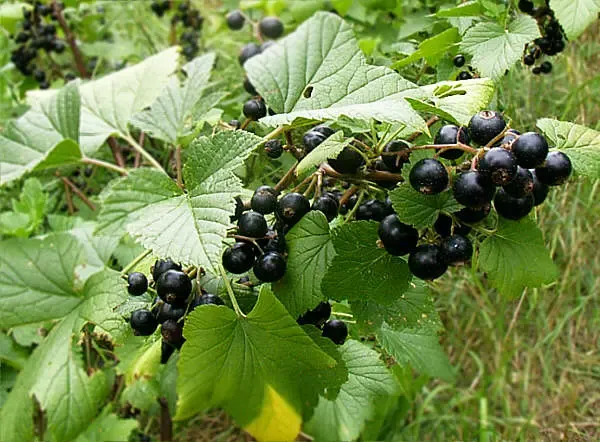
© Unknown (see Commons) · Public domain · Commons
Blackcurrant
Schwarze Johannisbeere · (Ribes nigrum)
Gooseberry family (Grossulariaceae)
Description
The blackcurrant, black currant or cassis is a deciduous shrub in the family Grossulariaceae grown for its edible berries. It is native to temperate parts of central and northern Europe and northern Asia, where it prefers damp fertile soils. It is widely cultivated both commercially and domestically.
- TeaLeafInternalTraditional use
Leaf infusion of dried blackcurrant leaves, traditionally used for minor joint complaints. The EMA HMPC monograph (Ribis nigri folium) classifies this as traditional use.
Preparation & dosage
Pour 150 ml of boiling water over 2–4 g of dried leaves, steep 10 minutes, strain. Up to 3 cups daily.
- Dry amount
- 2–4 g
- Doses per day
- 3×
[#src_ema_ribes_nigrum] [#src_wp_de_ribes] [#src_pfaf_ribes]
- TeaLeafInternalTraditional use
Leaf tea used as a supportive flush of the urinary tract for minor complaints. The EMA HMPC monograph (Ribis nigri folium) recognises this as traditional use to increase urine production.
Preparation & dosage
As for joint tea. When used for urinary flushing, ensure adequate fluid intake (≥ 1.5 l water daily).
- Dry amount
- 2–4 g
- Doses per day
- 3×
- Max duration
- 4 weeks
- RawFruitInternalTraditional use
Fresh blackcurrants contain approximately 180 mg vitamin C per 100 g – among the highest of any temperate berry. Traditionally eaten as a natural tonic during colds and to support immune resistance.
[#src_wp_de_ribes] [#src_wp_en_ribes] [#src_pmc_berry_leaves]
- TeaLeafInternalFolk medicine
Leaf infusion as gargle or drink for sore throat and pharyngeal irritation. Recorded in folk medicine; the astringent effect of tannins and antioxidant flavonoids are considered the basis of action.
- TinctureLeafInternalFolk medicine
Leaf tincture (1:5 in 40% ethanol) for rheumatic joint pain. Recorded in folk medicine since the Middle Ages; quercetin glycosides and chlorogenic acid are considered the key anti-inflammatory compounds.
- GargleLeafExternalFolk medicine
Cooled leaf infusion as mouthwash for oral mucosa inflammation and aphthous ulcers. Tannins exert an astringent effect on irritated mucous membranes.