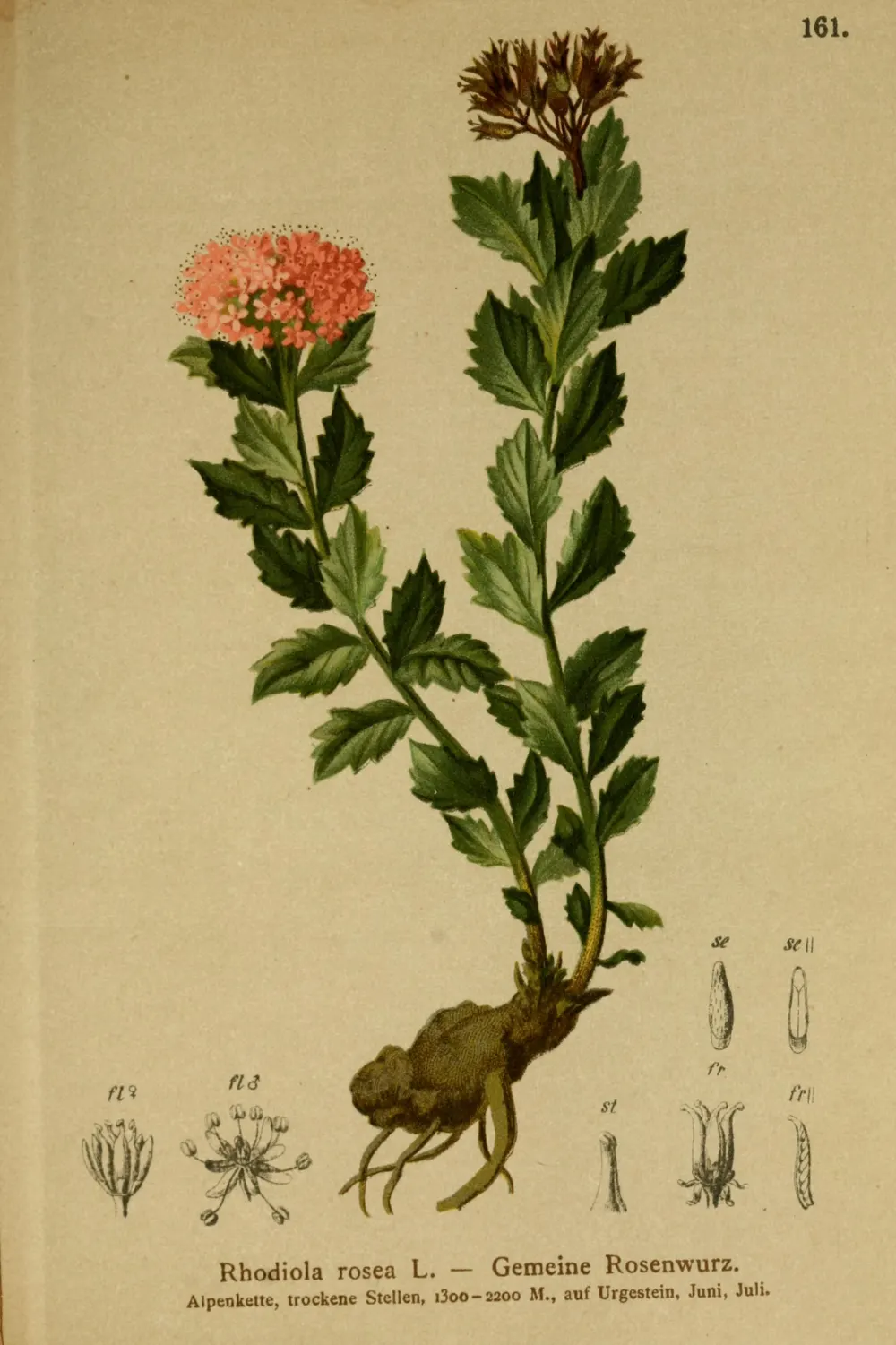
© Anton Hartinger / K. W. von Dalla Torre (Atlas der Alpenflora, 1882) · Public domain · Commons
Roseroot (Golden root, Arctic root)
Rosenwurz (Rosenwurzel) · (Rhodiola rosea)
Stonecrop family (Crassulaceae)
Description
Roseroot is a perennial, succulent herb of the arctic and alpine regions of Eurasia and North America, growing at elevations up to about 3000 m. From a thick, tuberous rootstock (rhizome) arise several fleshy, leafy stems with bluish-green, lance-shaped leaves. The plant is dioecious (separate male and female plants); the yellow to greenish-yellow flower heads appear in summer. The freshly cut rootstock has a characteristic rose-like scent, which gives the plant its name. The medicinal parts are the root and rhizome (Rhodiolae roseae rhizoma et radix), from which a standardised dry extract is produced. Roseroot is a classic adaptogen of Scandinavian, Russian and Siberian folk medicine. In Germany it grows wild only in Bavaria near Bodenmais; due to over-harvesting the species is protected (CITES Appendix II).
CONTRAINDICATED during pregnancy
Use in pregnancy is not recommended due to lack of safety data (EMA HMPC).
CONTRAINDICATED for children
Not for children and adolescents under 18 years due to lack of data (EMA HMPC).
- TinctureRootInternalTraditional use
The standardised root/rhizome extract is used traditionally for the temporary relief of stress symptoms such as fatigue and a sensation of weakness. The European Medicines Agency (HMPC) classifies this as 'traditional use': effectiveness is plausible and based on long-standing safe use of more than 30 years (over 15 years in the EU), rather than on robust clinical trials – the HMPC judged the available studies to have considerable methodological shortcomings.
Preparation & dosage
A standardised dry extract of root and rhizome is used (e.g. the special extract WS 1375, adjusted to about 3 % rosavins and 1 % salidroside). Typical doses are about 144–400 mg of dry extract per day, in one or two single doses. It should be taken in the morning or before noon, as the mildly stimulating remedy may disturb sleep if taken late. Do not use for longer than two weeks without medical advice. Home-made tinctures or teas do not reach the defined active-compound composition of the licensed product.
- Dry amount
- 0.144–0.4 g
- Doses per day
- 2×
- Max duration
- 2 weeks
⚠ Age restriction: ≥ 18 years — Adults aged 18 and over only; not for children and adolescents under 18 due to lack of data (EMA HMPC). Do not use for longer than 2 weeks without medical advice.
- TeaRhizomeInternalTraditional use
The traditional tea from the rootstock reflects the historical folk use as a strengthening remedy. It falls under the same traditional-use classification (EMA HMPC) as the extract but is less well standardised pharmaceutically.
Preparation & dosage
In Scandinavian, Russian and Siberian folk medicine the dried, chopped rootstock was also prepared as an infusion: about 1.5–3 g per 250 ml of hot water, steeped for roughly 10 minutes. Best taken in the morning, not late in the day. The tea is uncommon today and delivers a less defined dose than the standardised extract; it does not replace medical advice and should not be taken for longer than two weeks without consultation.
- Dry amount
- 1.5–3 g
- Doses per day
- 1×
- Max duration
- 2 weeks
⚠ Age restriction: ≥ 18 years — Adults aged 18 and over only; not for children and adolescents under 18 due to lack of data (EMA HMPC). Do not use for longer than 2 weeks without medical advice.
🤝 Permaculture Partners
In your garden, this plant acts as: