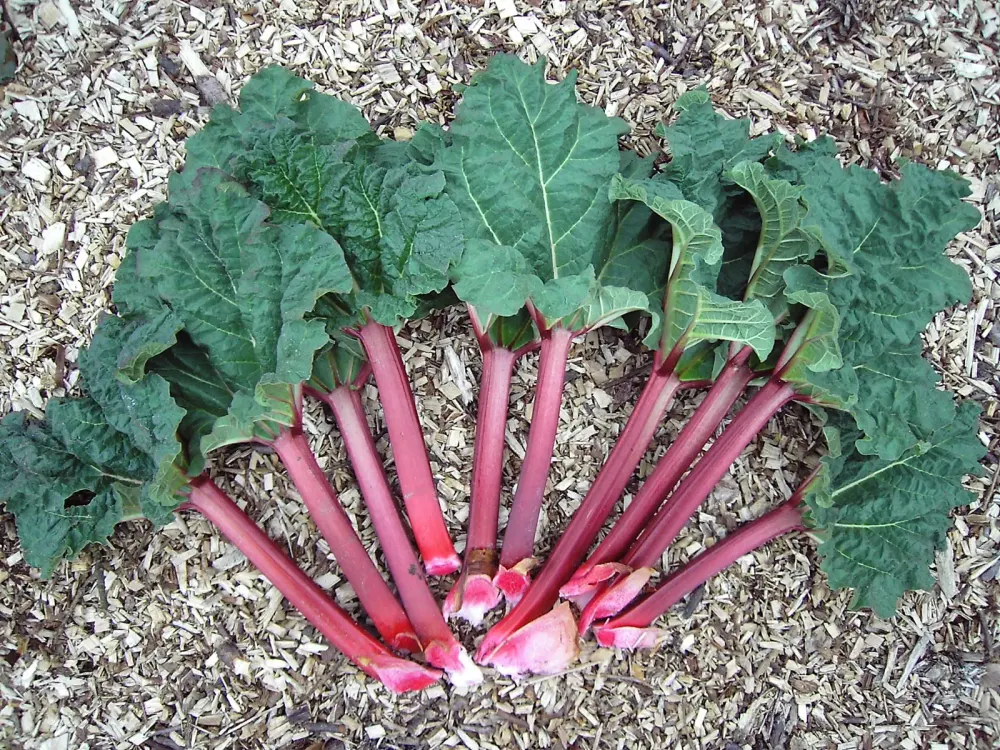
© Dieter Weber (User:Uellue) · CC BY-SA 3.0 · Commons
Rhubarb
CautionRhabarber · (Rheum rhabarbarum)
Knotweed family (Polygonaceae)
Description
Rhubarb is a perennial herbaceous species in the genus Rheum within the knotweed family (Polygonaceae). Originally from the temperate mountainous regions of Asia, it has been cultivated in Europe as a vegetable and medicinal plant since the 18th century. Only the fleshy, tart leaf stalks (petioles) are used in cooking — the large leaves are toxic due to their high oxalic acid content.
CONTRAINDICATED during pregnancy
Rhubarb root preparations are contraindicated in pregnancy: anthraquinones (emodin, sennosides) are embryotoxic in animal experiments and may stimulate uterine contractions. Rhubarb stalk as food in usual culinary amounts is considered safe, but should also be restricted due to oxalic acid.
CONTRAINDICATED during breastfeeding
Anthraquinones from rhubarb root pass into breast milk and may cause laxative effects in the infant. Rhubarb root preparations are contraindicated during lactation. Rhubarb stalk as food in small amounts is acceptable.
Critical drug interactions with:
Herzglykoside (Digitalis, Digoxin)
- SpiceAerial partsInternalFolk medicine
The petiole (stalk) of garden rhubarb is the only edible part of the plant and is used in cooking as a vegetable and compote fruit. It contains oxalic acid (approx. 0.5–1.5 %) and malic acid, which give it its sour taste. Cooking partially destroys oxalic acid; nevertheless rhubarb should not be eaten daily in large quantities. Leaves and root are unsuitable for culinary use (see warning).
Preparation & dosage
[#src_wiki_rheum_rhabarbarum_de] [#src_pfaf_rheum] [#src_wiki_rheum_en]
- TeaRootInternalCommission E
The Kommission E has issued a positive monograph for Rhei radix (rhubarb root): at low doses (0.1–0.3 g crude drug) as a bitter and stomachic for digestive weakness, at higher doses (1–4 g) as a stimulant laxative for constipation. The main active constituents are anthraquinone glycosides (sennosides, rhein-8-glucoside, emodin glycosides). Important note: the Kommission E monograph refers primarily to R. palmatum and R. officinale (medicinal rhubarb from China); garden rhubarb (R. rhabarbarum) contains the same class of active compounds in the root but at lower and more variable concentrations — it is not pharmacopoeially standardised as Rhei radix.
Preparation & dosage
Pour 200 ml of boiling water over 0.5–2 g dried, ground rhubarb root (R. rhabarbarum), steep for 10 minutes, strain. One cup in the evening. Do not use for more than 1–2 weeks without medical supervision. Note: Standardised Rhei radix preparations use R. palmatum/officinale.
- Dry amount
- 0.5–2 g
- Doses per day
- 1×
- Max duration
- 2 weeks
[#src_kommission_e_rhei] [#src_pfaf_rheum] [#src_wiki_rheum_en]
- TinctureRootInternalTraditional use
In folk medicine and older phytotherapy, rhubarb root tincture was used as a bitter tonic to stimulate bile flow and gastric juice secretion (dyspepsia, bloating). The bitters (emodin, rhein) stimulate liver secretion and intestinal motility. In small amounts (bitter dose) the tonic effect predominates; in larger amounts the laxative effect takes over.
Preparation & dosage
20–30 drops of 1:5 tincture (40–60 % ethanol) before meals in a little water. No longer than 2 weeks without a break.
- Doses per day
- 3×
[#src_kommission_e_rhei] [#src_wiki_rheum_en] [#src_pfaf_rheum]
- CompressRootExternalFolk medicine
In folk medicine, decoctions of rhubarb root were applied as compresses for skin itching, minor inflammations, and wounds. The tannin content (tannins, galloylglucose) acts astringently; emodin shows antibacterial activity in vitro. This external use is transmitted only through folk healing tradition.
Preparation & dosage
Simmer 5–10 g dried rhubarb root in 300 ml water for 15 minutes, allow to cool, then strain. Apply compress to affected skin areas.
- Dry amount
- 5–10 g
- Doses per day
- 2×
- RawLeafExternalFolk medicine
WARNING — TOXIC: Rhubarb leaves contain very high amounts of oxalic acid (up to 1 % oxalate as soluble potassium oxalate + insoluble calcium oxalate) as well as anthraquinones. Ingestion of rhubarb leaves can cause severe poisoning: vomiting, kidney damage, convulsions — in rare cases fatal. Leaves must NOT be eaten. Historically, rhubarb leaves were used externally (as a 'green soap') for removing stains — now obsolete.
Preparation & dosage
[#src_wiki_rheum_rhabarbarum_de] [#src_pfaf_rheum] [#src_wiki_rheum_en]
🤝 Permaculture Partners
In your garden, this plant acts as:
✨ Best symbiotic partners
- 🌿 Garlic Garlic deters rhubarb pests and root fungi.
- 🌿 Cabbage Rhubarb leaves shade the soil, cabbage benefits from the retained moisture.
- 🌿 Red cabbage Rhubarb leaves shade the soil — red cabbage likes it too.
- 🌿 Lettuce Lettuce as ground cover beneath the large rhubarb leaves.
⚠️ Better not planted together
- 🥬 Carrot Both deep-rooting — compete for the same root space.
📦 Part of these planting sets:
Source: Helga und Margarete Langerhorst, Mein gesunder Naturgarten (eigene Kuration)