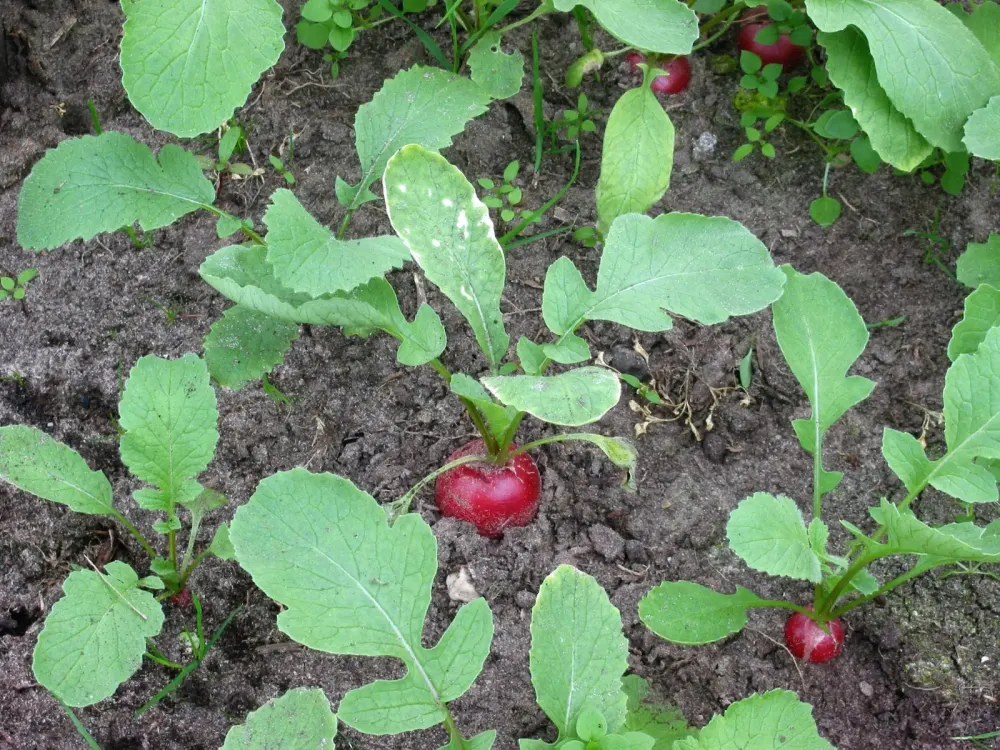
© Rasbak · CC BY-SA 3.0 · Commons
Radish
CautionRadieschen · (Raphanus sativus var. sativus)
Cabbage family (Brassicaceae)
Description
The radish is a flowering plant in the mustard family, Brassicaceae. Its large taproot is commonly used as a root vegetable, although the entire plant is edible and its leaves are sometimes used as a leaf vegetable. Originally domesticated in Asia, radishes are now grown and consumed globally.
- RawRootInternalTraditional use
The radish is one of the fastest-growing vegetables (harvest after approx. 25–35 days) and is consumed fresh worldwide. The root contains approx. 27–29 mg vitamin C per 100 g (approx. 30 % of daily requirement), potassium (approx. 225–255 mg/100 g), folate and iron (approx. 1.2 mg/100 g) at only 14 kcal/100 g. Eaten raw in salads, as a snack with butter and sea salt (classic French style), in dips or thinly sliced on open sandwiches. The sharp flavour comes from isothiocyanates (especially 4-methylthio-3-butenyl isothiocyanate / glucoraphasatin degradation product), released from glucosinolates by myrosinase upon cell damage.
[#src_wp_de_radieschen] [#src_wp_en_radish] [#src_pfaf_raphanus]
- RawRootInternalTraditional use
In the traditional folk medicine of Europe and Asia, radishes are considered digestive-promoting, appetite-stimulating and mildly laxative. The bitter compounds and mustard oils (isothiocyanates) are believed to stimulate bile secretion and promote liver circulation. Folk-medicinal tradition sees grated or pressed radishes as a traditional remedy for bloating, sluggish digestion and flatulence. PFAF references the tonic and laxative effect on the intestines and indirect gallbladder stimulation.
[#src_pfaf_raphanus] [#src_wp_de_radieschen] [#src_wp_en_radish]
- RawRootInternalFolk medicine
Fresh radish juice or grated radishes were used in folk medicine for colds, coughs and bronchitis. The antibacterially active substance raphanin (a glucosinolate breakdown product with isothiocyanate-like structure) is said to be expectorant and germicidal. PFAF mentions the use of seeds for digestive complaints and bronchitis. Clinical evidence is lacking; folk-medicinal tradition from several European and Asian traditions.
- RawLeafInternalTraditional use
Radish leaves are as edible as the root: they contain (dried) extremely high levels of vitamin C (approx. 704 mg/100 g dry), calcium (approx. 1,913 mg/100 g dry), iron and potassium according to PFAF. Fresh leaves can be sautéed as leafy greens, used in salads or added to soups. In normal households they are usually discarded — an underrated nutrient supplier. Young leaves are milder, older ones somewhat bitter.
- CompressRootExternalFolk medicine
Grated or mashed radish root was used in folk medicine as an external compress for minor burns, bruises and skin irritation (PFAF). The cooling, moist mass is said to soothe local inflammatory reactions. Not clinically confirmed; no substitute for medical wound care. Isothiocyanates can cause irritation on sensitive skin — observe short application time.
- RawRootInternalTraditional use
Radishes contain glucosinolates (especially glucoraphasatin, glucoraphenin, glucoerucin) and their breakdown products isothiocyanates (especially sulforaphene, sulforaphane). Sulforaphane activates the transcription factor Nrf2, which induces cellular detoxification enzymes. Preclinical studies (in vitro / animal model) show antiproliferative and antioxidative effects. Anthocyanins (pelargonidin in red radish) act antioxidatively and may inhibit LDL oxidation. Clinical evidence in humans is still outstanding.
- SpiceSeedInternalFolk medicine
Radish seeds contain particularly high concentrations of glucosinolates and isothiocyanates and are used in folk medicine to promote digestion and as an appetite-stimulating spice. Sprouts from radish seeds (microgreens) are a concentrated source of glucosinolates, flavonoids, beta-carotene and vitamin C. PFAF mentions the use of seeds for indigestion, flatulence and bronchitis.
🤝 Permaculture Partners
In your garden, this plant acts as:
✨ Best symbiotic partners
📦 Part of these planting sets:
Source: Helga und Margarete Langerhorst, Mein gesunder Naturgarten (eigene Kuration)