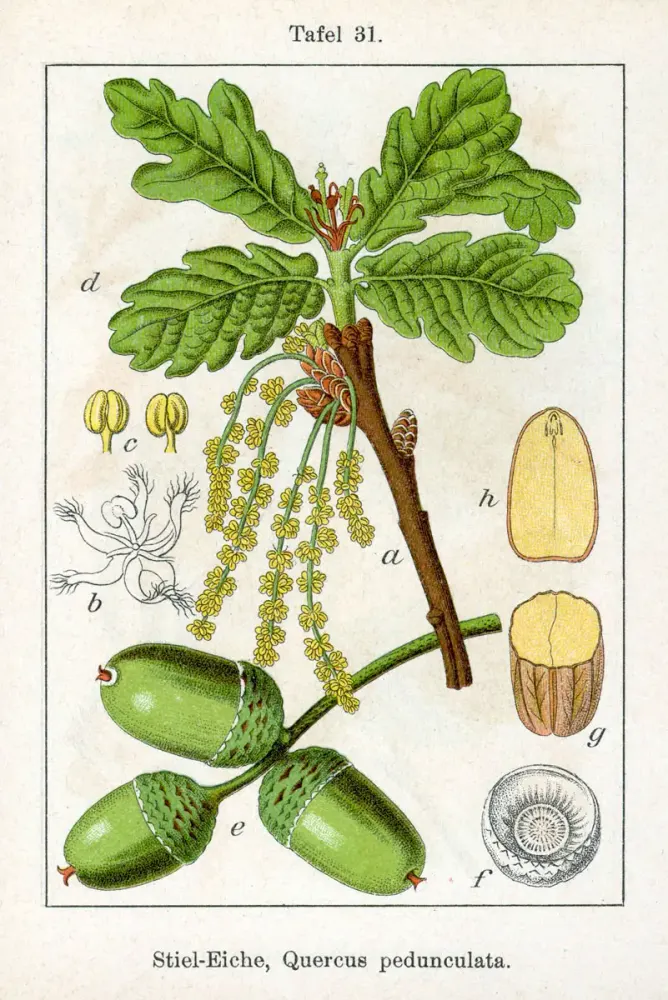
© Johann Georg Sturm (Painter: Jacob Sturm) · Public domain · Commons
Quercus robur
CautionStieleiche · (Quercus robur)
Beech family (Fagaceae)
Description
Quercus robur, pedunculate oak, or English oak, is a species of flowering plant in the beech and oak family, Fagaceae. It is a large tree, native to Europe and western Asia, and is widely cultivated in other temperate regions. It grows on soils of near neutral acidity in the lowlands and is notable for its value to natural ecosystems, supporting a diversity of herbivorous insects, acorn eating mammals and birds, and fungi.
External use only!
This plant must NOT be taken internally. Use only as compress, salve, or bath.
- TeaBarkInternalCommission E
A decoction of 1–2 g dried oak bark (briefly boiled, steeped 15 min) has an astringent and secretion-reducing effect in acute, uncomplicated diarrhoea. Tannins precipitate mucosal proteins and form a protective layer. Maximum use 3–4 days; seek medical advice if symptoms persist.
Preparation & dosage
Place 1–2 g bark in 250 ml cold water, briefly bring to a boil, steep 15 minutes, strain. Daily dose: 3 g drug divided over 3 cups.
- Dry amount
- 1–2 g
- Doses per day
- 3×
- GargleBarkExternalCommission E
A 2% decoction (2 g bark per 100 ml water) is suitable for gargling in mild inflammation of the oral and pharyngeal mucosa, and as a mouthwash for gum problems. The astringent action of tannins reduces swelling and redness.
Preparation & dosage
Boil 10–20 g bark in 1 litre water, simmer 15 minutes, strain. Gargle or use as mouthwash several times daily.
- Dry amount
- 10–20 g
- Doses per day
- 3×
- BathBarkExternalCommission E
Sitz baths and partial baths with oak bark decoction (5 g bark per litre water) relieve burning and itching in haemorrhoids, anal eczema, and intertrigo. The tannin-containing solution has anti-inflammatory and secretion-reducing effects. Balneological preparations should contain at least 10% tannins.
Preparation & dosage
5 g drug per 1 litre water, boil, simmer 10–15 min, strain and add to bathwater. Bath duration 15–20 minutes.
- Dry amount
- 5–100 g
[#src_komm_e_quercus] [#src_ema_quercus] [#src_altmeyers_quercus]
- CompressBarkExternalCommission E
Moist compresses from a strong oak bark decoction (10 g per litre) are effective in inflammatory, weeping skin conditions such as eczema, wounds, and excessive foot perspiration. The compress is prepared fresh daily and applied for 15–20 minutes.
Preparation & dosage
Simmer 10 g bark in 1 litre water for 15 minutes, strain, allow to cool. Soak cloth and apply to affected area. Prepare fresh daily.
- Dry amount
- 10–20 g
- TinctureBarkInternalTraditional use
Oak bark tincture (1:5 in 60% ethanol) is used internally for chronic diarrhoea and applied externally in diluted form for inflamed skin and mucosal areas. Tannins dissolve into solution and retain their protein-precipitating action.
Preparation & dosage
1–2 ml tincture (1:5, 60% ethanol) up to three times daily. For external use, dilute to 20–30%.
- Liquid amount
- 1–2 ml
- Doses per day
- 3×
- BathBarkExternalFolk medicine
Full baths with oak bark extract (commercial preparation or 100 g bark per full bath) are used in folk medicine for rheumatism, chilblains, and extensive skin conditions. Not to be used in acute fever, cardiac insufficiency grades III–IV, or extensive open wounds.
Preparation & dosage
Simmer 100 g bark in 5 litres water for 30 minutes, strain and add to full bath. Water temperature approx. 37°C, duration 15–20 minutes.