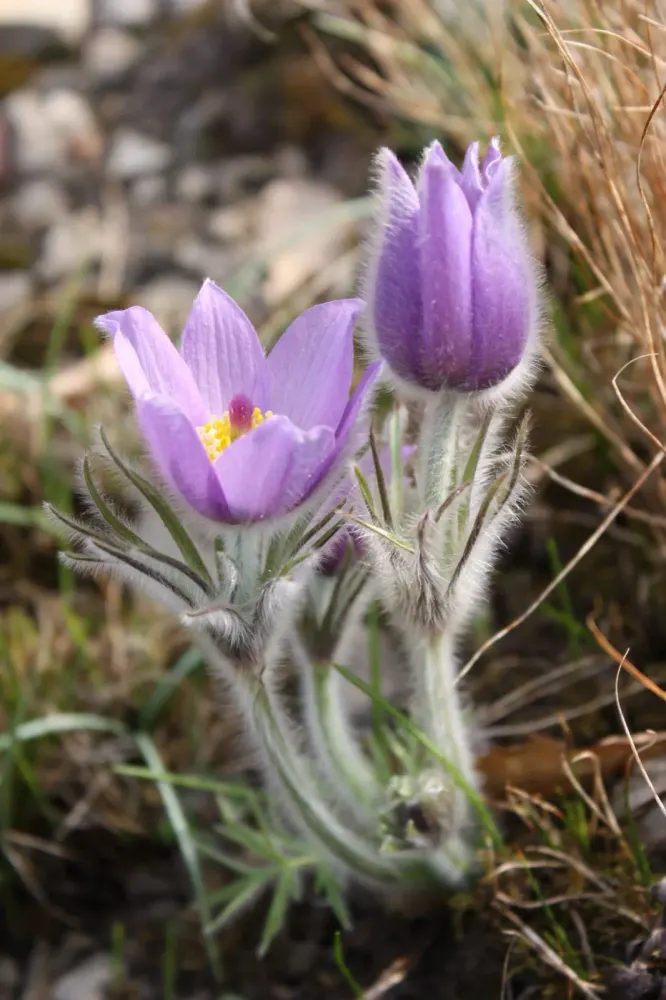
© Marco Schmidt [1] · CC BY-SA 3.0 · Commons
Pulsatilla vulgaris
Toxic🐾Gewöhnliche Kuhschelle · (Pulsatilla vulgaris)
Buttercup family (Ranunculaceae)
Description
Pulsatilla vulgaris, the pasqueflower, is a species of flowering plant belonging to the buttercup family (Ranunculaceae), found locally on calcareous grassland in Europe, and widely cultivated in gardens. It was considered part of the genus Anemone, to which it is closely related. Several sources still list Anemone pulsatilla as the accepted name, with Pulsatilla vulgaris as a synonym.
External use only!
This plant must NOT be taken internally. Use only as compress, salve, or bath.
CONTRAINDICATED during pregnancy
Pulsatilla has a uterine-stimulating (uterotonic) effect and can trigger uterine contractions, promoting premature birth or miscarriage. Any internal use during pregnancy is strictly contraindicated.
CONTRAINDICATED during breastfeeding
Sufficient safety data during lactation are lacking; due to the known toxicity of protoanemonin and missing safety data, internal use during lactation is contraindicated.
CONTRAINDICATED for children
Internal use in children under 18 years contraindicated due to toxicity risk. Homoeopathic high potencies (D6+) are frequently used in paediatric homoeopathy but do not fall under this restriction.
Critical drug interactions with:
Uterustonisierende Mittel (Oxytocin, Prostaglandine)
- BathAerial partsExternalFolk medicine
In folk medicine, dried Pulsatilla herb was used as a bath additive for joint pain, rheumatism, and skin irritation. External application of dried preparations is less risky than internal, however direct contact with fresh plant sap must be strictly avoided due to protoanemonin-induced contact dermatitis.
Historical documentation only — do NOT use
These internal applications are historically documented. This plant is highly toxic — self-treatment can cause severe poisoning or death. For documentation only, explicitly NOT a recommendation.
- TinctureAerial partsInternalCommission E
The German Commission E issued a positive monograph for Pulsatilla herb for colds and inflammatory conditions of the skin and mucous membranes as well as diseases of the urogenital tract. Historically Pulsatilla was used particularly for dysmenorrhoea and irregular menstrual bleeding. In the dried state, the reactive protoanemonin has cyclised to anemonin and is considerably less toxic than in the fresh plant.
- TinctureAerial partsInternalFolk medicine
Homoeopathically, Pulsatilla pratensis/vulgaris is one of the most frequently prescribed remedies. The constitutional remedy is used in homoeopathy for changeable, mild, weeping mental states, menstrual complaints, stomach problems, and sinusitis. Potencies used: D4–D30, C30. Basis: homoeopathic principle of similars — scientific proof of efficacy is lacking.
- TinctureAerial partsInternalFolk medicine
In the folk medicine of Central Europe, dried Pulsatilla herb was used as a tincture for colds, cough, and catarrhal inflammation of the mucous membranes. The compound anemonin (formed from the precursor protoanemonin during drying) showed antibacterial and antifungal properties in early in-vitro studies.
- TeaAerial partsInternalFolk medicine
Tea from dried Pulsatilla herb was used in folk medicine for menstrual cramps and absent menstruation. IMPORTANT: Prepare only from fully dried plant material — the fresh plant contains protoanemonin, which causes mucosal irritation and systemic poisoning. The folk use is historically documented but carries risks from incorrect preparation.
- TinctureAerial partsInternalFolk medicine
In the folk medicine of the 18th and 19th centuries, Pulsatilla was used as a sedative and antispasmodic for nervous agitation, sleep disorders, and migraine. The sedative effect was attributed to anemonin. Without standardised preparation, the poisoning risk was considerable.
- TinctureAerial partsInternalFolk medicine
In folk medicine, Pulsatilla was used for mild urinary tract infections and urogenital complaints — an aspect also mentioned in the Commission E monograph. The antimicrobial properties of anemonin formed the rational basis of this use.