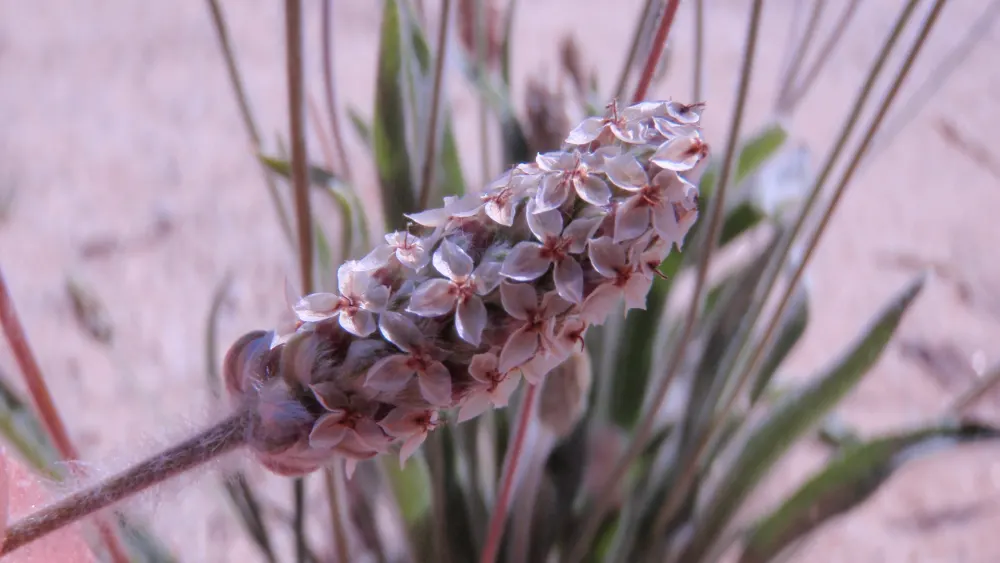
© Joshua Tree National Park (US National Park Service) · Public domain · Commons
Blond psyllium
Indischer Flohsamen · (Plantago ovata)
Plantain family (Plantaginaceae)
Description
Blond psyllium (Plantago ovata), also called Indian plantain or ispaghula, is an annual herb of the plantain family. It forms a low rosette of narrow, linear leaves and flower stalks only 2 to 10 cm tall with dense, oval spikes. The species is native to the dry regions of North Africa and Southwest Asia - from the Canary Islands across the Mediterranean, the Near East and the Arabian peninsula to Afghanistan, Pakistan and India - and is cultivated mainly in India and Pakistan. Its medicinal parts are the small boat-shaped seeds (Plantaginis ovatae semen) and above all their seed husk (testa, Plantaginis ovatae testa - the 'psyllium husk' or 'ispaghula husk'). This husk is rich in arabinoxylan-based mucilage that swells strongly in water and binds many times its volume of fluid.
- RawSeedInternalEMA well-established
Main use with EMA-recognised 'well-established use' evidence: the psyllium husks swell in the gut, increase stool volume and water content, and thereby exert a gentle, stretch-mediated stimulus on intestinal peristalsis. Used for chronic (habitual) constipation. Taking it with plenty of fluid is essential.
Preparation & dosage
Adults and children from 12 years: usually 7-11 g of psyllium husk daily, divided into several single doses. Stir each single dose (about 3-5 g) into a full glass (at least 150 ml) of cold water, drink promptly and follow with plenty of additional fluid - at least 30 ml of water per gram of husk. Do NOT take immediately before going to bed. Onset of action is usually after 12-24 hours, with full effect only after 2-3 days. Keep at least half an hour to one hour between intake and the intake of other medicines.
- Dry amount
- 7–11 g
- Doses per day
- 3×
⚠ Age restriction: ≥ 12 years — Standard use for adults and adolescents from 12 years. For younger children only after medical advice.
- RawSeedInternalEMA well-established
Recognised by the EMA as 'well-established use': for conditions in which easier bowel emptying with a soft stool is desired - for example anal fissures, haemorrhoids or after anorectal procedures. The swelling husks keep the stool soft and bulky, reducing straining.
Preparation & dosage
Dose as for the constipation use (about 7-11 g daily, with plenty of fluid). The aim here is a soft, easily passed stool to reduce pain on defecation, for example with anal fissures, haemorrhoids or after anorectal surgery.
- Dry amount
- 7–11 g
- Doses per day
- 3×
⚠ Age restriction: ≥ 12 years — For adults and adolescents from 12 years; in younger children only after medical advice.
- RawSeedInternalEMA well-established
The EMA monograph on the seed husk lists use as a fibre supplement - including in irritable bowel syndrome - under 'well-established use' (from 12 years). The soluble mucilage regulates stool consistency and can favourably influence both the constipation and the diarrhoea components of irritable bowel syndrome.
Preparation & dosage
As a soluble fibre source, e.g. supportively in irritable bowel syndrome: gradually titrate the dose (often 4-10 g daily, divided), stir each portion into at least 150 ml of fluid and follow with plenty of water. Use in irritable bowel syndrome only after a confirmed medical diagnosis.
- Dry amount
- 4–10 g
- Doses per day
- 2×
⚠ Age restriction: ≥ 12 years — For adults and adolescents from 12 years.
- RawSeedInternalEMA well-established
The EMA monograph on the seed husk names supportive use in raised cholesterol (hypercholesterolaemia) as 'well-established use' (from 12 years, under medical supervision). The soluble mucilage binds bile acids in the gut and can thereby favourably influence the LDL cholesterol level.
Preparation & dosage
As a supportive dietary measure for raised cholesterol, only under medical supervision: usually several grams of psyllium husk daily (often in the 7-11 g range, divided), each in plenty of fluid. Does not replace a doctor-prescribed cholesterol-lowering therapy.
- Dry amount
- 7–11 g
- Doses per day
- 3×
⚠ Age restriction: ≥ 12 years — For adults and adolescents from 12 years, under medical supervision.
- RawSeedInternalTraditional use
Because of their high water-binding capacity, psyllium husks are also traditionally used to thicken stool in mild diarrhoea - then deliberately with less fluid. This 'two-way' (regulating in both constipation and diarrhoea) use rests on the swelling and water-binding action of the mucilage.
Preparation & dosage
For mild, non-specific diarrhoea the husks are traditionally taken with only a little fluid (just enough to let them swell) so that they bind excess water in the gut and thicken the stool. Seek medical advice if diarrhoea persists beyond two days.
- Dry amount
- 3–5 g
- Doses per day
- 2×
🤝 Permaculture Partners
In your garden, this plant acts as: