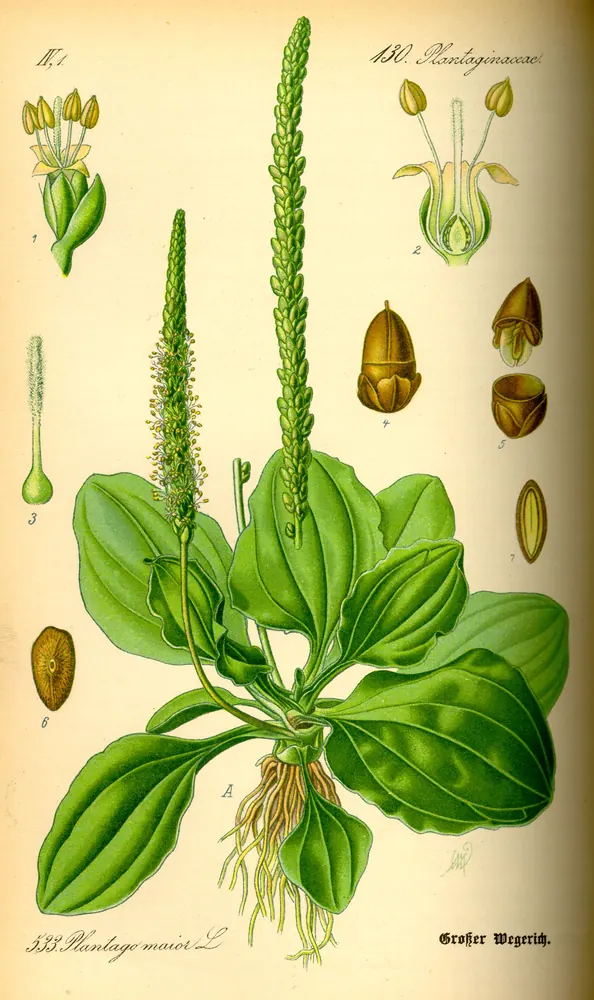
© Walther Otto Müller, Carl Friedrich Schmidt, K. Gunther / Otto Wilhelm Thomé, Flora von Deutschland, Österreich und der Schweiz (1885) · Public domain (PD-old-100-expired) · Commons
Greater plantain
Breitwegerich · (Plantago major)
Plantain family (Plantaginaceae)
Description
Greater plantain (Plantago major) is a perennial herb forming a basal rosette of broad, oval to elliptic leaves marked by five to nine prominent longitudinal veins. Slender cylindrical flower spikes rise from the rosette, bearing inconspicuous greenish-brown flowers from June to October followed by very large numbers of tiny seeds. Extremely tolerant of trampling, it thrives along paths, in yards, on pastures and even in pavement cracks, serving as an indicator of compacted soil. Originally native to Eurasia, it spread worldwide with European settlers and was called 'white man's footprint' by Native Americans. Traditionally the fresh leaf is the best-known remedy for minor wounds and insect bites, while young leaves and seeds are also eaten.
- CompressLeafExternalFolk medicine
The best-known folk application: the crushed fresh leaf has been used for centuries to quickly soothe itching and swelling after insect bites and as a cooling dressing for minor wounds. Mucilage, aucubin and tannins act soothing and astringent.
Preparation & dosage
Crush a fresh, clean leaf between the fingers or in the hand until juice appears and apply directly to the insect bite or minor wound; renew every few hours as needed. A classic field remedy.
- SalveLeafExternalTraditional use
A leaf-based salve is traditionally used to care for minor skin damage and irritated skin. Allantoin and aucubin are associated with cell-regenerating and anti-inflammatory properties.
Preparation & dosage
Warm-infuse fresh, finely chopped leaves in plant oil, strain, and set with beeswax into a salve. Apply thinly to clean, intact skin. Do not use on deep, heavily bleeding or infected wounds.
- TeaLeafInternalTraditional use
Because of its mucilage content, the tea is traditionally drunk as a soothing remedy for irritating cough and upper respiratory catarrh. Note: a positive Commission E or EMA monograph exists only for the related ribwort plantain, not for greater plantain.
Preparation & dosage
Pour 250 ml hot water over 1.5-3 g dried plantain herb, cover and steep about 10 minutes, then strain. Drink up to three times daily.
- Dry amount
- 1.5–3 g
- Doses per day
- 3×
- Max duration
- 4 weeks
[#src_wikipedia_de] [#src_pmc_review] [#src_kommission_e_note]
- TeaLeafInternalFolk medicine
In folk use the herb's tannins and mucilage are taken for mild diarrhoea and an irritated gastrointestinal lining; tannins act astringent and mucilage soothing.
Preparation & dosage
Prepare like the cough tea. For mild diarrhoea, sip several times daily. Seek medical advice if symptoms persist beyond two days.
- Dry amount
- 1.5–3 g
- Doses per day
- 3×
- Max duration
- 2 weeks
- RawLeafInternalFolk medicine
Young greater plantain leaves are an edible wild green with a mild, slightly bitter taste and supply minerals and vitamins. With age the leaves become tough and fibrous.
Preparation & dosage
Use only very young, tender leaves; add them raw to salads or blanch briefly, as they quickly turn tough and fibrous. Older leaves are better cooked in soups or stews.
- RawSeedInternalFolk medicine
The small seeds are edible and rich in mucilage (related to the psyllium of other Plantago species), which can act as a gentle bulking fibre. Harvesting is laborious due to the tiny seed size.
Preparation & dosage
Strip ripe seeds from the spikes; eat raw, cook, or grind to meal and blend with other flour. Take the mucilage-rich seeds with plenty of fluid.
- GargleLeafExternalFolk medicine
The mucilage- and tannin-containing infusion is traditionally used as a soothing gargle for minor throat and pharyngeal irritation.
Preparation & dosage
Prepare a slightly stronger infusion (2-4 g per 250 ml), let cool, and gargle or rinse several times daily. Do not swallow if used only as a gargle.
- Dry amount
- 2–4 g
- Doses per day
- 4×
- Max duration
- 2 weeks
🤝 Permaculture Partners
In your garden, this plant acts as: