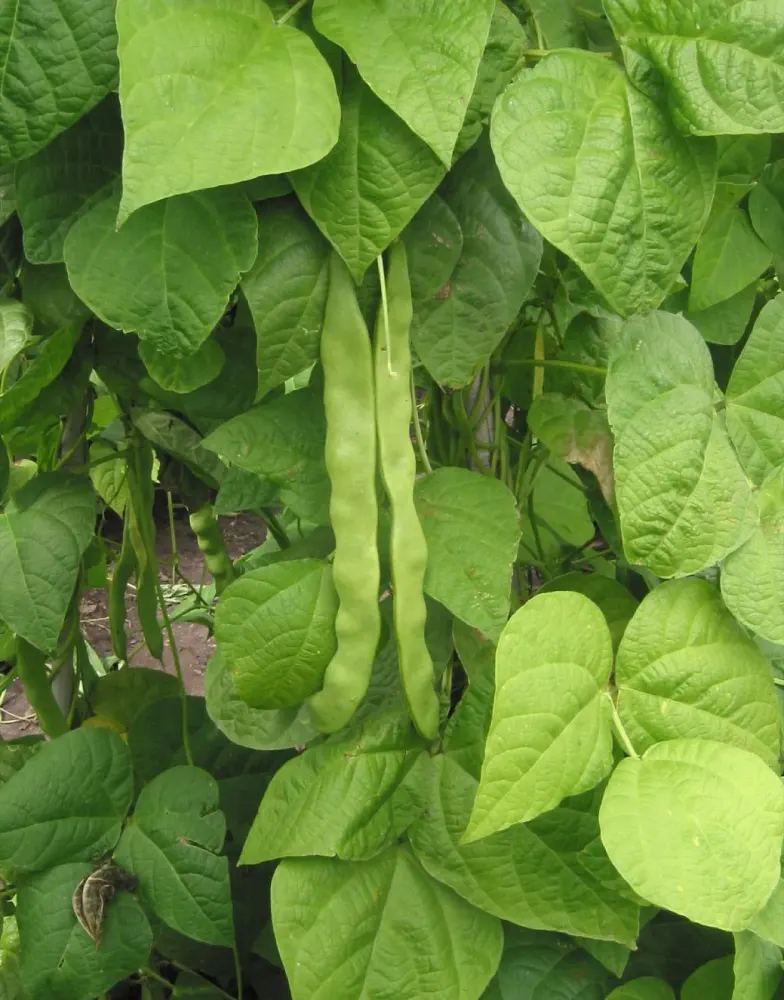
© Unknown · CC BY-SA 3.0 · Commons
Phaseolus vulgaris
CautionGartenbohne · (Phaseolus vulgaris var. vulgaris)
Bean family (Fabaceae)
Description
Phaseolus vulgaris, the common bean, is a herbaceous annual plant. Its botanical classification, along with other Phaseolus species, is as a member of the legume family, Fabaceae. It forms a green-leaved vine which produces beans inside of pods.
- RawFruitInternalClinical trial
Fresh green beans (harvested immature pod) are a nutrient-rich vegetable providing vitamin K, vitamin C, folate and dietary fibre — to be consumed cooked only.
Preparation & dosage
FRESH GREEN BEANS (vegetable): Harvest young, immature pods (approx. 10–15 cm, seeds still small and soft) and ALWAYS cook for a minimum of 10 minutes in plenty of rapidly boiling water — never eat raw. Discard the cooking water, which contains leached lectins and oligosaccharides. Use as a side dish, in salads (after cooling), soups, stews or bean puree. Blanched and frozen, the produce keeps 10–12 months.
[#src_usda_fdc_green_beans] [#src_efsa_beans] [#src_wp_de_gartenbohne] [#src_wp_en_phaseolus]
- RawSeedInternalClinical trial
Dried bean seeds are a plant protein source (approx. 7–9 g/100 g cooked) with low glycaemic index, high dietary fibre, folate, iron and potassium — to be consumed only after proper cooking.
Preparation & dosage
DRIED BEANS (pulse): Soak dried beans for at least 8–12 hours in plenty of cold water; discard soaking water. Then boil vigorously in fresh water for at least 45–60 minutes (strong boiling is essential to fully denature phytohaemagglutinin — do NOT use a slow cooker for dried kidney beans). Discard the cooking water (leached lectins and oligosaccharides). Use cooked beans in soups, stews, salads (after cooling), hummus-style dips or bean paste. Tinned/canned beans are already cooked — drain and rinse before use.
[#src_usda_fdc_kidney_beans] [#src_efsa_beans] [#src_fda_bad_bug_book] [#src_wp_en_phaseolus] [#src_pfaf_phaseolus]
- TeaFruitInternalFolk medicine
Traditional bean hull tea (Phaseoli pericarpium) — folk medicinal mild aquaretic for urinary flushing therapy; evidence at folk medicine level only.
Preparation & dosage
BEAN HULL TEA (Phaseoli pericarpium): Pour 250 ml boiling water over 3–5 g dried, chopped bean hulls (outer pods without seeds — use only from ripe dried beans; green pods are less suitable), cover, steep 15 minutes, strain. 2 cups daily for a maximum of 4 weeks. Folk medicinal use as a mild aquaretic (diuretic) for mild urinary tract infections and flushing of the urinary tract — adjunctive only, no substitute for medical treatment. Important: drink plenty of fluid (at least 2 litres of water daily) during use. Fever, severe pain or blood in urine: see doctor immediately.
- Dry amount
- 3–5 g
- Doses per day
- 2×
- Max duration
- 4 weeks
[#src_pfaf_phaseolus] [#src_wp_de_gartenbohne] [#src_wikidata_phaseolus]
- RawSeedInternalClinical trial
Cooked dried beans are a clinically supported plant protein source with low glycaemic index — beneficial for blood glucose management and LDL cholesterol reduction.
Preparation & dosage
PLANT PROTEIN SOURCE / DIABETIC DIET: Cooked beans (tinned or home-cooked) have a low glycaemic index (GI approx. 20–40 depending on variety) and high satiety effect. A protein source in vegetarian and vegan diets (beans + cereal = complete amino acid profile). Studies show: regular legume consumption (at least 3–4 × weekly 80 g cooked beans) lowers LDL cholesterol and improves glycaemic control. Not for self-treatment of diabetes — dietary therapy under medical/dietetic supervision.
- SpiceSeedInternalTraditional use
Traditional kitchen bean in stews, salads and gratins — a classic of European and Latin American cuisine; traditionally combined with savory to reduce flatulence.
Preparation & dosage
KITCHEN — TRADITIONAL PREPARATIONS: Cooked beans (white, red, black, borlotti) in classic dishes: stews (minestrone, chilli con/sin carne), bean salad with vinegar and oil (only from cooled, fully cooked beans), bean puree (hummus-style), bean bread (cooked beans as flour substitute up to 30 %), fermented soy-sauce analogues (traditional in Latin America). Savory (Satureja hortensis/montana) is the traditional kitchen companion — reputed to reduce flatulence and aid digestion, effect empirical. Always: never raw or merely lukewarm. Slow cookers (< 100 °C) may fail to inactivate lectins sufficiently — insist on vigorous boiling.
[#src_wp_de_gartenbohne] [#src_wp_en_phaseolus] [#src_pfaf_phaseolus]
- RawSeedInternalClinical trial
Cooked dried beans are a significant source of folate, non-haem iron and potassium — especially relevant in vegetarian/vegan diets and during pregnancy.
Preparation & dosage
FOLATE / IRON / POTASSIUM — MICRONUTRIENT USE: 100 g cooked white beans provide approx. 130 µg folate (≈ 65 % of EU daily requirement), 3.7 mg iron (≈ 26 % DV) and 561 mg potassium (≈ 28 % DV). Particularly relevant in pregnancy (increased folate demand) and vegetarian/vegan diets (iron supply). Combining with vitamin-C-rich vegetables (peppers, tomatoes) enhances non-haem iron absorption. Not a substitute for supplementation in clinically confirmed deficiency.
- RawSeedInternalClinical trial
Beans are rich in dietary fibre and resistant starch — prebiotic effect, blood glucose buffering and promotion of gut health, clinically documented.
Preparation & dosage
DIETARY FIBRE / RESISTANT STARCH: Cooked beans contain 6–8 g dietary fibre per 100 g (soluble + insoluble) and resistant starch (especially high after cooling). Both fractions act as prebiotics, promote gut microbiome diversity and increase stool frequency. Slowly digestible carbohydrates buffer blood glucose rise. Note: dietary fibre and non-absorbable oligosaccharides (raffinose, stachyose) can cause bloating and flatulence — gradual increase in consumption amount is recommended.
[#src_efsa_beans] [#src_usda_fdc_kidney_beans] [#src_wp_en_phaseolus]
🤝 Permaculture Partners
In your garden, this plant acts as:
✨ Best symbiotic partners
- 🌿 Cucumber Classic companion-planting partner.
- 🌿 Cucurbita pepo Bean is nitrogen-rich, squash is heavy feeder — perfect symbiosis.
- 🌿 Zucchini Classic companion-planting partner.
- 🌿 Summer savory Savory is the classic bean partner against aphids.
- 🌿 Maize Bean fixes atmospheric nitrogen that hungry maize needs.
⚠️ Better not planted together
📦 Part of these planting sets:
Source: Helga und Margarete Langerhorst, Mein gesunder Naturgarten (eigene Kuration) | Klassische Mischkultur-Tradition (Three Sisters, Bauernregel)