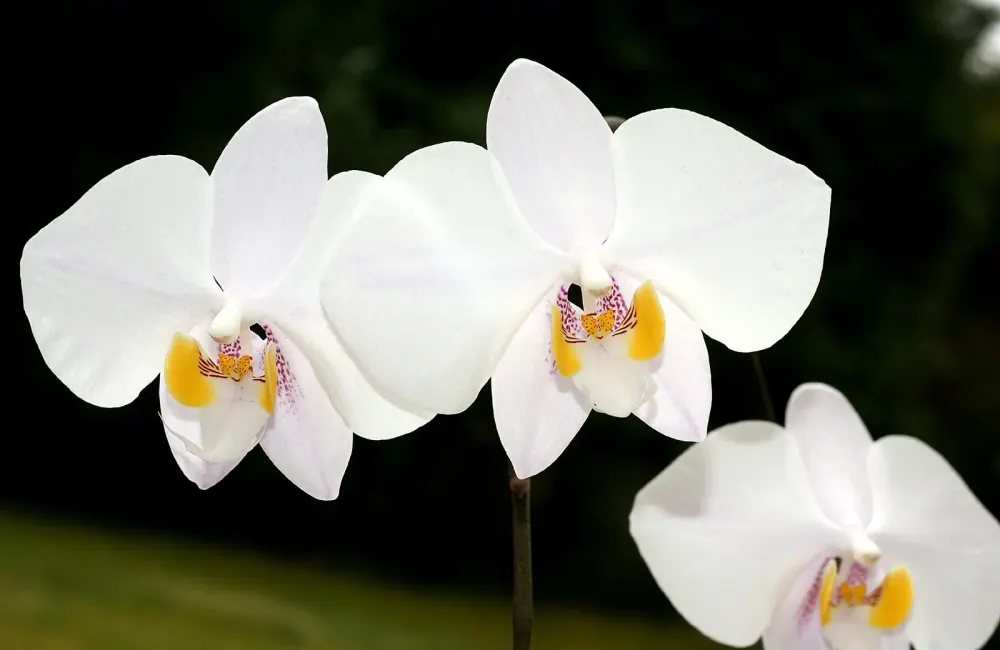
© Orchi · CC BY-SA 3.0 · Commons
Phalaenopsis
Phalaenopsis · (Phalaenopsis spp.)
Orchid family (Orchidaceae)
Description
Phalaenopsis, also known as moth orchids, is a genus of about seventy species of plants in the family Orchidaceae. Orchids in this genus are monopodial epiphytes or lithophytes with long, coarse roots, short, leafy stems and long-lasting, flat flowers arranged in a flowering stem that often branches near the end. Orchids in this genus are native to Asia, New Guinea, and Australia, but mostly occur in Indonesia and the Philippines.
- RawLeafExternalTraditional use
Phalaenopsis orchids use CAM photosynthesis (Crassulacean Acid Metabolism): daytime stomata remain closed, while at night they open for CO₂ uptake and release oxygen. This makes them one of the rare houseplants that produce O₂ at night.
- RawFlowerExternalFolk medicine
As a flowering houseplant with long inflorescences, Phalaenopsis demonstrably improves wellbeing in interiors. In many Asian cultures, it is a symbol of fertility, elegance, and good fortune.
- RawWhole plantExternalTraditional use
According to ASPCA, Phalaenopsis is not toxic to dogs and cats. The moth orchid is thus one of the safest flowering houseplants for households with pets and children.
- RawWhole plantExternalFolk medicine
Ethnobotanically, related Dendrobium orchids (Orchidaceae) were used in Traditional Chinese Medicine (TCM) — e.g., Dendrobium nobile as a yin tonic. For Phalaenopsis itself, a documented western or TCM medicinal use is barely substantiated.
🪴 Grow at home
- ☀ Light
- bright, indirect
- 💧 Water
- weekly
- 🌱 Soil
- Orchid substrate (bark mix)
- 🪴 Pot
- 15 cm
- ⭐ Difficulty
- ★★☆ intermediate
- 🐾 Pets
- pet-safe
Tips:
- Keep in transparent pot — roots photosynthesise too.
- Dunk in water for 5 min weekly instead of daily watering.
- CAM plant: produces O₂ at night, ideal for bedroom.
- After flowering: cut stem above 2nd node — re-flowering possible.
Care tips are general indoor-gardening recommendations, not scientific sources.