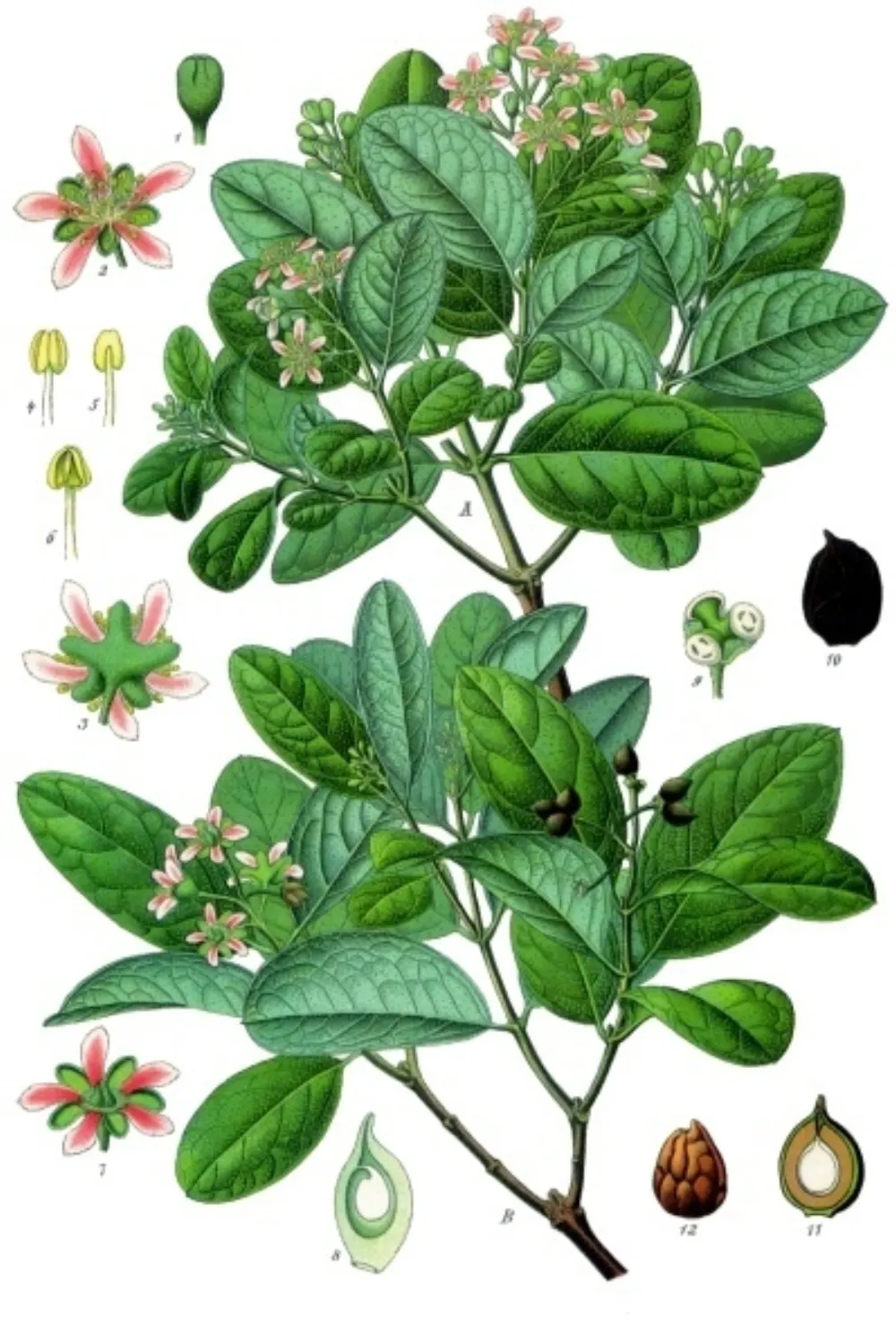
© Franz Eugen Köhler, in Köhler's Medizinal-Pflanzen (1897), Plate 104 · Public domain · Commons
Boldo
Caution🐾Boldo · (Peumus boldus)
Monimia family (Monimiaceae)
Description
Boldo (Peumus boldus) is an evergreen, aromatic shrub or small tree of the Monimia family, native to the dry hill country of central Chile, reaching heights of about 6 and rarely up to 15 metres. The opposite, leathery leaves are rough on the upper surface and give off a strong, camphor-like scent when crushed. The medicinal part is the dried leaf, known as boldo leaf (Boldi folium). It contains the aporphine alkaloid boldine together with an essential oil rich in ascaridole, p-cymene and 1,8-cineole. Boldo traditionally stimulates the flow of bile and is used for mild digestive complaints and mild spasms of the gastrointestinal tract.
CONTRAINDICATED during pregnancy
Do not use during pregnancy. Safety is not established, and preclinical data showed fetal malformations and occasional abortions at high doses.
CONTRAINDICATED during breastfeeding
Do not use while breastfeeding, as safety is not established and the EMA monograph advises that use be avoided.
CONTRAINDICATED for children
Do not use in children and adolescents under 18 years of age, as data are insufficient.
Mild dyspepsia and mild gastrointestinal spasms
Preparation & dosage
Pour about 150 ml of hot water over 1 to 2 g of comminuted, dried boldo leaf, cover and steep for 5 to 10 minutes, then strain. Drink as an infusion two to three times daily. Prefer water-based preparations, as the poorly water-soluble ascaridole barely passes into the tea. Use short-term only; if symptoms persist for more than two weeks or worsen, seek medical advice.
- Dry amount
- 1–2 g
- Doses per day
- 3×
- Max duration
- 2 weeks
⚠ Age restriction: ≥ 18 years — For adults only. Use in children and adolescents under 18 years of age is not recommended because of insufficient data.
Standardised aqueous dry extract for digestive complaints
Preparation & dosage
Standardised dry extracts (5:1, aqueous) of boldo leaf are dosed at up to 400 mg twice daily. Home-made alcoholic tinctures are less suitable, because alcohol extracts more of the concerning ascaridole from the essential oil than water does; commercial preparations tested for ascaridole content are preferable. Use short-term only; if symptoms persist beyond two weeks, seek medical advice.
- Doses per day
- 2×
- Max duration
- 2 weeks
⚠ Age restriction: ≥ 18 years — For adults only. Use under 18 years of age is not recommended.
Boldo leaf contains an essential oil with a high proportion of ascaridole, which can be liver- and nerve-damaging (hepatotoxic and neurotoxic) at higher doses. The isolated boldo essential oil must never be taken internally; medicinally, only the whole dried leaves are used, preferably as a water-based infusion, because ascaridole is poorly water-soluble. Use must remain short-term (have complaints lasting more than two weeks assessed by a doctor). Do not use in obstruction of the bile duct, inflammation of the bile duct (cholangitis), liver disease, gallstones and other biliary disorders requiring medical supervision. Do not use during pregnancy or breastfeeding, or in children and adolescents under 18 years of age. In animal studies, high doses of boldo extract and boldine caused fetal malformations and occasional abortions. Hypersensitivity reactions up to anaphylaxis have been reported. Seek medical advice if symptoms worsen.
Do not use during pregnancy. Safety is not established, and preclinical data showed fetal malformations and occasional abortions at high doses.
Do not use while breastfeeding, as safety is not established and the EMA monograph advises that use be avoided.
Do not use in children and adolescents under 18 years of age, as data are insufficient.
Drug interactions
Gerinnungshemmer (Antikoagulanzien, z. B. Warfarin)
A case report describes a raised INR with concurrent use of boldo and fenugreek during warfarin therapy. The anticoagulant effect may be enhanced; caution is therefore advised with anticoagulants.
Lebertoxische Arzneimittel (hepatotoxische Wirkstoffe)
The ascaridole-containing essential oil can stress the liver; concurrent use of other liver-damaging medicines may add to this burden.
Contraindications
- Obstruction of the bile duct
- Inflammation of the bile duct (cholangitis)
- Liver disease
- Gallstones and other biliary disorders requiring medical supervision
- Hypersensitivity to the herbal substance
- Pregnancy and breastfeeding
- Children and adolescents under 18 years of age
Harvested part: Dried foliage leaves
- Time of day:
- Leaves are harvested from the evergreen shrub; in its Chilean homeland gathering takes place mainly in the southern-hemisphere summer (November to February).
- Drying:
- Air-dry the leathery leaves in the shade until brittle, preserving the aroma. Use only whole leaves medicinally; the isolated essential oil is not suitable for ingestion.
- Storage:
- Store dry, cool and protected from light in closed containers to preserve the essential oil.
- BoldinAlkaloidContent: ca. 0,1-0,5%Leaf
Aporphine alkaloid and the pharmacologically leading substance; antioxidant, antispasmodic and bile-promoting.
- Ätherisches ÖlEssential oilContent: ca. 2-4%Leaf
Aromatic oil of the leaf; its high ascaridole content is responsible for toxicity on overdose.
- AscaridolEssential oilContent: ca. 16-38% des ätherischen ÖlsLeaf
Main component of the essential oil and a peroxide; liver- and nerve-damaging at higher doses, so the isolated boldo oil must not be ingested.
- p-CymolEssential oilLeaf
Aromatic monoterpene hydrocarbon in the essential oil of boldo leaves.
- 1,8-CineolEssential oilLeaf
Eucalyptol-like component of the essential oil that contributes to the camphor-like smell.
- β-PinenEssential oilLeaf
Bicyclic monoterpene in the essential oil of boldo leaves.
- FlavonoideFlavonoidLeaf
Secondary plant compounds (including glycosides) contributing to the antioxidant effect.
- Gerbstoffe (Tannine)TanninLeaf
Astringent accompanying substances of the leaf.
- [1]MonographCommunity herbal monograph on Peumus boldus Molina, folium (HMPC, EMEA/HMPC/591648/2007)(accessed: 2026-06-12)
- [2]MonographBoldi folium - herbal medicinal product | European Medicines Agency (EMA)(accessed: 2026-06-12)
- [3]MonographAssessment report on Peumus boldus Molina, folium - European Medicines Agency(accessed: 2026-06-12)
- [7]MonographLambert JP, Cormier J. Potential interaction between warfarin and boldo-fenugreek. Pharmacotherapy. 2001 (PubMed 11444587)(accessed: 2026-06-12)
- [9]MonographCliniTox Giftpflanzen — Peumus boldus Molina: schwach giftig (+) (Institut für Veterinärpharmakologie und -toxikologie, Universität Zürich)(accessed: 2026-08-10)
- [4]WikipediaBoldo - Wikipedia (deutsch)(accessed: 2026-06-12)
- [5]WikipediaPeumus - Wikipedia(accessed: 2026-06-12)
- [8]CommonsFile:Peumus boldus - Köhler's Medizinal-Pflanzen-104.jpg - Wikimedia Commons(accessed: 2026-06-12)
- [6]WikidataPeumus boldus (Q310810) - Wikidata(accessed: 2026-06-12)
🤝 Permaculture Partners
In your garden, this plant acts as: