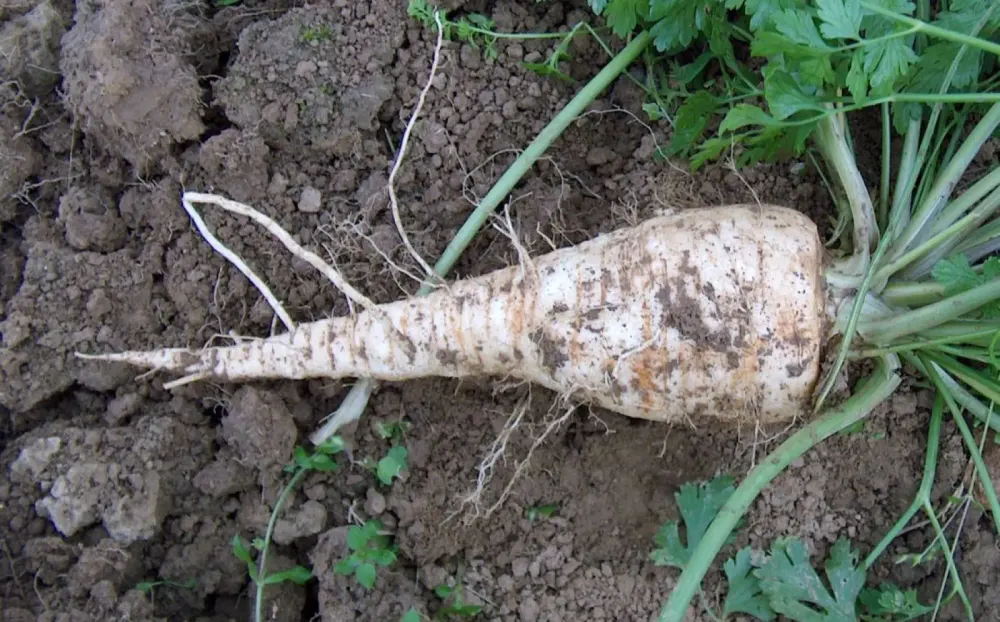
© User:MarkusHagenlocher · CC BY-SA 3.0 · Commons
Parsley
CautionWurzelpetersilie · (Petroselinum crispum subsp. tuberosum)
Carrot family (Apiaceae)
Description
Parsley, or garden parsley, is a species of flowering plant in the family Apiaceae that is native to the Balkans. It has been introduced and naturalized in Europe and elsewhere in the world with suitable climates, and is widely cultivated as a herb and a vegetable.
CONTRAINDICATED during pregnancy
Parsley in medicinal doses (tea, tincture, oil) is contraindicated in pregnancy due to emmenagogue and potentially abortifacient effects (apiole, myristicin). Culinary amounts used in cooking are considered safe.
- SpiceRootInternalFolk medicine
The root of Hamburg parsley (Tuberosum group) is eaten in central and eastern European cuisines as a soup vegetable, stew ingredient, and raw food. It tastes of celery-parsley with a nutty note. Rich in vitamin C, vitamin A, folate, and iron. Nutritionally well-supported; no independent medicinal evidence as a remedy.
[#src_stephens_parsley_root] [#src_wiki_hamburg_parsley] [#src_yagmur_parsley_nutrients]
- TeaRootInternalFolk medicine
Tea from dried parsley roots is used in folk medicine as a mild diuretic for bladder complaints, stones, and oedema. PFAF lists the use as 'effective in ridding the body of stones, jaundice, dropsy, cystitis'. Mechanism: furanocoumarins and essential oil (apiole) stimulate kidney activity. No clinical studies available.
Preparation & dosage
Pour 200 ml boiling water over 2–5 g dried root pieces, steep for 15 minutes, strain. 2–3 cups daily. Ensure adequate fluid intake (at least 2 litres daily). Do not use with kidney disease.
- Dry amount
- 2–5 g
- Doses per day
- 3×
- TeaLeafInternalFolk medicine
Parsley leaf tea is used in folk medicine for digestive complaints (flatulence, cramps) and to stimulate menstrual flow. The antispasmodic and emmenagogue effect is attributed to myristicin and apiole in the essential oil. Contraindicated in pregnancy due to emmenagogue potential.
Preparation & dosage
Steep 2–4 g dried parsley leaves in 200 ml hot water for 10 minutes. 2 cups daily; not during pregnancy.
- Dry amount
- 2–4 g
- Doses per day
- 2×
- RawLeafInternalFolk medicine
Fresh parsley leaves are among the most vitamin- and mineral-rich culinary herbs: excellent source of vitamin C (up to 130 mg/100g), vitamin K, folate, iron, and flavonoids (apigenin, luteolin). Regular consumption supports immune function and antioxidant capacity. Nutritional value well supported.
- SpiceLeafInternalFolk medicine
Ubiquitous as a culinary herb in European cooking. Aromatic constituents (apiole, myristicin, limonene) promote digestion and act as carminatives. Culinary amounts are safe; very high doses of the essential oil (extracts, not cooking herb) are hepato- and nephrotoxic.
- BathAerial partsExternalFolk medicine
In European folk medicine, parsley infusions are used as a hair rinse for dandruff or seborrhoeic scalp conditions. PFAF documents an anti-dandruff effect. Apply a decoction of leaves to the scalp and leave to act.
🤝 Permaculture Partners
In your garden, this plant acts as:
✨ Best symbiotic partners
⚠️ Better not planted together
- 🥬 Lettuce Classic companion-planting partner.
Source: Gertrud Franck, Gesunder Garten durch Mischkultur (1980, eigene Kuration) | Helga und Margarete Langerhorst, Mein gesunder Naturgarten (eigene Kuration)