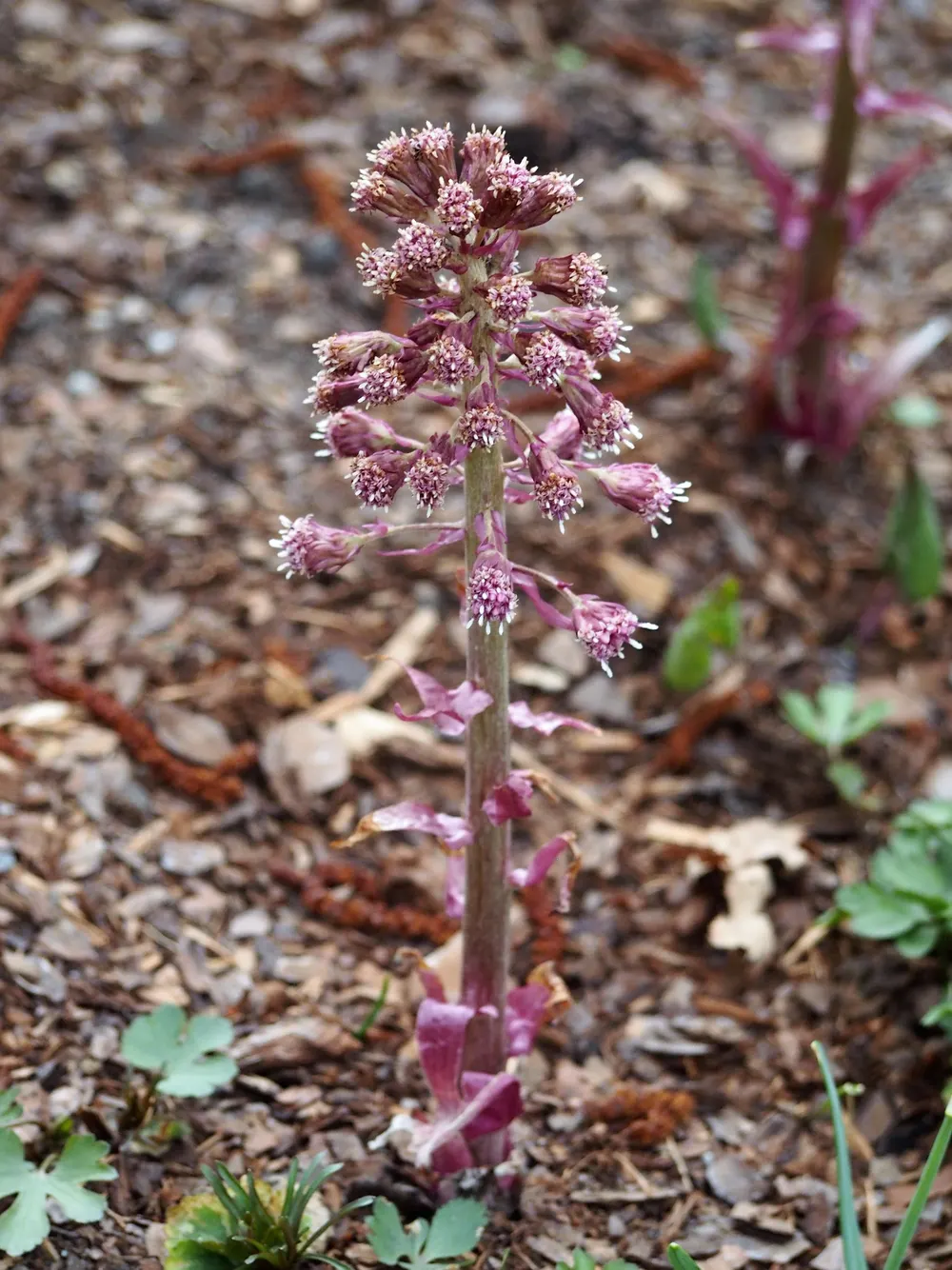
© Agnieszka Kwiecień, Nova (Wikimedia Commons) · CC BY-SA 4.0 · Commons
Butterbur
Caution🐾Gewöhnliche Pestwurz · (Petasites hybridus)
Daisy family (Asteraceae)
Description
Common butterbur is a perennial herbaceous plant of the daisy family, native to Europe and northern Asia, where it grows along streams and in damp meadows. In early spring the pink to pale-red flower spikes appear on thick stalks before the leaves emerge. The very large, rounded heart-shaped leaves that follow are among the largest of any native European plant. Medicinally, standardized root extracts are used mainly for migraine prophylaxis and to relieve spasms. The raw plant, however, contains hepatotoxic pyrrolizidine alkaloids, so only PA-free, quality-controlled standardized products are considered safe.
- TinctureRootInternalClinical trial
Standardized root extracts (standardized to petasins) reduce the frequency and intensity of migraine attacks in controlled trials. Use only PA-free, quality-controlled products – never the raw plant.
- TinctureLeafInternalClinical trial
Standardized leaf or root extracts can ease symptoms of allergic rhinitis (hay fever). Only PA-free, standardized preparations are suitable for this.
- TinctureRhizomeInternalTraditional use
Traditionally, butterbur preparations are used as antispasmodics for gastrointestinal and urinary-tract spasms. Here too, only PA-free, standardized products should be used.