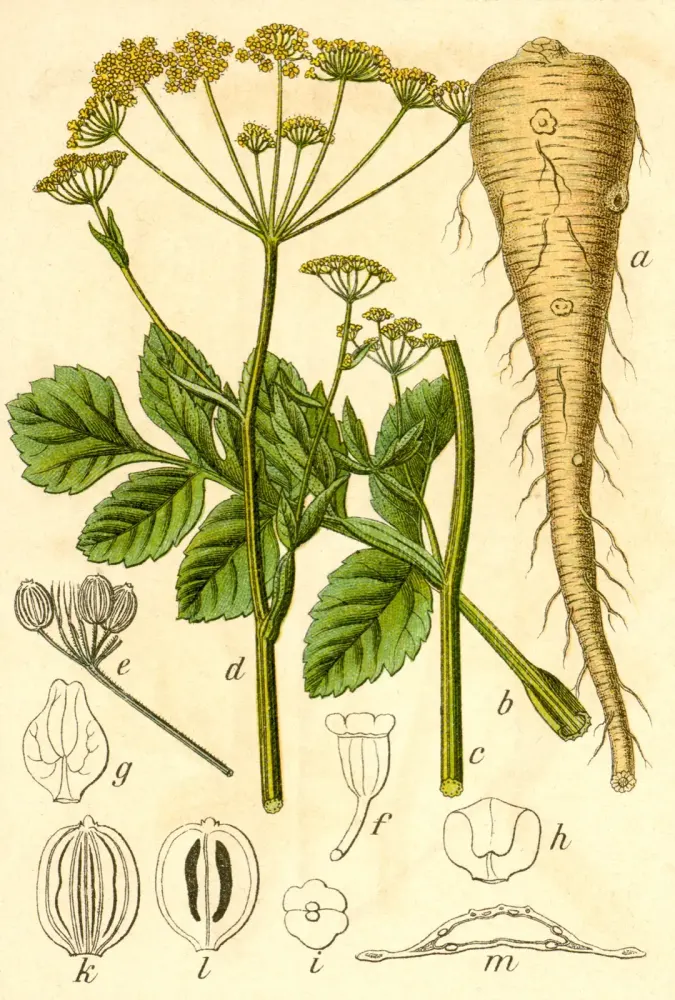
© Jacob und Johann Georg Sturm · Public domain · Commons
Parsnip
CautionPastinak · (Pastinaca sativa)
Carrot family (Apiaceae)
Description
The parsnip is a root vegetable closely related to carrot and parsley, all belonging to the flowering plant family Apiaceae. It is a biennial plant usually grown as an annual. Its long taproot has light cream colored skin and flesh, and, left in the ground to mature, becomes sweeter in flavor after winter frosts.
- RawRootInternalTraditional use
The parsnip root is one of Europe's oldest root vegetables and was a central staple food before the introduction of the potato (16th century). It is boiled, steamed, oven-roasted, puréed or used in soups and stews. Frost exposure converts part of the starch to fructose and sucrose, which explains the characteristic sweetness of winter parsnips. Raw consumption is possible but less common (astringent-spicy flavour). Provides carbohydrates, potassium (approx. 523 mg/100 g), folate (approx. 59 µg/100 g) and dietary fibre (approx. 4–5 g/100 g).
[#src_wp_de_pastinak] [#src_wp_en_parsnip] [#src_pfaf_pastinaca]
- RawRootInternalTraditional use
Parsnips provide approx. 18 mg vitamin C per 100 g as well as relevant amounts of folate (approx. 59 µg/100 g, ~15 % of daily requirement), manganese and copper. Folate is essential for cell division and DNA synthesis; the parsnip is considered one of the better folate sources among root vegetables. Vitamin C content is partly lost during cooking — steaming or cooking in the skin preserves it better. Potassium (approx. 523 mg/100 g) supports normal cardiac function and blood pressure regulation.
[#src_wp_de_pastinak] [#src_wp_en_parsnip] [#src_zdg_pastinaken]
- RawRootInternalTraditional use
With 4–5 g of dietary fibre per 100 g — significantly more than carrots (approx. 3 g) — parsnip supports intestinal peristalsis and a healthy gut flora. It contains both soluble fibres (inulin-type fructans with prebiotic effect on bifidobacteria) and insoluble cellulose. Inulin is not digested in the small intestine and serves as a substrate for gut bacteria in the large intestine. The parsnip is thus a functional food for digestive health — known for centuries in European folk medicine as a stomach-warming vegetable.
[#src_wp_de_pastinak] [#src_wp_en_parsnip] [#src_pfaf_pastinaca]
- TeaRootInternalFolk medicine
In European folk medicine, a decoction of parsnip root was traditionally used as a mild diuretic and to support digestion. Historical sources (PFAF) reference the diuretic effect and use for kidney and bladder complaints. Not clinically confirmed; medicinal use is today rarely practised.
Preparation & dosage
Pour 250 ml of boiling water over 5–10 g of dried, chopped parsnip root, steep for 10 minutes, strain. Drink 2× daily. Folk-medicinal tradition as a diuretic and digestive aid — not clinically confirmed.
- Dry amount
- 5–10 g
- Doses per day
- 2×
- RawRootExternalFolk medicine
The plant sap and mashed root were applied topically in folk medicine for skin inflammations and swellings. This use is no longer recommended, as parsnip sap contains furanocoumarins (bergapten, xanthotoxin, imperatorin) that can trigger severe photodermatitis (blisters, permanent pigmentation changes) in combination with UV light. WARNING: External use of fresh parsnip sap in sunlight is hazardous.
[#src_pfaf_pastinaca] [#src_wp_en_parsnip] [#src_pubmed_photosens]
- SpiceSeedInternalFolk medicine
Parsnip seeds can be used as a spice similar to dill seeds (PFAF: 'similar in taste to dill'). Historically, ground parsnip seeds were used in folk medicine of several European cultures as a stomach spice and appetite stimulant. The seed content of essential oils (especially myristicin, bergapten) also makes them phytochemically interesting — precise dosage and potential phototoxicity should be noted.
- RawRootInternalTraditional use
Parsnips are one of the best plant sources of folate (vitamin B9): approx. 59 µg per 100 g raw root (approx. 15 % of an adult's recommended daily intake). Folate is essential for foetal neural tube development in early pregnancy. Additionally, the root contains vitamin B1 (thiamine) and B6, both significant for nerve metabolism. Combining with other folate-rich vegetables (leafy greens, legumes) complements intake well.
🤝 Permaculture Partners
In your garden, this plant acts as:
✨ Best symbiotic partners
⚠️ Better not planted together
- 🥬 Apium graveolens Classic companion-planting partner.
Source: Gertrud Franck, Gesunder Garten durch Mischkultur (1980, eigene Kuration) | Helga und Margarete Langerhorst, Mein gesunder Naturgarten (eigene Kuration)