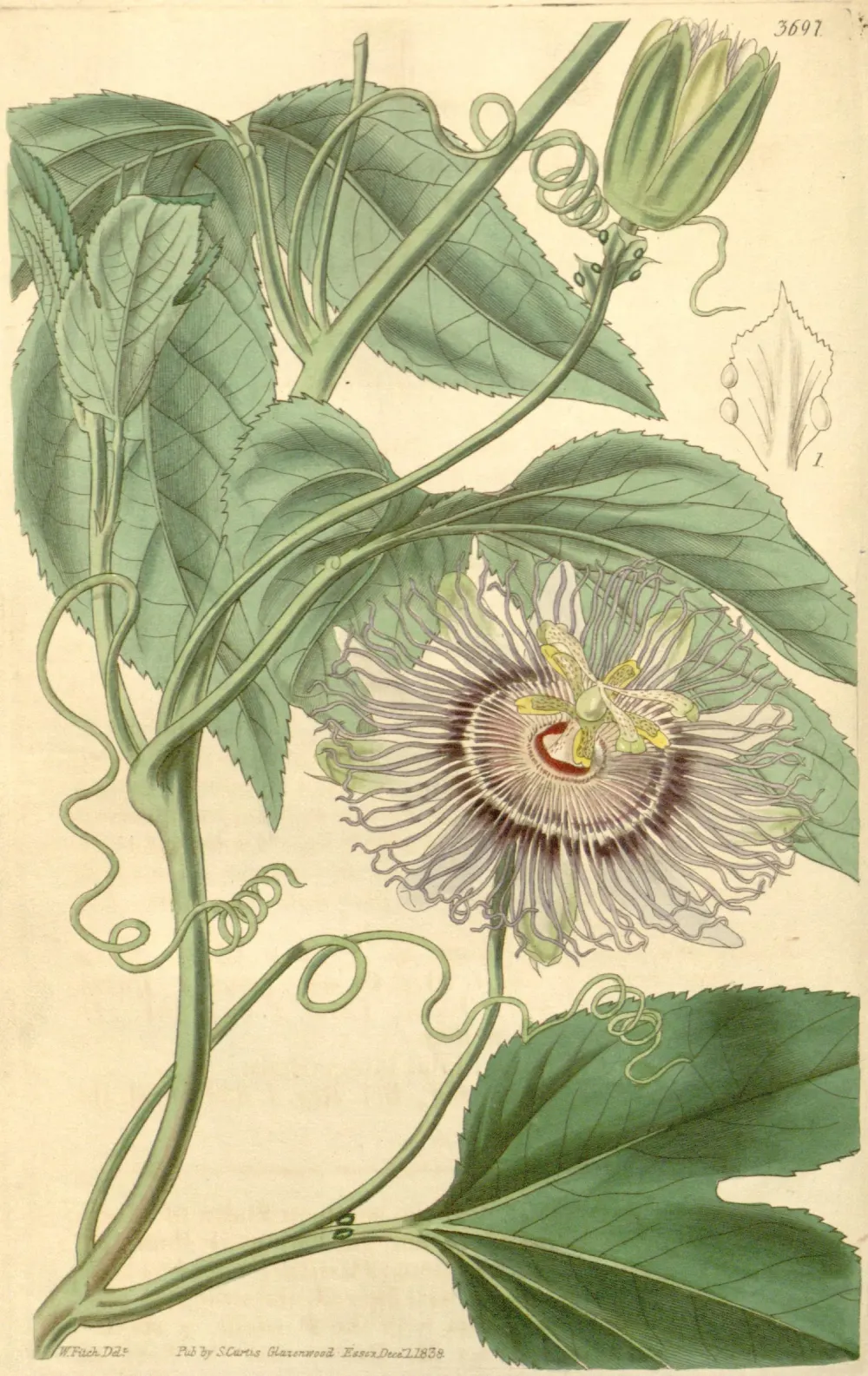
© Curtis's Botanical Magazine, Plate 3697 (1839) · Public domain · Commons
Passionflower
CautionPassionsblume · (Passiflora incarnata)
Passionflower family (Passifloraceae)
Description
Passionflower (Passiflora incarnata) is a perennial herbaceous climbing vine native to the south-eastern United States, ascending several metres by means of axillary tendrils. Its alternate leaves are deeply three- to five-lobed with finely serrate margins. The plant is distinguished by its striking flower, bearing about ten whitish petals topped by a dense corona of thread-like, blue-to-purple banded filaments. The dried aerial parts (Passiflorae herba) are used, traditionally for nervous restlessness and difficulty falling asleep.
🌿 Risk of confusion — read before wild-harvesting!
IMPORTANT: Passionflower may impair the ability to drive and operate machinery — affected users should not drive or use machines. If symptoms persist for more than 2 weeks, consult a doctor. Safety during pregnancy and lactation has not been established — use is therefore not recommended. Not for children under 12 due to lack of data. Use only true Passiflora incarnata (do not confuse with other Passiflora species).
CONTRAINDICATED for children
Not for children under 12 due to lack of data.
- TeaAerial partsInternalTraditional use
Calming tea for nervous restlessness and as a gentle aid to falling asleep.
Preparation & dosage
INFUSION: Pour 150 ml boiling water over 1–2 g of the comminuted herb, cover, steep and strain. One to four times daily; for sleep, one cup about half an hour to an hour before bedtime. To relieve mild symptoms of mental stress (nervous restlessness) and to aid sleep. The EMA monograph specifies no fixed steeping time — 5–10 minutes is customary. If symptoms persist for more than 2 weeks, consult a doctor.
- Dry amount
- 1–2 g
- Doses per day
- 4×
⚠ Age restriction: ≥ 12 years — Not for children under 12 due to lack of data.
- TinctureAerial partsInternalTraditional use
Concentrated calming form for travel use.
Preparation & dosage
LIQUID EXTRACT/TINCTURE: Depending on the preparation (e.g. extract 1:8 with 25% ethanol) 2–4 ml single dose, up to four times daily in a little water. A concentrated form for nervous tension. Due to the alcohol, not for pregnant or breastfeeding women, children, or people with liver disease.
- Liquid amount
- 2–4 ml
- Doses per day
- 4×
⚠ Age restriction: ≥ 18 years — Alcohol-containing extracts only for adults from 18 years.
🤝 Permaculture Partners
In your garden, this plant acts as: