Legal notice
Psilocybin and psilocin are internationally controlled substances (1971 UN Convention on Psychotropic Substances); psilocybin-containing mushrooms are subject to narcotics/drug law in many countries.
The legal situation differs by country and changes over time – inform yourself about the applicable rules in your jurisdiction. This note is neither permission nor encouragement to possess or consume.
For education and documentation only. Not a consumption guide, not legal or medical advice. Possession, cultivation and use are regulated differently by country and species — check the law that applies to you.
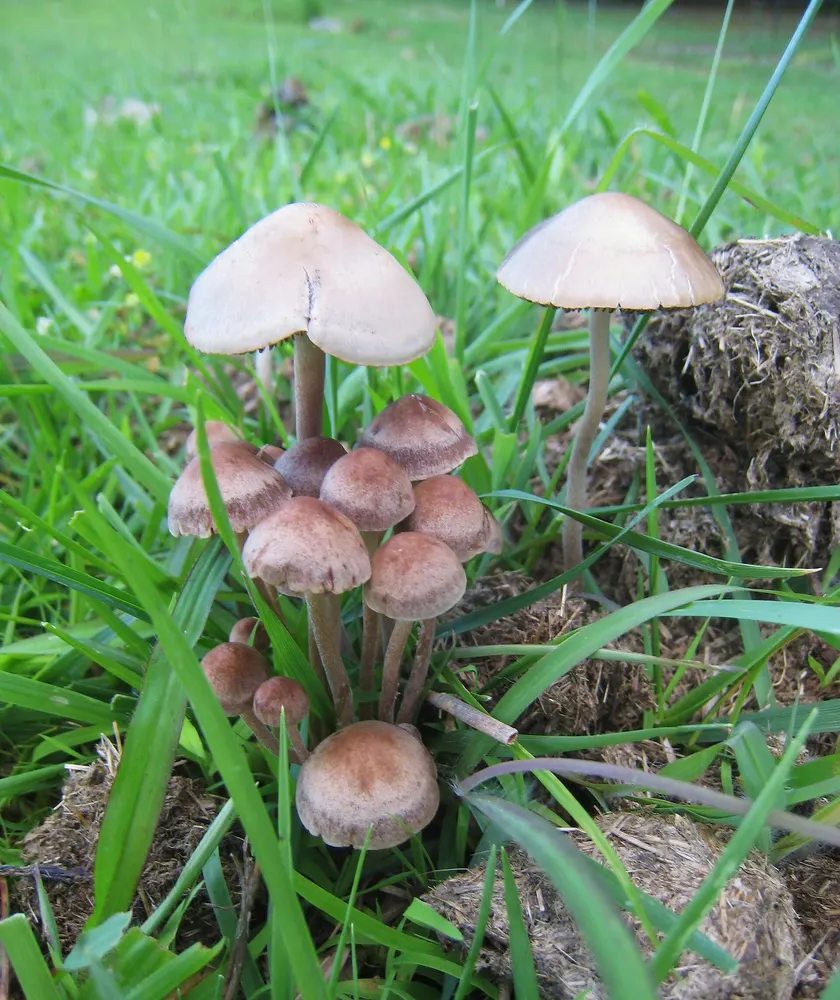
© Amanita77 · CC BY-SA 3.0 · Commons
Banded mottlegill
Caution🐾Dunkelrandiger Düngerling · (Panaeolus cinctulus)
Bolbitiaceae (Bolbitiaceae)
Description
The banded mottlegill (Panaeolus cinctulus, syn. P. subbalteatus) is a small saprobic gilled mushroom in the genus Panaeolus that grows worldwide on nutrient-rich, manured soils, compost heaps, lawns and especially on horse dung. Its 1.5–6 cm cap is strongly hygrophanous, cinnamon to chestnut-brown when moist and fades from the centre as it dries, leaving a darker marginal band – the source of the names 'banded', 'belted' or 'zoned'. The fungus contains the psychoactive alkaloids psilocybin and psilocin and, according to mycologist David Arora, is the most common psilocybin mushroom in California. As a nondescript 'little brown mushroom', it is easily confused with deadly toxic species.
🌿 Risk of confusion — read before wild-harvesting!
Caution: as a nondescript 'little brown mushroom' (LBM), the banded mottlegill is easily confused with deadly toxic species, especially the funeral bell (Galerina marginata), which contains liver-destroying amatoxins – a mix-up can be fatal.
- RawWhole plantInternalTraditional use
Ethnomycological/historical note: psilocybin-containing mushrooms were used in Mesoamerican cultures (Aztec 'teonanácatl') in religious ritual, and Panaeolus species are discussed in the scientific literature among potentially ritually used mushrooms. This is a purely historical, documentary note and not any instruction for consumption.
- RawWhole plantInternalClinical trial
Pharmacologically the species contains psilocybin, whose active metabolite psilocin acts at the serotonin 5-HT2A receptor. Pure psilocybin (not this mushroom) is being investigated in randomized clinical trials for depression, e.g. a phase-2 trial by Carhart-Harris et al. (2021, NEJM) compared with escitalopram. This is a documentary note on the research status, not a recommendation for self-medication or mushroom consumption.