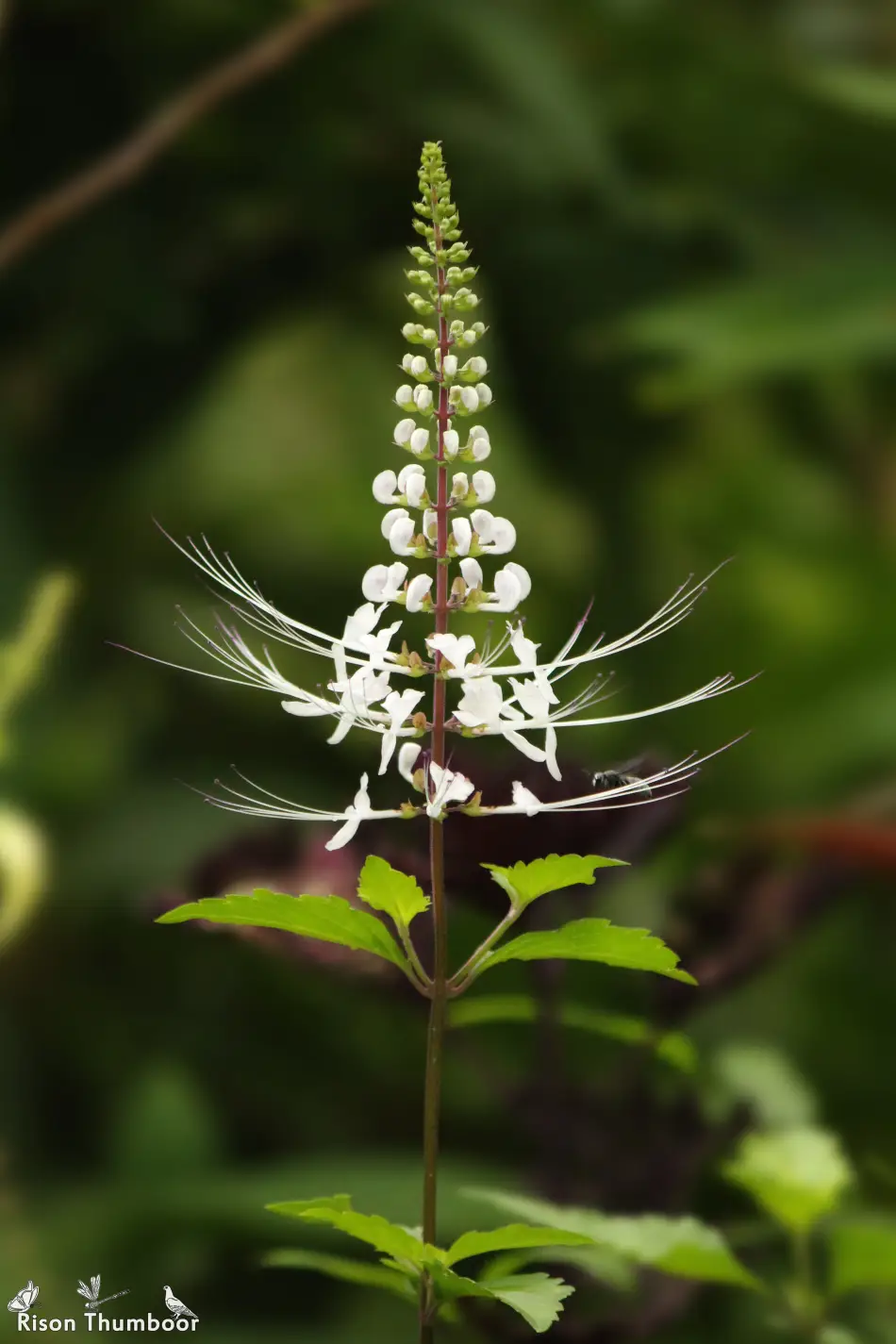
© Rison Thumboor from Thrissur, India · CC BY 2.0 · Commons
Java tea (Cat's whiskers)
Katzenbart (Indischer Nierentee, Java-Tee) · (Orthosiphon aristatus)
Mint family (Lamiaceae)
Description
Orthosiphon aristatus (synonym: Orthosiphon stamineus) is a perennial tropical herb of the mint family (Lamiaceae), native to southern and Southeast Asia and northeastern Australia. Its most striking feature is the very long, white to pale lilac stamens that project well beyond the two-lipped flowers, giving the plant its name 'cat's whiskers' (Indonesian 'kumis kucing', Malay 'misai kucing'). The medicinal part is the leaf (Orthosiphonis folium), dried and drunk as a tea to flush the urinary tract. The leaves contain lipophilic flavones, caffeic acid derivatives such as rosmarinic acid, and abundant potassium salts, and act as a mild diuretic (aquaretic).
CONTRAINDICATED for children
Use in children and adolescents under 18 years of age is not recommended due to a lack of adequate data.
Traditional herbal medicinal product used to increase the amount of urine in order to flush the urinary tract, as an adjuvant in minor urinary tract complaints. Its use is based exclusively on long-standing tradition.
Preparation & dosage
Pour 150 ml of boiling water over 2-3 g of dried cat's whiskers leaves, cover and steep for about 10 minutes, then strain. Drink 2-3 cups per day (daily dose 6-12 g). Important: for the intended flushing effect an ample fluid intake of at least 2 litres per day is required. Do not use for flushing therapy in cases of fluid retention (oedema) resulting from impaired heart or kidney function.
- Dry amount
- 2–3 g
- Doses per day
- 3×
⚠ Age restriction: ≥ 18 years — According to the EMA monograph, use is not recommended in children and adolescents under 18 years of age due to a lack of adequate data.
Do not use for flushing therapy in cases of fluid retention (oedema) resulting from impaired heart or kidney function. Ensure ample fluid intake (at least 2 litres per day). Consult a doctor or qualified health care practitioner if fever, painful urination (dysuria), spasms or blood in the urine occur, or if complaints persist for longer than 2 weeks.
Safety during pregnancy has not been established. In the absence of sufficient data, use during pregnancy is not recommended.
Safety during lactation has not been established. In the absence of sufficient data, use during breastfeeding is not recommended.
Use in children and adolescents under 18 years of age is not recommended due to a lack of adequate data.
Drug interactions
diuretics
Possible additive diuretic effect when taken together with other diuretics; the EMA monograph reports no specific interactions, but an additive effect on fluid and electrolyte balance cannot be excluded.
Contraindications
- Fluid retention (oedema) resulting from impaired heart or kidney function
- Conditions where a reduced fluid intake is recommended (e.g. severe cardiac or renal disease)
- Hypersensitivity to the active substance
Harvested part: Leaves and stem tips, shortly before or during flowering
- SinensetinFlavonoidLeaf
Lipophilic methoxylated flavone; a key marker constituent of the drug.
- EupatorinFlavonoidLeaf
Another lipophilic flavone found in the leaves.
- RosmarinsäurePhenolic acidContent: min. 0.3%Leaf
Caffeic acid derivative; per Ph. Eur. the content is expressed as rosmarinic acid (minimum 0.3%).
- KaliumsalzeMineralContent: ca. 3%Leaf
High content of potassium salts contributing to the aquaretic (diuretic) effect.
- Ätherisches ÖlEssential oilLeaf
Essential oil containing sesquiterpenes and monoterpenes in small amounts.
- Orthosiphol (Benzochromone / oxygenierte Diterpene)OtherLeaf
Oxygenated diterpenes and benzochromones characteristic of the genus Orthosiphon.
- [1]MonographEuropean Union herbal monograph on Orthosiphon aristatus (Blume) Miq. var. aristatus, folium (Orthosiphonis folium), EMA/HMPC/486551/2020(accessed: 2026-07-02)
- [2]MonographFinal assessment report on Orthosiphon aristatus (Blume) Miq. var. aristatus, folium (EMA/HMPC)(accessed: 2026-07-02)
- [7]BookJava-Tee (Orthosiphonis folium) - Arzneipflanzenlexikon(accessed: 2026-07-02)
- [3]WikipediaOrthosiphon aristatus - Wikipedia (English)(accessed: 2026-07-02)
- [4]WikipediaKatzenbart (Orthosiphon) - Wikipedia (Deutsch)(accessed: 2026-07-02)
- [6]CommonsFile:Cat whiskers (Orthosiphon aristatus) (38891043775).jpg - Wikimedia Commons(accessed: 2026-07-02)
- [5]WikidataOrthosiphon aristatus (Q1141184) - Wikidata(accessed: 2026-07-02)
🤝 Permaculture Partners
In your garden, this plant acts as: