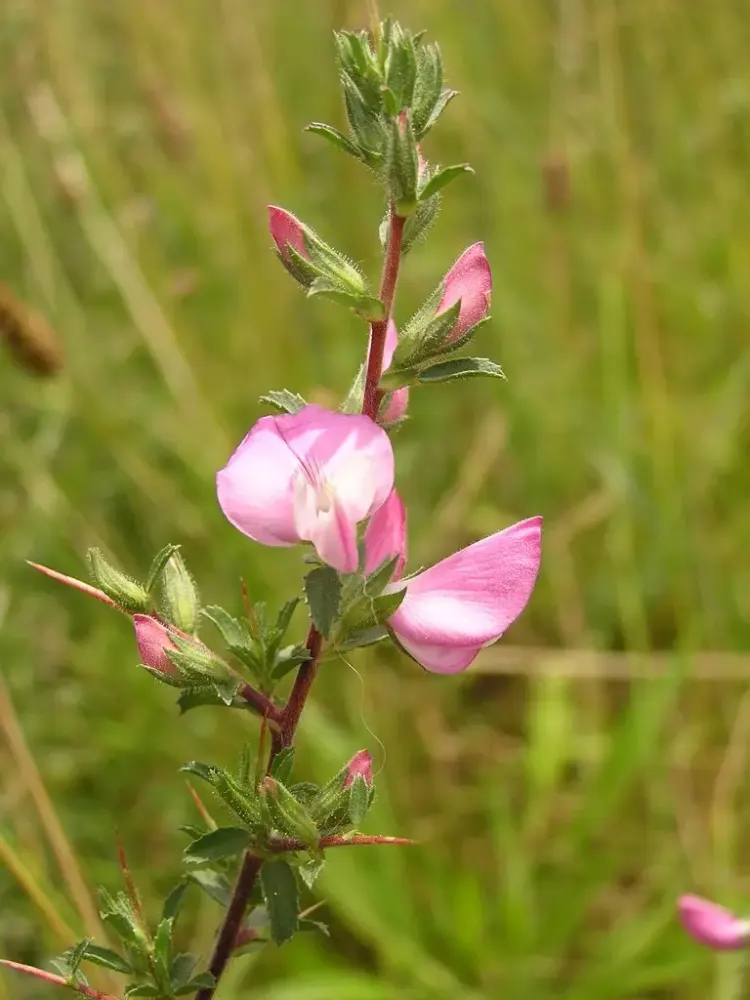
© Michael Becker · CC BY-SA 3.0 · Commons
Ononis spinosa
CautionDornige Hauhechel · (Ononis spinosa)
Legume family (Fabaceae)
Description
Ononis spinosa is a flowering plant belonging to the family Fabaceae, that is commonly known as spiny restharrow or just restharrow. It is found throughout much of Europe including Britain, but rarely as far north as Scotland. It is closely related to Ononis repens ; the two are considered conspecific by the Plants of the World Online database, with O.
CONTRAINDICATED during pregnancy
Do not use in pregnancy. Animal and in vitro data show uterine-stimulating potential of constituents (isoflavones, ononidin); additionally no adequate clinical safety data. Kommission E and EMA do not recommend use in pregnancy.
CONTRAINDICATED during breastfeeding
Do not use during lactation — insufficient safety data; transfer of isoflavones into breast milk cannot be excluded.
- TeaRootInternalCommission E
Classic irrigation therapy using restharrow root infusion for inflammatory urinary tract complaints and prevention of kidney gravel — positively assessed by Kommission E and EMA (traditional use).
Preparation & dosage
INFUSION (Kommission E, EMA traditional use): 2–3 g of coarsely chopped dried restharrow root (Ononidis radix) in 250 ml boiling water, covered, steep 15 min, strain. Prepare fresh each time. 2–3 cups daily, preferably between meals. Daily dose: 6–9 g drug. For irrigation therapy in inflammatory conditions of the urinary tract and to prevent kidney gravel. IMPORTANT: Drink plenty of fluids (at least 2 litres daily) — the plant acts as an aquaretic, increasing urine volume. Duration up to 4 weeks; persistent symptoms or fever require medical evaluation.
- Dry amount
- 2–3 g
- Doses per day
- 3×
- Max duration
- 4 weeks
[#src_kommission_e_ononidis_radix] [#src_ema_ononidis_radix] [#src_wichtl_ononidis_radix]
- TinctureRootInternalTraditional use
Traditional restharrow root tincture as an alternative to tea — liquid dosage form for urinary irrigation therapy.
Preparation & dosage
TINCTURE (DER 1:5 in 45–60 % ethanol): 2–4 ml (~40–80 drops) 3× daily, taken with ample water. Equivalent to ~6–9 g drug per day. Drink liberally alongside (at least 2 litres daily) — the aquaretic effect requires adequate fluid intake. Traditional alternative to tea for urinary irrigation therapy. Duration up to 4 weeks.
- Liquid amount
- 2–4 ml
- Doses per day
- 3×
- Max duration
- 4 weeks
- TeaRootInternalFolk medicine
Folk use for gout and rheumatic complaints — the aquaretic effect is traditionally held to support uric acid elimination; evidence is traditional only.
Preparation & dosage
FOLK USE FOR GOUT/RHEUMATISM: Infusion as for urinary indication (2–3 g root, 250 ml boiling water, 15 min covered, strain). 2× daily, alongside increased fluid intake. Folk use for supporting elimination of uric acid in gout and rheumatic complaints. Efficacy for this indication is not documented by modern clinical studies — traditional use only. Not a substitute for medically prescribed gout therapy.
- Dry amount
- 2–3 g
- Doses per day
- 2×
- Max duration
- 3 weeks
- TeaAerial partsInternalFolk medicine
Folk flower tea as a mild alternative to the root — lower in active constituents, less scientific evidence, used as an adjunct.
Preparation & dosage
FLOWER TEA (folk): 1.5–2 g dried restharrow flowers in 200 ml hot water, covered, steep 10 min, strain. 2× daily. Folk use as a milder alternative to the root — lower active constituent concentration. Less well documented than root preparations; Kommission E and EMA assessed only the root positively. For urinary complaints, prefer root preparations.
- Dry amount
- 1.5–2 g
- Doses per day
- 2×
- Max duration
- 2 weeks
- BathRootExternalFolk medicine
Folk restharrow root bath for rheumatic complaints and skin conditions — external use, not officially assessed.
Preparation & dosage
FULL / PARTIAL BATH (folk): 50–100 g dried restharrow root in 2–3 litres cold water, simmer 20–30 min (decoction), cool, strain into bath water. Bath temperature 36–38 °C, duration 15–20 minutes, 2–3× weekly. Folk use for rheumatic complaints, skin rashes and pruritic skin conditions as hip or full bath. External use is not assessed by Kommission E or EMA; traditional use only.
- TeaRootInternalTraditional use
Restharrow root as a component of bladder and kidney tea blends (e.g. DAB bladder tea) — synergistic aquaretic effect with birch leaf, goldenrod and horsetail.
Preparation & dosage
HERBAL BLEND: Restharrow root is traditionally a component of bladder and kidney tea blends (Blasentee, DAB Nr. 8 blend). Typical combination: restharrow root + birch leaf + goldenrod herb + horsetail, equal parts. 1 tbsp (~5 g) blend per 250 ml, steep 15 min, 3× daily. Synergistic aquaretic effect of all components. Officially established in phytotherapy (DAB, NRF formulations).
- Dry amount
- 2–3 g
- Doses per day
- 3×
- Max duration
- 4 weeks
[#src_wichtl_ononidis_radix] [#src_ema_ononidis_radix] [#src_escop_ononidis_radix]
- TinctureRootInternalCommission E
Standardised restharrow root extracts as phytopharmaceuticals — officially approved dosage form for irrigation therapy (Kommission E positive).
Preparation & dosage
LIQUID / STANDARDISED EXTRACT: Dry and liquid extracts (DER 3–6:1, ethanol 40–60 %) are approved as phytopharmaceuticals. Daily equivalent: 6–9 g drug. Proprietary preparations (e.g. Cysto Fink, Hepaselect, combination kidney-bladder teas) dose per manufacturer instructions. Drink ample fluid (≥ 2 l/day). Not longer than 4 weeks without medical supervision. Kommission E positive assessment for urinary irrigation therapy.
- Liquid amount
- 2–5 ml
- Doses per day
- 3×
- Max duration
- 4 weeks
[#src_kommission_e_ononidis_radix] [#src_ema_ononidis_radix] [#src_escop_ononidis_radix]