© Unknown (see Commons) · See Commons file page · Commons
Olive
CautionOlivenbaum · (Olea europaea)
Olive family (Oleaceae)
Description
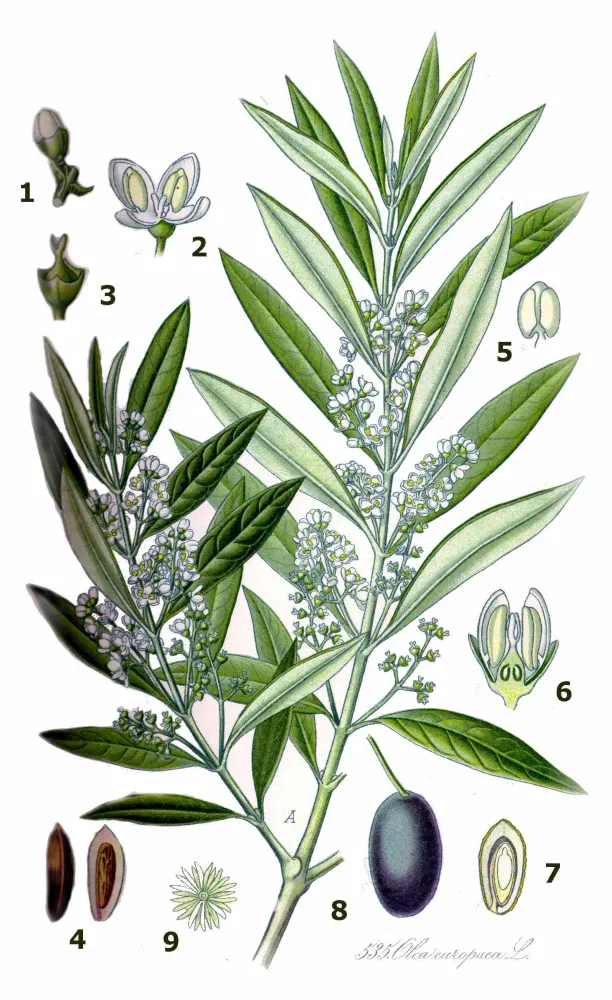
The olive is a species of subtropical evergreen tree in the family Oleaceae. Originating in Asia Minor, it is abundant throughout the Mediterranean Basin, with wild subspecies in Africa and western Asia; modern cultivars are traced primarily to the Near East, Aegean Sea, and Strait of Gibraltar. The olive is the type species for its genus, Olea, and lends its name to the Oleaceae plant family, which includes lilac, jasmine, forsythia, and ash.
- TeaLeafInternalTraditional use
Traditional olive leaf tea for supportive use in mildly elevated blood pressure and as a mild aquaretic — oleuropein is considered the principal active compound.
Preparation & dosage
OLIVE LEAF INFUSION (Oleae folium): 1–2 g (~1–2 tsp) dried chopped olive leaves in 200 ml boiling water, covered, steep 10–15 min, strain. 2–3 cups daily between meals. Traditional use for mild supportive blood pressure management and mild aquaretic (diuretic) effect. Onset only after 2–3 weeks of continuous use. Not a substitute for prescribed antihypertensives; monitor blood pressure regularly. Persistently elevated blood pressure requires medical assessment.
- Dry amount
- 1–2 g
- Doses per day
- 3×
- Max duration
- 4 weeks
[#src_escop_oleae_folium] [#src_wichtl_teedrogen] [#src_pfaf_olea_europaea]
- TinctureLeafInternalTraditional use
Olive leaf tincture as a more concentrated alternative to infusion — traditionally used for mildly elevated blood pressure and general immune support.
Preparation & dosage
OLIVE LEAF TINCTURE (1:5 in 40–45 % ethanol): 2–4 ml (~40–80 drops) 3× daily, diluted in water, between meals. Standardised commercial tinctures (adjusted for oleuropein) are preferred over home preparations. Onset after 2–4 weeks. When co-administering antihypertensives, monitor blood pressure more frequently — additive effect possible. Due to ethanol content, do not use in alcohol dependence, severe liver disease or epilepsy.
- Liquid amount
- 2–4 ml
- Doses per day
- 3×
- Max duration
- 4 weeks
- RawFruitInternalClinical trial
Extra virgin olive oil as functional food — EFSA-authorised health claim: protects LDL particles from oxidation (20 g/day, at least 5 mg hydroxytyrosol derivatives).
Preparation & dosage
EXTRA VIRGIN OLIVE OIL (Oleae oleum virginale): 20 g (~2 tbsp) extra virgin olive oil daily as part of the diet. EFSA health claim (EFSA 2011 NDA Panel, EFSA Journal 9(4):2033): 20 g/day extra virgin olive oil containing at least 5 mg hydroxytyrosol and its derivatives per 20 g protects LDL cholesterol particles from oxidative damage. Authorised only for oils meeting this polyphenol threshold — not a blanket claim for all olive oils. Prefer cold-pressed (first pressing); refined olive oil contains significantly fewer polyphenols. Mildly laxative when taken on an empty stomach (1–2 tbsp in the morning) — traditional use for constipation.
[#src_efsa_olive_polyphenols] [#src_wp_en_olive_oil] [#src_pfaf_olea_europaea]
- SalveFruitExternalTraditional use
Extra virgin olive oil as skin care and salve base — emollient, re-fattening; traditionally for dry skin, wound care and infant skin care.
Preparation & dosage
OLIVE OIL SALVE / SKIN CARE: Apply pure extra virgin olive oil thinly to dry, irritated or cracked skin, massage gently and allow to absorb. Alternatively as base for home-prepared herbal salves (e.g. with calendula). Infant care: thin application of undiluted olive oil on sore areas (nappy region) — traditional practice, well tolerated. Consult dermatologist for chronic skin conditions (eczema, psoriasis). Do not apply to open, infected wounds.
- SpiceFruitInternalTraditional use
Table olive varieties as part of the Mediterranean diet — cardioprotective association documented by the PREDIMED trial; oleuropein debittering required.
Preparation & dosage
TABLE OLIVES / KITCHEN: Ripe black or semi-ripe green olives are debittered before eating due to bitterness (oleuropein) — by soaking in water, brine or lye; natural brine-cured olives take several weeks. Commercial ready-to-eat olives in oil or brine can be consumed directly. As part of the Mediterranean diet, associated with documented cardioprotective effects (PREDIMED trial). Dietary ingredient, not a medicinal preparation per se. Olive kernel oil is food-grade but lower in polyphenols.
[#src_predimed_study] [#src_wp_en_olive_oil] [#src_wp_de_olivenbaum]
- CompressLeafExternalFolk medicine
Folk olive leaf compress for mild skin inflammation and rheumatic complaints — mild external use with limited evidence.
Preparation & dosage
OLIVE LEAF COMPRESS: Place fresh or briefly scalded olive leaves (warmed 2–3 min in hot water) on a clean cloth, apply warm to affected skin or aching joint, leave for 15–20 min. Folk use for mild skin inflammation, insect bites and rheumatic joint pain. Scientific evidence for topical efficacy in humans is limited; in vitro studies show antioxidant and mild antimicrobial activity of oleuropein extracts. Seek medical evaluation for severe or persistent complaints.
- TeaLeafInternalFolk medicine
Folk olive leaf bitter tea for stimulating digestion and bile flow — oleuropein acts as a bitter reflex stimulant.
Preparation & dosage
OLIVE LEAF BITTER TEA: 1–2 g dried olive leaves in 200 ml boiling water, steep 8–10 min, strain. 1–2 cups daily before meals. Folk use for stimulating bile flow and digestion (cholagogue effect) and in mild dyspeptic complaints. Bitter-tasting oleuropein reflexively stimulates digestive secretions. Evidence based on traditional transmission and pharmacological in vitro data; clinical studies for this indication are lacking. Avoid in gallstones without medical advice.
- Dry amount
- 1–2 g
- Doses per day
- 2×
- Max duration
- 3 weeks
- RawLeafInternalFolk medicine
Olive leaf extract (powder/capsule) as food supplement for general immune support — traditional, without EMA monograph for this indication.
Preparation & dosage
OLIVE LEAF POWDER / CAPSULES: Dried olive leaves finely ground can be taken as powder in capsules (commercial food supplements) — typical daily dose of standardised products: 500–1000 mg extract (standardised to 20 % oleuropein). Folk use for general immune support and mild feverish colds. Clinical studies suggest immunomodulatory effects, but no EMA or ESCOP monograph exists for this indication. No medicinal health claim proven under EU law; supplement, not medicinal product. Prefer commercial standardised products for consistent potency.