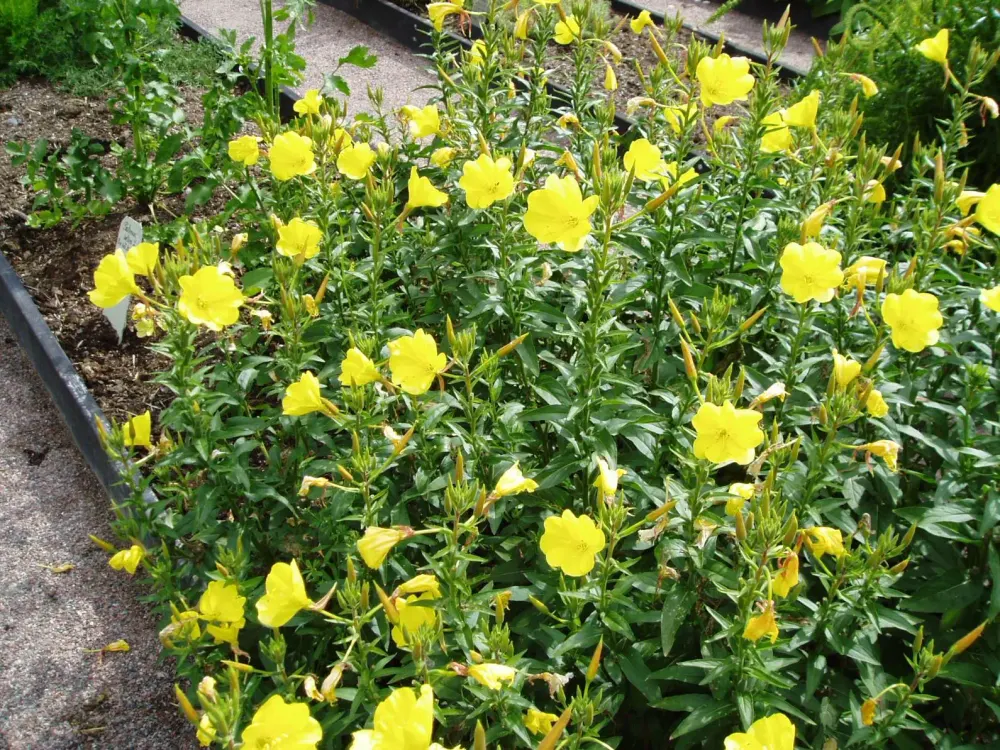
© Udo Schröter · CC BY-SA 2.5 · Commons
Oenothera biennis
CautionGemeine Nachtkerze · (Oenothera biennis)
Evening primrose family (Onagraceae)
Description
Oenothera biennis, the common evening-primrose, is a species of flowering plant in the family Onagraceae, native to eastern and central North America, from Newfoundland west to Alberta, southeast to Florida, and southwest to Texas, and widely naturalized elsewhere in temperate and subtropical regions. Evening primrose oil is produced from the plant.
Critical drug interactions with:
Phenothiazine (Antipsychotika)
- RawRootInternalFolk medicine
The fleshy taproot of first-year plants (October to spring before flowering) is edible. Tastes peppery-spicy, similar to parsnip or salsify. Cooked or prepared like a vegetable. Once the plant flowers the root becomes woody and is no longer suitable for eating.
[#src_wp_de_oenothera] [#src_wp_en_oenothera] [#src_pfaf_oenothera]
- RawSeedInternalFolk medicine
The small seeds contain 28 % fatty oil, rich in gamma-linolenic acid (GLA, 7–14 %) and linoleic acid (ca. 70 %). Cold-pressed evening primrose oil from the seeds is widely used as a dietary supplement.
- TinctureSeedInternalTraditional use
Evening primrose oil (GLA-rich) is traditionally taken for atopic dermatitis. GLA promotes synthesis of anti-inflammatory prostaglandins (PGE1). Clinical studies show inconsistent results; the NCCIH finds no clear proof of efficacy.
- CompressRootExternalFolk medicine
In folk medicine, mashed roots were applied as a poultice to bruises, contusions, and haemorrhoids. Documented among North American indigenous peoples (Iroquois, Cherokee).
- TeaRootInternalFolk medicine
Tea from roots (first harvest, autumn) traditionally used for digestive complaints and obesity. Contains mucilage-like compounds that soothe the intestinal mucosa.
- TinctureSeedInternalFolk medicine
Evening primrose oil traditionally used for premenstrual syndrome (PMS), breast pain (mastalgia), and rheumatoid arthritis. The anti-inflammatory mechanism via GLA metabolites is discussed; clinical evidence remains limited.