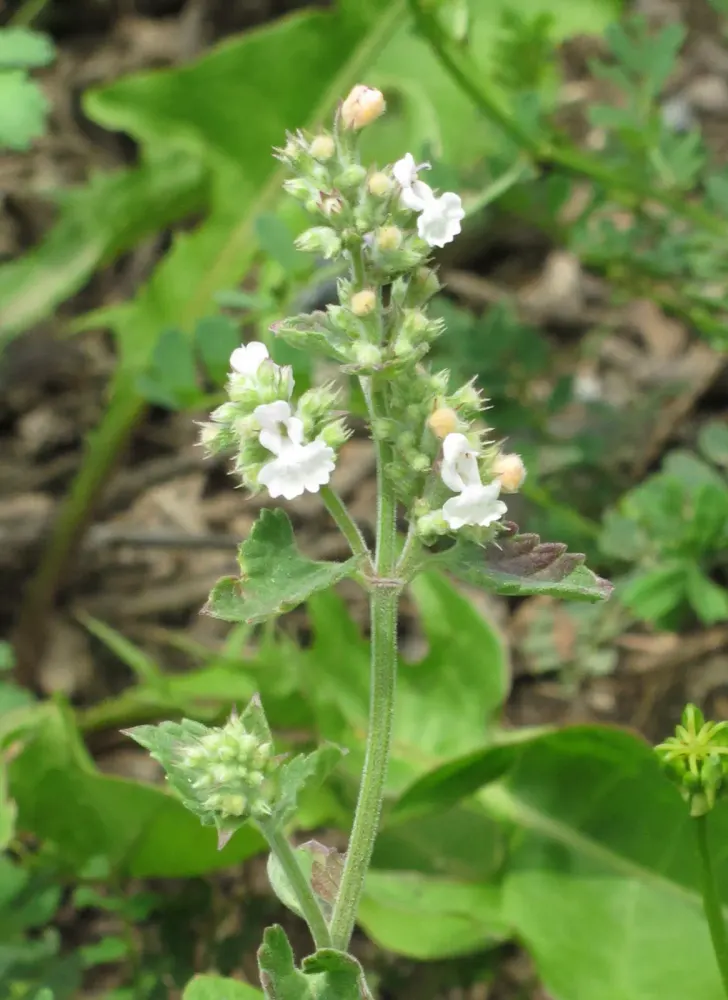
© Robert Flogaus-Faust · CC BY 4.0 · Commons
Echte_Katzenminze
CautionEchte Katzenminze · (Nepeta cataria)
Mint family (Lamiaceae)
Description
Description for Echte_Katzenminze pending — see Wikipedia article.
CONTRAINDICATED during pregnancy
Not for use during pregnancy due to emmenagogue action — may stimulate uterine contractions.
- TeaAerial partsInternalTraditional use
Tea from flowering aerial parts has a mildly sedative and nervine action. Traditionally used for nervous exhaustion, restlessness, and difficulty sleeping. The infusion calms without strong hypnotic effect — suitable for adults and older children.
Preparation & dosage
Pour non-boiling water (approx. 90 °C) over 2–4 g dried herb, steep 10 minutes, strain. Avoid boiling water — volatile oils evaporate.
- Dry amount
- 2–4 g
- Doses per day
- 3×
- TeaAerial partsInternalTraditional use
Warm catnip tea is considered diaphoretic and antipyretic. Used in European folk medicine for feverish colds and influenza to reduce body temperature through perspiration.
Preparation & dosage
Prepare like nervine tea; drink warm in small sips to encourage perspiration. Keep warm afterwards.
- Dry amount
- 2–3 g
- Doses per day
- 3×
- TeaAerial partsInternalFolk medicine
Cold-prepared infusion or cooled tea acts as a tonic and appetite stimulant. Taken warm before meals it supports digestion and relieves flatulence (carminative action).
- TeaAerial partsInternalFolk medicine
Used in traditional European herbalism as a mild emmenagogue for dysmenorrhoea (menstrual pain) and amenorrhoea (absent menstruation). Effect is considered mild and not reliably reproducible.
- Essential oilAerial partsExternalFolk medicine
Essential oil obtained by steam distillation contains nepetalactone and acts as insect repellent against mosquitoes, cockroaches, and termites. In laboratory tests comparably effective to DEET as a spatial repellent, but less effective than DEET when applied directly to skin.
- CompressAerial partsExternalFolk medicine
Fresh or rewarmed leaves applied as a poultice to bruises (especially black eyes) and contusions. Astringent tannins and rosmarinic acid are thought to provide anti-inflammatory action.
Distribution in Europe
🪴 Grow at home
- ☀ Light
- full sun
- 💧 Water
- every few days
- 🌱 Soil
- Standard herb compost
- 🪴 Pot
- 20 cm
- ⭐ Difficulty
- ★☆☆ beginner
- 🐾 Pets
- pet-safe
Tips:
- If cats live with you: keep out of reach — otherwise gets shredded.
- Natural mosquito repellent on balcony.
- Tea from flowers/leaves has calming effect.
Care tips are general indoor-gardening recommendations, not scientific sources.
🤝 Permaculture Partners
In your garden, this plant acts as:
✨ Best symbiotic partners
- 🌿 Garlic Classic companion-planting partner.
- 🌿 Cucurbita pepo Classic companion-planting partner.
Source: Helga und Margarete Langerhorst, Mein gesunder Naturgarten (eigene Kuration)