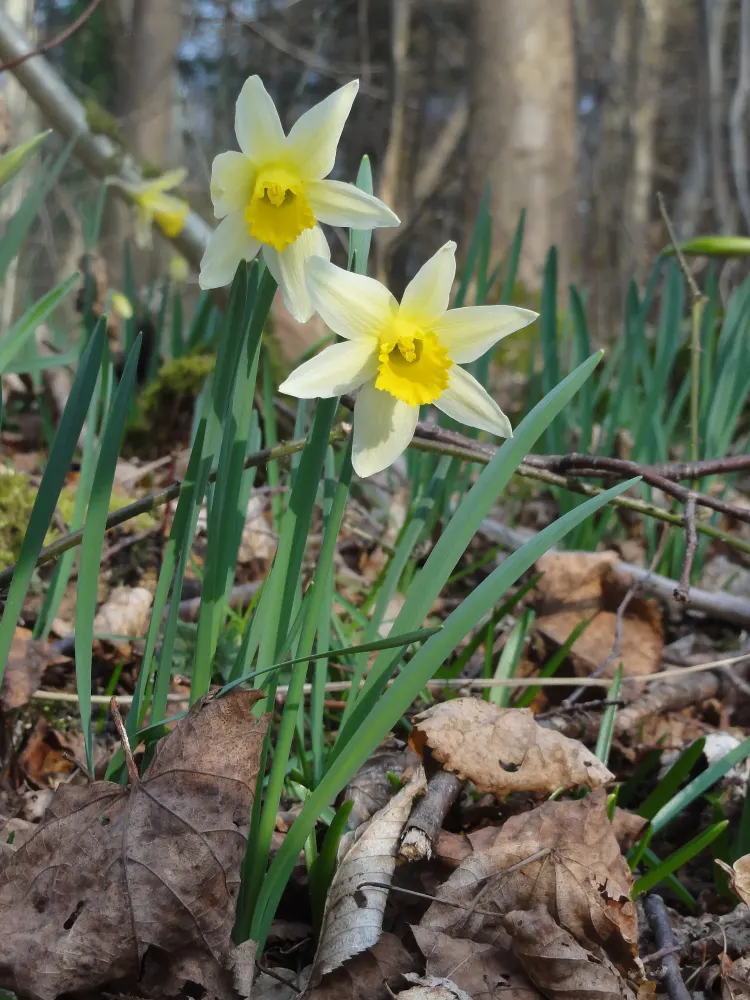
© Pierre Poschadel · CC BY-SA 4.0 · Commons
Narcissus pseudonarcissus
Toxic🐾Gelbe Narzisse · (Narcissus pseudonarcissus)
Amaryllis family (Amaryllidaceae)
Description
Narcissus pseudonarcissus, commonly named the wild daffodil or Lent lily, is a perennial flowering plant.
🌿 Risk of confusion — read before wild-harvesting!
Poisonings classically occur through accidental confusion of the bulb with kitchen onion or shallot — a documented problem particularly during food shortages (Dutch Hunger Winter 1944/45; recently: migrant poisonings in Central Europe).
External use only!
This plant must NOT be taken internally. Use only as compress, salve, or bath.
CONTRAINDICATED during pregnancy
Lycorine and other Amaryllidaceae alkaloids are embryotoxic in vitro and teratogenic in animal studies; lycorine inhibits protein biosynthesis at the ribosomal level and impacts cell division. Any oral or high-dose topical application of narcissus material during pregnancy is contraindicated. Pharmaceutically isolated galantamine (Alzheimer's indication) has its own risk assessment — administration to pregnant women only on strict medical indication.
CONTRAINDICATED during breastfeeding
Transfer behaviour of Amaryllidaceae alkaloids into breast milk is insufficiently studied; given the acute toxicity (vomiting, seizures) strictly contraindicated for the infant. Pharmaceutical galantamine: breastfeeding is not recommended per the product information.
CONTRAINDICATED for children
Children frequently poison themselves by eating bulbs (confusion) or flowers and leaves in family gardens — even a single bulb can trigger severe vomiting and dehydration in a small child. Narcissi in kindergartens, schoolyards and near playgrounds should be out of reach or preferably replaced with non-toxic spring bloomers. No lay use in children.
Critical drug interactions with:
Cholinesterase-Hemmer (Donepezil, Rivastigmin, Galantamin selbst, Pyridostigmin)
- Compressuse.plant_part.bulbExternalFolk medicine
Traditional external use in the Mediterranean and Arab world: cut-open fresh narcissus bulbs were applied as poultices for ulcers, abscesses, poorly healing wounds and 'corns' (callous skin lesions). Avicenna (Ibn Sina, 11th century) mentions Narcissus in his Canon of Medicine. Mechanism: local irritant and macerating action of the alkaloids (lycorine, homolycorine, narcissin). Today obsolete due to contact dermatitis risk ('daffodil rash') and systemic absorption.
Preparation & dosage
[#src_wp_en_narcissus_pseudonarcissus] [#src_pfaf_narcissus_pseudonarcissus]
- Rawuse.plant_part.bulbExternalFolk medicine
Occupational contact dermatitis ('daffodil itch', 'lily rash') in florists, gardeners and bulb sorters — not a therapeutic application but a relevant occupational medicine and allergology issue. The plant sap contains calcium oxalate raphides and alkaloids (lycorine, narciclasine) that mechanically and chemically trigger an irritant and allergic contact dermatitis. Clinically documented since the late 19th century; particularly affects hands and forearms. Protective gloves are the standard prevention.
Preparation & dosage
[#src_wp_en_narcissus_pseudonarcissus] [#src_wp_lycorine_narcissus_pseudonarcissus]
- RawFlowerExternalFolk medicine
Symbolic and cultural-historical significance: the wild daffodil is the national flower of Wales (worn on St. David's Day, 1 March) and is regarded in Christianity as the 'Lent lily' / 'Easter bell' because of its bloom during Lent. In Greek mythology the plant is linked to the youth Narcissus, who fell in love with his own reflection — root of the term 'narcissism'. The Marie Curie Cancer Care Foundation has used the daffodil as the symbol of UK hospice work since 1986. No medicinal use — purely cultural-historical and symbolic significance.
Preparation & dosage
[#src_wp_en_narcissus_pseudonarcissus] [#src_wp_de_narcissus_pseudonarcissus] [#src_wikidata_narcissus_pseudonarcissus]
Historical documentation only — do NOT use
These internal applications are historically documented. This plant is highly toxic — self-treatment can cause severe poisoning or death. For documentation only, explicitly NOT a recommendation.
- Rawuse.plant_part.bulbInternalFolk medicine
Historical folk-medicinal use of dried and powdered bulb as an emetic and as a wound dressing for burns and boils. The application is based on the strong emetic effect of the main alkaloid lycorine and the locally skin-irritating action of further Amaryllidaceae alkaloids. Already Dioscorides (1st century CE) and Pliny describe Narcissus applications — today completely obsolete due to unpredictable toxicity (LD50 lycorine oral mouse ca. 41 mg/kg). No modern recommendation for use.
Preparation & dosage
[#src_wp_en_narcissus_pseudonarcissus] [#src_pfaf_narcissus_pseudonarcissus] [#src_wp_lycorine_narcissus_pseudonarcissus]
- Tinctureuse.plant_part.bulbInternalClinical trial
Galantamine — an Amaryllidaceae alkaloid originally extracted commercially from Galanthus species and the Narcissus pseudonarcissus cultivar 'Carlton' — is today an approved prescription medicine (Reminyl®, Razadyne®) for mild to moderate Alzheimer's dementia (selective acetylcholinesterase inhibitor and allosteric modulator of nicotinic receptors). Welsh fields ('Black Mountains' daffodil farms) supplied part of the global galantamine demand in the 2000s. Important: this application concerns standardised, isolated galantamine — no direct use of raw narcissus material. Relevance as a constituent, not as a folk application of the plant.
Preparation & dosage
[#src_wp_galantamine_narcissus_pseudonarcissus] [#src_wp_en_narcissus_pseudonarcissus]
- Tinctureuse.plant_part.bulbInternalFolk medicine
Homeopathic use of Narcissus pseudonarcissus (D6–D12) for catarrhal respiratory complaints, bronchitis in children and irritable cough — based on the homeopathic similarity principle to the symptoms of narcissus poisoning (mucosal irritation, cough, vomiting). From D6/D12 onward, pharmacologically active alkaloid amounts are no longer present; clinical efficacy over placebo not established. Low potencies below D6 are prescription-only in Germany.
Preparation & dosage
[#src_wp_de_narcissus_pseudonarcissus] [#src_wp_en_narcissus_pseudonarcissus]