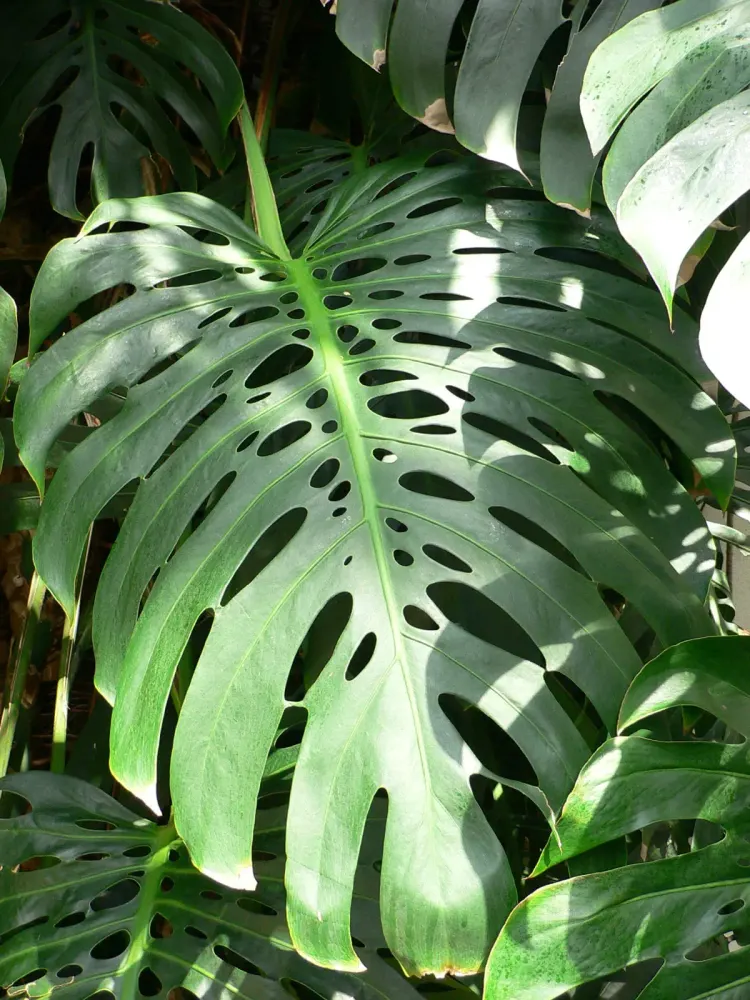
© Raul654 · CC BY-SA 3.0 · Commons
Swiss cheese plant
Caution🐾Fensterblatt · (Monstera deliciosa)
Arum family (Araceae)
Description
Monstera deliciosa, commonly known as the Swiss cheese plant, is a species in the arum family Araceae, native to the tropical rainforests of Central America and Mexico. It is widely recognised for its large, deeply lobed leaves with distinctive natural perforations, which give the plant its popular English name. Because Monstera deliciosa is not frost-hardy and cannot survive outdoor winters in Central Europe or Bulgaria, it can only be grown as a houseplant in these regions.
- RawWhole plantExternalFolk medicine
Monstera deliciosa is one of the most popular tropical houseplants worldwide. Its large, glossy leaves with characteristic holes (fenestrations) and slits give living spaces a jungle-like atmosphere. Since the rise of social media, the plant has become an icon of the urban-jungle and biophilic-design trends and is widely used to enhance interior aesthetics and support wellbeing.
[#src_wiki_de_monstera] [#src_wiki_en_monstera] [#src_mobot_monstera]
- RawWhole plantExternalFolk medicine
Monstera deliciosa is regarded as a particularly low-maintenance houseplant: it tolerates partial shade, forgives irregular watering, and grows reliably even at standard indoor humidity. This resilience makes it an ideal beginner plant for homes, offices, and public interiors.
[#src_mobot_monstera] [#src_rhs_monstera] [#src_wiki_en_monstera]
- RawWhole plantExternalFolk medicine
Like many large-leaved tropical plants, Monstera deliciosa can release water vapour indoors and trap dust on its leaf surfaces. A specific uptake of individual indoor pollutants by Monstera deliciosa is NOT documented in the NASA Clean Air Study; its contribution to indoor air should therefore be understood as general and not as therapeutic air purification.
- RawFruitInternalFolk medicine
In its native range (Mexico, Central America), the fully ripe fruit of Monstera deliciosa is traditionally eaten. The ripe inflorescence/fruit (spadix) develops after 12 to 14 months a soft, pineapple- to banana-flavoured pulp — the epithet deliciosa (delicious) refers to this culinary use. CAUTION: only the fully ripe fruit; unripe fruit and all other plant parts contain irritating calcium oxalate raphides.
[#src_wiki_en_monstera] [#src_wiki_de_monstera] [#src_powo_monstera]
- RawWhole plantExternalFolk medicine
Monstera deliciosa is deliberately used in indoor-plant and biophilic-design concepts to make interiors greener and more inviting. The presence of large green plants is popularly associated with stress reduction and wellbeing; specific clinical effects of individual species are however not established.
- RawLeafExternalFolk medicine
WARNING (not a use, but a safety notice): All parts of Monstera deliciosa except the fully ripe fruit contain insoluble calcium oxalate raphides. On contact with the oral or gastrointestinal mucosa they cause mechanical irritation, burning, salivation, and swelling. Keep the plant out of reach of children and pets.
🪴 Grow at home
- ☀ Light
- bright, indirect
- 💧 Water
- weekly
- 🌱 Soil
- Well-draining potting compost mixed with perlite or coarse sand
- 🪴 Pot
- 30 cm
- ⭐ Difficulty
- ★★☆ intermediate
- 🐾 Pets
- toxic to pets
Tips:
- Monstera deliciosa is not frost-hardy and in Central Europe and Bulgaria can only be grown as a houseplant — temperatures below 10 °C damage the plant.
- Bright, indirect light encourages the characteristic leaf perforations — direct midday sun scorches the leaves.
- Do not remove aerial roots — they can be guided into the soil and supply the plant with additional nutrients.
- Regular misting increases humidity and maintains the plant's tropical character.
- Fertilise every 4–6 weeks during the growing season (spring/summer).
Care tips are general indoor-gardening recommendations, not scientific sources.