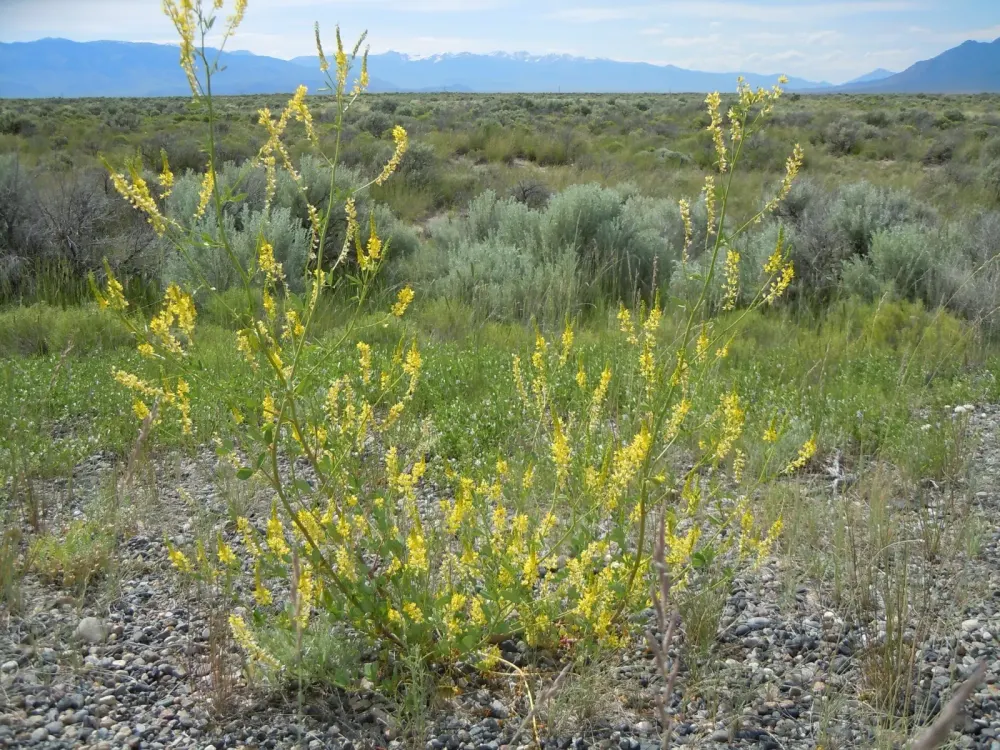
© Unknown (see Commons) · See Commons file page · Commons
Melilotus officinalis
CautionGelber Steinklee · (Melilotus officinalis)
Legume family (Fabaceae)
Description
Dried, yellow sweet clover develops a distinctive scent reminiscent of freshly cut hay — caused by coumarin, which makes up nearly one percent of the flowering spikes of this legume-family plant. That very compound is what makes the flowering herb a recognised remedy for vein health: Kommission E gives a positive assessment for chronic venous insufficiency, with its heaviness, pain and nocturnal calf cramps. Externally, salves are used for haemorrhoids and varicose veins, compresses are traditionally applied to bruises, sprains and local swelling, and a sitz bath is used in folk medicine for haemorrhoids and pelvic lymphatic congestion. Safety depends heavily on the quality of the raw material: only correctly dried sweet clover from a controlled source should be used, since spoiled, fermented or mouldy material forms dicoumarol, a potent anticoagulant with a bleeding risk. Overdose can cause headache, nausea and liver strain; sweet clover should be avoided by anyone with existing liver disease.
Critical drug interactions with:
Antikoagulantien (Warfarin, Phenprocoumon, DOAKs wie Apixaban/Rivaroxaban)
Chronic venous insufficiency (CVI): heaviness, pain, nocturnal leg cramps, itching, swelling of the legs
Preparation & dosage
Haemorrhoidal complaints and varicose veins (topical salve)
Preparation & dosage
Local oedema, contusions, sprains, superficial haematomas (compress)
Preparation & dosage
Haemorrhoids, pelvic lymphatic congestion (sitz bath)
Preparation & dosage
Lymphatic congestion, supportive in thrombophlebitis and post-thrombotic syndrome (tincture, internal)
Preparation & dosage
Mild skin inflammation, poorly healing wounds (compress/wash)
Preparation & dosage
Coumarin risk: overdose may cause headache, nausea, dizziness, liver stress. USE ONLY PROPERLY DRIED material from controlled pharmacy sources — spoiled (fermented/mouldy) sweet clover forms dicoumarol (potent anticoagulant, bleeding risk). Avoid in pre-existing liver disease.
⏱ Max continuous use: 2 weeks
-
-
-
Drug interactions
Antikoagulantien (Warfarin, Phenprocoumon, DOAKs wie Apixaban/Rivaroxaban)
Coumarin and especially dicoumarol from spoiled material potentiate anticoagulation, increased bleeding risk
Thrombozytenaggregationshemmer (ASS, Clopidogrel)
Possible additive bleeding tendency
Hepatotoxische Arzneimittel (Paracetamol in hoher Dosis, Methotrexat)
Coumarin may increase liver stress, combine cautiously
Contraindications
- Known liver disease; concurrent anticoagulant therapy without medical supervision; pregnancy and lactation (coumarin content); children under 12 years; discontinue 2 weeks before planned surgery
Harvested part: flowering herb
- CumarinPhenolic acidContent: 0,4-0,9 %
Main active compound, formed during drying from melilotoside (o-coumaric acid glycoside), responsible for typical hay scent and vascular effects
- Melilotosid (o-Cumarsäure-Glykosid)Glycoside
Precursor of coumarin in the fresh plant, enzymatically cleaved during drying
- MelilotigeninSaponin
Triterpene saponin aglycone, contributes to anti-inflammatory and vascular effects
- Flavonoide (Kämpferol- und Quercetin-Glykoside)Flavonoid
Increase capillary resistance, reduce vascular permeability, antioxidant
- Hydroxyzimtsäure-Derivate (o-Cumarsäure, Melilotsäure)Phenolic acid
Phenolic acids with mild antiseptic and anti-inflammatory effect
- TriterpensaponineSaponin
Support lymph flow and venous drainage
- SchleimstoffeMucilage
Demulcent component, relevant for topical use on irritated skin
- [1]MonographEuropean Union herbal monograph on Melilotus officinalis (L.) Lam., herba (HMPC)(accessed: 2026-05-19)
- [2]MonographKommission E Monographie: Meliloti herba (Steinkleekraut)(accessed: 2026-05-19)
- [3]WikipediaMelilotus officinalis - Plants For A Future(accessed: 2026-05-19)
- [4]WikipediaSteinklee - Arzneipflanzen-Lexikon(accessed: 2026-05-19)
- [5]WikipediaMeliloti herba - Altmeyers Encyclopedia Phytotherapy(accessed: 2026-05-19)
- [6]WikipediaSteinklee (Melilotus officinalis) - Wirkung(accessed: 2026-05-19)
- [7]WikipediaTherapeutika - Melilotus officinalis(accessed: 2026-05-19)
- [8]WikipediaSweet Clover Monograph - Erika Larsen Clinical Herbalist(accessed: 2026-05-19)