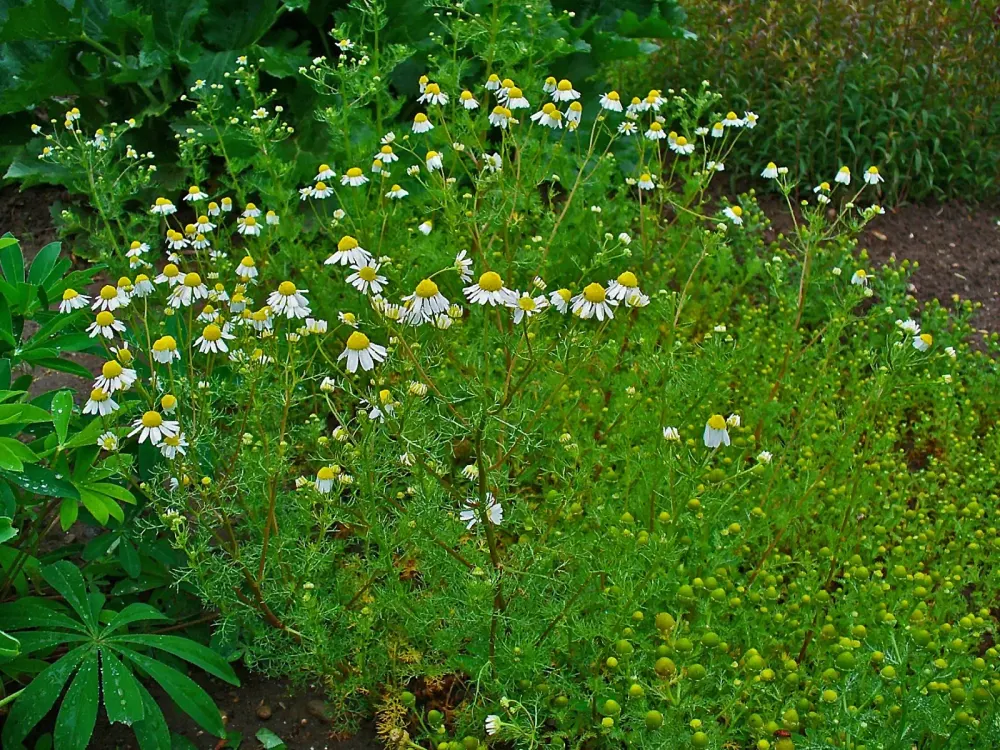
© H. Zell · CC BY-SA 3.0 · Commons
Matricaria chamomilla
CautionEchte Kamille · (Matricaria chamomilla)
Daisy family (Asteraceae)
Description
German chamomile is one of Central Europe's best-known medicinal plants, recognisable by its hollow, dome-shaped flower head — the feature that separates it from look-alike daisies. The part used are the flowers, gathered in early summer (May to August). Its essential oil, rich in (−)-α-bisabolol, is associated with anti-inflammatory and antispasmodic properties; this is the basis for the traditional use in digestive complaints and mild inflammation described in the EMA and Commission E monographs. As a member of the daisy family, chamomile can provoke reactions in people allergic to mugwort, chrysanthemum or ragweed, so first-time users should test their tolerance first.
Classic chamomile tea (Kommission E positive) for gastrointestinal spasms, gastritis and inflammatory disorders of the digestive tract.
Preparation & dosage
INFUSION (Kommission E indication): 3–5 g dried, comminuted chamomile flowers (Matricariae flos) in 150 ml boiling water, covered, steep 5–10 min, strain. 3–4× daily freshly prepared, preferably between meals, drunk hot. Daily dose 9–15 g. Indication: gastrointestinal spasms and inflammatory disorders of the GI tract, gastritis, irritable stomach. Effect usually within 1–2 days; consult a doctor if symptoms persist beyond 2 weeks. Children 6–12 yrs: 1.5–3 g; 2–6 yrs: 1–1.5 g.
- Dry amount
- 3–5 g
- Doses per day
- 3×
- Max duration
- 2 weeks
⚠ Age restriction: ≥ 2 years — Children from 2 years with age-appropriate dose. Under 6 months only on medical advice.
Traditional chamomile tincture for nervous gastric complaints and IBS symptoms — alternative to tea when ethanol is acceptable.
Preparation & dosage
TINCTURE (DER 1:5 in 40–70 % ethanol): 1–3 ml (~20–60 drops) diluted in water, 3× daily before or between meals. Traditional use for nervous gastric complaints, IBS symptoms and mild anxiety. Due to ethanol content: not for pregnancy, lactation, alcohol dependence, or liver disease. Consult a doctor if no improvement after 4 weeks.
- Liquid amount
- 1–3 ml
- Doses per day
- 3×
- Max duration
- 4 weeks
⚠ Age restriction: ≥ 18 years — Tincture for adults only due to ethanol content.
Blue chamomile essential oil (rich in chamazulene and alpha-bisabolol oxides) — anti-inflammatory and skin-soothing externally; Kommission E positive for skin and mucous membrane inflammations.
Preparation & dosage
ESSENTIAL OIL (Blue chamomile oil): dilute 1–2 drops of blue chamomile oil (Matricariae aetheroleum) in 10 ml carrier oil (e.g. almond, jojoba) to a 1–2 % solution. Apply externally to affected skin or joints, massage gently. For inhalation: 1–2 drops in steam inhaler or aroma diffuser. Deep blue colour (from chamazulene) fades with heat — do not overheat. Store in dark airtight bottle below 20 °C; shelf life after opening ~6–12 months. Do NOT apply undiluted to skin.
External full bath or sitz bath for inflammatory skin and mucous membrane disorders, eczema, vulvitis, haemorrhoids — Kommission E positive.
Preparation & dosage
FULL BATH / SITZ BATH (Kommission E, skin-mucosa indication): 50–100 g dried chamomile flowers as infusion (10 min, strain), added to bath water. Bath temperature 35–38 °C, duration 10–15 min; once daily. Sitz bath: smaller amount (20–30 g per 5 L) for perineal area, haemorrhoids, anal fistulae, gynaecological inflammation. CONTRAINDICATION (full bath): open wounds, acute skin disease, high fever, severe infections, cardiac insufficiency. Rest briefly after bathing.
- Dry amount
- 50–100 g
- Doses per day
- 1×
- Max duration
- 2 weeks
Chamomile compress for poorly healing wounds, boils and superficial skin injuries — anti-inflammatory and wound-healing via chamazulene and alpha-bisabolol.
Preparation & dosage
COMPRESS / POULTICE: 3–10 g dried chamomile flowers in 200 ml boiling water, covered, steep 10 min, strain, cool to drinkable temperature. Soak a clean linen cloth, wring lightly, apply to affected skin area; leave for 15–20 min. 2–3× daily. Indications: poorly healing wounds, boils, superficial injuries, mild skin irritation. Moist heat enhances the effect. Do not use compress on wounds showing signs of deep infection (redness, swelling, pus, fever) — consult a doctor.
- Dry amount
- 3–10 g
- Doses per day
- 3×
- Max duration
- 2 weeks
Chamomile mouthwash or gargle for aphthae, gingivitis and mild throat inflammation — positively assessed by Commission E; traditional use per the EMA monograph.
Preparation & dosage
MOUTHWASH / GARGLE (Commission E): 3–5 g comminuted chamomile flowers in 150 ml boiling water, steep 5–10 min, strain, cool to warm temperature. Use 3–4× daily as mouthwash or gargle — swill for 30–60 seconds, do not swallow. Indication: aphthae, gingivitis, stomatitis, mild throat inflammation. Children under 12: only with supervision and if safe spitting is assured. Consult a dentist or doctor if symptoms persist beyond 7 days.
- Dry amount
- 3–5 g
- Doses per day
- 4×
- Max duration
- 1 weeks
⚠ Age restriction: ≥ 6 years — Gargling not recommended under age 6 due to aspiration risk; 6–12 yrs only under supervision.
Traditional steam inhalation with chamomile flowers or blue chamomile oil for catarrhal complaints of the upper airways — anti-inflammatory and mucosa-soothing.
Preparation & dosage
STEAM INHALATION: 5–10 g dried chamomile flowers in a bowl, pour ~1 litre boiling water, let steep 2–3 min. Lean head over bowl, drape towel over head and bowl. Breathe slowly and deeply for 5–10 min. 1–2× daily for cold symptoms, catarrhal complaints of the upper airways, and sinusitis. Alternatively: 2–3 drops of blue chamomile essential oil instead of herb. Children under 6: steam inhalation NOT recommended (scalding risk, too intense). 6–12 yrs: only under supervision.
- Dry amount
- 5–10 g
- Doses per day
- 2×
- Max duration
- 1 weeks
Traditional chamomile salve or cream for inflammatory skin conditions, atopic eczema flares, wound healing and dry skin — alpha-bisabolol as key active compound.
Preparation & dosage
CHAMOMILE SALVE / CREAM: commercial chamomile creams or ointments (standardised to alpha-bisabolol ≥0.5 % or chamazulene) applied thinly to affected skin areas, 2–3× daily. Home preparation: steep 50 g dried flowers in 200 ml olive oil at 50 °C for 2–3 h in a water bath (maceration), strain and thicken with 10 g beeswax. Indications: mild atopic eczema flares, contact dermatitis, dry cracked skin, chickenpox itch, sunburn. Avoid eye area — eye baths only under strict hygiene with sterile-filtered infusion.
IMPORTANT: Hypersensitivity reactions are possible in Asteraceae — test skin tolerance on a small area before first use. Do NOT use with known allergy to chamomile, mugwort, chrysanthemums, ragweed or other Asteraceae — cross-reactivity possible. Eye baths only under strict hygiene with sterile-filtered infusion; contamination risk. Chamomile does NOT treat the underlying condition — consult a doctor if complaints persist beyond 1–2 weeks without improvement. Full baths are contraindicated for open wounds, acute skin disease, high fever, severe infections and heart failure. Never apply essential oil undiluted.
Tea from comminuted herbal substance: per EMA used under traditional use during pregnancy — however, caution advised due to lack of systematic safety data; avoid high therapeutic doses. Essential oil and tincture not recommended in pregnancy. Occasional cups of tea considered uncritical. Consult a doctor if in doubt.
Tea from comminuted flowers: per EMA traditional use includes nursing women; avoid cutaneous use on nipple area (sensitisation of infant). Essential oil and tincture: not recommended due to lack of data. Occasional tea in normal amounts considered safe.
Tea from 6 months (EMA, traditional use) with age-appropriate dose. Steam inhalation not recommended under 6 years (scalding risk). Gargling not suitable under 6 years (aspiration risk). Tincture (ethanol) from 18 years only. Always consult a doctor for infants — GI complaints can be serious.
Drug interactions
Cumarin-Antikoagulanzien (Warfarin, Phenprocoumon)
Chamomile contains small amounts of natural coumarin derivatives (7-hydroxycoumarin glucosides) and flavonoids that may theoretically inhibit platelet aggregation. Potentiation of anticoagulant effect of coumarins possible with high-dose long-term use (extracts, tincture). Case reports exist. Regular INR monitoring recommended in patients on oral anticoagulation.
CYP450-Substrate (CYP1A2, CYP3A4)
In vitro and animal data suggest possible inhibition of CYP1A2 and CYP3A4 by chamomile extracts. Elevated ciclosporin levels reported in renal transplant patients on long-term high-dose chamomile. Clinical relevance at standard therapeutic dose (tea) unclear, but caution with narrow therapeutic window drugs (immunosuppressants, cytostatics, antiepileptics).
Sedativa, Anxiolytika, Benzodiazepine
Chamomile extracts may exhibit weak anxiolytic and sedative properties (GABA-A receptor modulation by apigenin). Theoretical additive effect with sedatives and benzodiazepines. Clinically low relevance with standard tea, but monitor alertness and reaction capacity with high-dose extracts (capsules).
Contraindications
- Hypersensitivity to Matricaria chamomilla or other Asteraceae/Compositae — cross-allergy possible with mugwort, ragweed, chrysanthemums.
- Full baths: open wounds, acute skin disease, high fever (above 38.5 °C), severe infections, manifest heart failure, severe circulatory weakness.
- Essential oil (undiluted): must not be applied directly to skin or mucous membranes.
- Steam inhalation under 6 years: scalding risk, excessive mucosal irritation.
Harvested part: flowers
- Time of day:
- On a dry, sunny morning (approx. 9–12), after morning dew has completely evaporated. Essential oil and active compound content (alpha-bisabolol, apigenin) are highest in the morning hours and in sunny weather. Avoid harvesting in overcast or rainy weather and after rain.
- Drying:
- HARVEST: Collect only fully opened flower heads where the white ray florets spread horizontally or are slightly bent downward — this is the optimal harvest stage for maximum active content. Avoid flowers where ray florets hang strongly downward or are browning. Cut stems as short as possible. IDENTIFICATION: Genuine chamomile receptacle is hollow (visible on cross-section) — key to distinguish from dog chamomile (solid receptacle, no scent) and scentless mayweed. DRYING: Spread flowers in a single layer on paper, cloth, or drying screens in shade, good ventilation, max. 35 °C. Not in oven above 40 °C (chamazulene loss). Turn regularly. Drying takes 3–7 days depending on humidity. Dry when flowers rustle and stems snap. Store airtight in dark jars, cool and dry — use within 12–18 months. Quality check: intense apple-like scent and bitter taste = good quality.
- Storage:
- 18 months — Airtight dark glass or metal containers, cool (below 20 °C), dry, light-protected. Use within 12–18 months. Loss of scent or browning indicates quality loss — discard.
- Time of day:
- Dry morning to midday hours in April–May when the plant is still in the rosette stage or just before flowering — for folk medicine fresh plant preparations (fresh plant tincture, fresh plant juice). For the herb (Herba Matricariae): harvest just before or at the beginning of flowering when active content in the herb is still high.
- Drying:
- WHOLE PLANT (fresh plant preparation or herb): Cut whole plant (stems, leaves, buds) close to the ground. For fresh plant tincture, process immediately (1:1 or 1:2 in 45–60 % ethanol). For herb drying: bundle or single layer at max. 40 °C, well ventilated. Dried herb is aromatic but contains less essential oil than the flowers — less used for medicinal quality, but suitable for home garden herbal teas and blends. Herb quality does not meet pharmacopoeial flower standard.
- Storage:
- 12 months — Dried herb stored airtight in the dark, use within 12 months. Fresh plant tincture stored dark and cool, shelf life 2–5 years.
- alpha-Bisabolol ((-)-alpha-Bisabolol)OtherContent: 0.1-0.5 %Flower
Main active terpenol of the essential oil — slightly floral-sweet scent. Strongly anti-inflammatory (COX-1, 5-LOX inhibition), wound-healing, antimicrobial and antipyretic. Lead marker for quality control per PhEur and EMA. Most important constituent for skin and mucosa indications.
- ChamazulenSesquiterpeneContent: 1-15 % (im EO)Flower
Formed only during steam distillation from matricine (pro-chamazulene) — responsible for the characteristic deep blue colour of the essential oil. Strongly anti-inflammatory (5-LOX inhibition, reduced histamine release), antioxidant. Responsible for the soothing effect on inflamed skin. Content highly variable depending on origin and cultivar (lower in cultivated varieties, higher in wild chamomile).
- Matricin (Prochamazulen)SesquiterpeneContent: 0.1-0.4 %Flower
Sesquiterpene lactone of the guaianolide class — direct precursor of chamazulene during steam distillation. Present as matricine in fresh herb and aqueous extracts, not as chamazulene. Has independent anti-inflammatory activity. Also pharmacologically relevant in tea infusion.
- Apigenin-7-O-glucosid (Apigenin-7-glucosid)FlavonoidContent: 0.5-1.5 %Flower
Quantitatively most important flavonoid glycoside of chamomile — hydrolysed to free apigenin. Apigenin shows anxiolytic and mildly sedative properties through partial agonism at GABA-A receptors. Antispasmodic (smooth muscle), antioxidant and antimutagenic properties in vitro. Lead marker for quality testing.
- Luteolin-7-O-glucosid und Quercetin-GlykosideFlavonoidContent: 0.1-0.5 %Flower
Accompanying flavonoids alongside apigenin — luteolin with anti-phlogistic and antihistamine effects, quercetin antiproliferative and capillary-protective. Synergistic with alpha-bisabolol and chamazulene for overall anti-inflammatory action.
- Ätherisches Öl (Matricariae aetheroleum) — GesamtölEssential oilContent: 0.4-1.5 %Flower
Total essential oil content in the drug (PhEur minimum: 0.4 %). Complex composition: alpha-bisabolol (~50 %), bisabolol oxides A and B, chamazulene (after distillation), en-in-dicycloether (spiroether), matricine. Deep blue colour of oil (from chamazulene) is a quality marker. Oil is anti-phlogistic, spasmolytic, antibacterial and wound-healing.
- Spiroether (cis- und trans-Spiroether, en-in-Dicycloäther)OtherContent: Spuren bis 0.3 %Flower
Characteristic compounds of genuine chamomile — used to differentiate from other chamomile-like species (e.g. scentless mayweed, dog chamomile). Spasmolytic and anti-inflammatory; analytically important for drug identification.
- Schleimpolysaccharide (Uronsäure-haltige Polysaccharide)MucilageContent: 1-5 %Flower
High-molecular polysaccharides composed of arabinose, xylose, galactose and glucuronic acid. Mucosa-protective and inflammation-modulating via macrophage activation. Contribute to the gastroprotective effect of the tea — complement the spasmolytic action of the essential oil.
- [1]MonographEMA/HMPC/55843/2011 — European Union herbal monograph on Matricaria recutita L. (syn. Matricaria chamomilla L.), flos (Final, 25 March 2015)(accessed: 2026-05-21)
- [2]MonographKommission E — Matricariae flos (Kamillenblüten), Monographie positiv, BAnz Nr. 228, 05.12.1984 (zuletzt aktualisiert 1990)(accessed: 2026-05-21)
- [3]MonographESCOP Monographs — Matricariae flos (Chamomile Flower), 2nd ed. incl. supplement 2009(accessed: 2026-05-21)
- [4]MonographWHO Monographs on Selected Medicinal Plants — Volume 1: Flos Matricariae (Chamomile Flower)(accessed: 2026-05-21)
- [5]BookWichtl, M. (Hrsg.) — Teedrogen und Phytopharmaka: Ein Handbuch für die Praxis auf wissenschaftlicher Grundlage, 5. Aufl., WVG Stuttgart, 2009 — Matricariae flos, S. 410–415(accessed: 2026-05-21)
Distribution in Europe
🤝 Permaculture Partners
In your garden, this plant acts as:
✨ Best symbiotic partners
- 🌿 Yarrow Classic companion-planting partner.
- 🌿 Onion Chamomile boosts onion aroma — old farming rule.
- 🌿 Garlic Chamomile strengthens garlic and deters root fungi.
- 🌿 Allium ursinum Classic companion-planting partner.
- 🌿 Calendula officinalis Classic companion-planting partner.
- 🌿 Cucurbita pepo Chamomile strengthens squash growth (classic companion).
- 🌿 Peppermint Chamomile enhances mint aroma — Holzer favourite pair.
- 🌿 Oregano Classic companion-planting partner.
- 🌿 Salvia officinalis Classic companion-planting partner.
- 🌿 Tanacetum parthenium Classic companion-planting partner.
- 🌿 Thymus vulgaris Classic companion-planting partner.
- 🌿 Tropaeolum majus Classic companion-planting partner.
- 🌿 Urtica dioica Nettle slurry strengthens chamomile and many other herbs.
Source: Helga und Margarete Langerhorst, Mein gesunder Naturgarten (eigene Kuration)