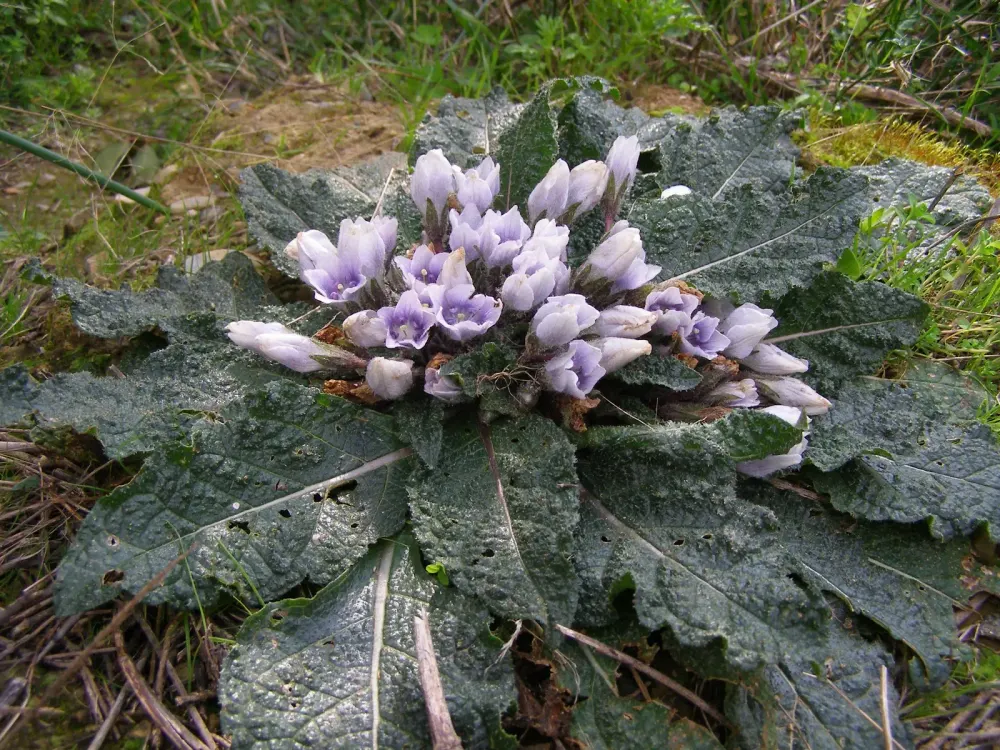
© Frente · CC BY-SA 2.0 de · Commons
Mandragora officinarum
Toxic🐾Gemeine Alraune · (Mandragora officinarum)
Nightshade family (Solanaceae)
Description
Mandragora officinarum is the type species of the plant genus Mandragora in the nightshade family Solanaceae. It is often known as mandrake, although this name is also used for other plants. As of 2015, sources differed significantly in the species they use for Mandragora plants native to the Mediterranean region.
🌿 Risk of confusion — read before wild-harvesting!
Symptoms: dry mouth, mydriasis, tachycardia, flushed skin, urinary retention, hallucinations, confusion, seizures, coma, death by central respiratory paralysis.
External use only!
This plant must NOT be taken internally. Use only as compress, salve, or bath.
CONTRAINDICATED during pregnancy
Tropane alkaloids (atropine, scopolamine, hyoscyamine) cross the placental barrier and can trigger fetal tachycardia and central nervous system damage. Dioscorides historically noted an abortifacient effect. Any use during pregnancy is absolutely contraindicated.
CONTRAINDICATED during breastfeeding
Atropine and scopolamine pass into breast milk and can cause anticholinergic effects in the infant (tachycardia, dry mouth, fever, restlessness). Breastfeeding: strictly contraindicated.
CONTRAINDICATED for children
Children are extremely sensitive to tropane alkaloids; even small amounts of root can cause fatal poisoning. The forked, often human-shaped root and the orange berries are visually attractive. No use in children and adolescents under 18 years.
Critical drug interactions with:
Anticholinergika (Tiotropium, Ipratropium, Oxybutynin, Glycopyrrolat) · Trizyklische Antidepressiva (Amitriptylin, Imipramin, Clomipramin) · MAO-Hemmer (Phenelzin, Tranylcypromin, Selegilin, Moclobemid) · Cholinesterase-Hemmer (Donepezil, Rivastigmin, Galantamin, Pyridostigmin)
- SalveRootExternalFolk medicine
External application: Grated mandrake root juice or salves were applied for rheumatic pain and chronic skin ulcers in antiquity and the Middle Ages. PFAF documents this topical use. No longer practised today due to transdermal tropane alkaloid absorption and skin irritation.
Preparation & dosage
[#src_pfaf_mandragora_officinarum] [#src_wp_en_mandragora_officinarum]
- TinctureRootExternalFolk medicine
Magical-ritual use: Carved forked roots, called 'Alraun(männlein)' in the German-speaking world, were kept as anthropomorphic protective figurines. Theophrastus prescribed drawing three sword-circles around the root; Flavius Josephus documented tying a dog to it for extraction — folk belief held the root's 'scream' to be lethal. Pure cultural history, no medicinal application.
Preparation & dosage
[#src_wp_mandrake_mandragora_officinarum] [#src_wp_de_mandragora_officinarum] [#src_pfaf_mandragora_officinarum]
Historical documentation only — do NOT use
These internal applications are historically documented. This plant is highly toxic — self-treatment can cause severe poisoning or death. For documentation only, explicitly NOT a recommendation.
- TinctureRootInternalTraditional use
Ancient anaesthesia: Dioscorides in 'De Materia Medica' (1st century AD) described administering a cyathus (~45 ml) of mandrake root decoction before surgery to induce unconsciousness and analgesia. Pliny the Elder (Naturalis Historia) also documented the narcotic action. This historical pre-surgical use is today completely replaced by modern anaesthetics.
Preparation & dosage
[#src_wp_en_mandragora_officinarum] [#src_wp_mandrake_mandragora_officinarum] [#src_pfaf_mandragora_officinarum]
- RawRootInternalFolk medicine
Medieval use against melancholy, convulsions, and mania. In large doses the mandrake root was reported to induce delirium and 'madness'. Owing to extreme tropane alkaloid toxicity (atropine, scopolamine, hyoscyamine) it is obsolete today; of cultural and pharmacy-historical interest only.
Preparation & dosage
[#src_wp_en_mandragora_officinarum] [#src_pfaf_mandragora_officinarum]
- RawRootInternalFolk medicine
Biblical and folk fertility interpretation: Genesis 30:14–16 recounts how Reuben finds mandrakes in the field and Leah barters them with Rachel for a night with Jacob — the plant was regarded as a remedy for infertility. Dioscorides additionally noted an abortifacient effect. Neither application has any modern pharmacological evidence and both are strictly avoided due to extreme toxicity.
Preparation & dosage
[#src_wp_mandrake_mandragora_officinarum] [#src_pfaf_mandragora_officinarum]
- TinctureRootInternalFolk medicine
Homoeopathic use: Mandragora officinarum is applied in homoeopathy (D6–D30) for restlessness, sleep disorders, and nervous exhaustion. Highly diluted homoeopathic preparations contain no pharmacologically active alkaloid amounts. Home preparation from plant material is strictly prohibited due to toxicity.
Preparation & dosage
[#src_wp_de_mandragora_officinarum] [#src_wikidata_mandragora_officinarum]