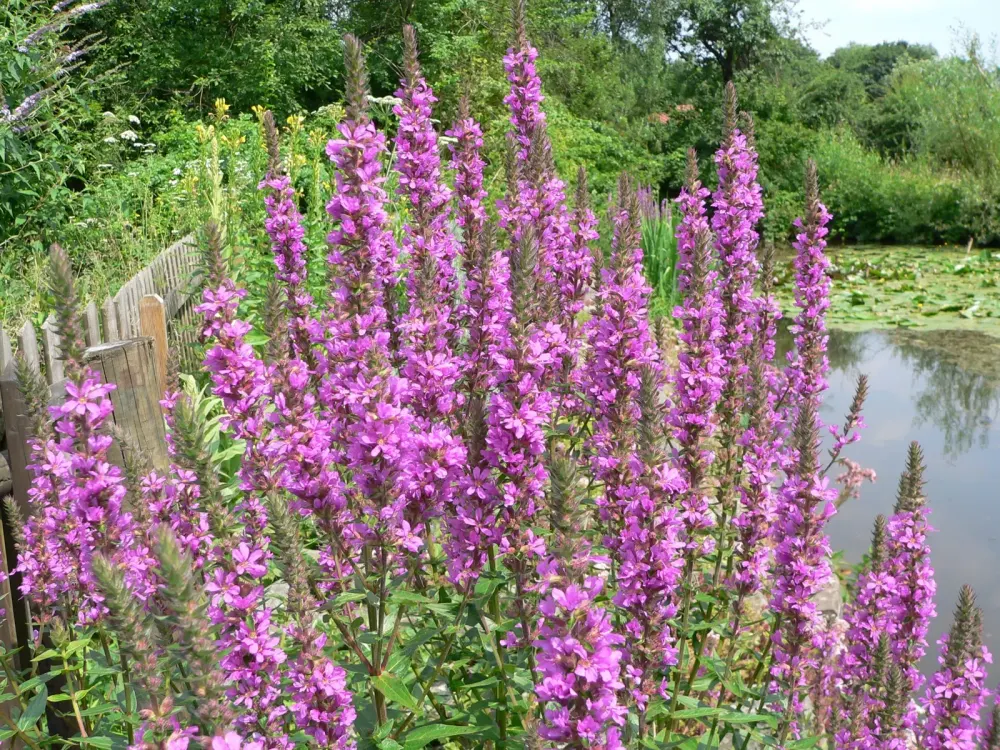
© BS Thurner Hof · CC BY-SA 3.0 · Commons
Lythrum salicaria
Gewöhnlicher Blutweiderich · (Lythrum salicaria)
Loosestrife family (Lythraceae)
Description
Lythrum salicaria or purple-loosestrife is a flowering plant belonging to the family Lythraceae. It should not be confused with other plants sharing the name loosestrife that are members of the genus Lysimachia in the family Primulaceae. This herbaceous perennial plant is native to temperate regions of Europe, Asia, northern Africa, and eastern Australia.
- TeaAerial partsInternalTraditional use
Tea from the flowering herb (decoction or infusion) is used in folk medicine for diarrhoea and dysentery. The high tannin content (up to 14 % in flowers) acts astringently on the intestinal mucosa, reducing secretion.
Preparation & dosage
Pour 250 ml of hot water over 2–4 g of dried herb, steep for 10 minutes, strain; 2–3 times daily.
- Dry amount
- 2–4 g
- Doses per day
- 3×
[#src_wiki_de_lythrum] [#src_pfaf_lythrum] [#src_review_piwowarski]
- TeaRootInternalFolk medicine
Decoction of the root (1–3 g per 250 ml water) was traditionally used for dysentery and haemorrhage, as reported already by Dioscorides. The root contains approx. 9 % tannins.
Preparation & dosage
Simmer 1–3 g root in 250 ml water for 15 minutes, strain.
- Dry amount
- 1–3 g
- Doses per day
- 3×
[#src_wiki_de_lythrum] [#src_kings_henriettes_lythrum] [#src_review_piwowarski]
- CompressAerial partsExternalFolk medicine
Compresses soaked in a strong tea from the flowering herb were applied externally to wounds, ulcers, eczema, and skin infections (impetigo). The astringent and antimicrobial action supports wound healing.
- GargleAerial partsExternalFolk medicine
Gargling with purple loosestrife tea was used for sore throats and pharyngitis. Tannins constrict mucous membranes and reduce inflammatory irritation.
- TeaAerial partsInternalFolk medicine
Purple loosestrife tea was traditionally used for excessive menstrual bleeding. The styptic (haemostatic) properties are attributed to the high tannin and flavonoid content.
- BathAerial partsExternalFolk medicine
Sitz baths or local baths with purple loosestrife extract were used in folk medicine for vaginal problems (leucorrhoea) and perianal complaints. PFAF also notes application for eczema.
- TinctureAerial partsInternalFolk medicine
Tincture of the flowering herb is used in contemporary herbal medicine as a concentrated tannin preparation — internally for irritable bowel complaints, externally as an antiseptic compress.