Legal notice
In the United States, peyote and mescaline are Schedule I controlled substances; the species is also protected (CITES Appendix II).
Non-drug use in bona fide religious ceremonies of the Native American Church is exempt in the USA (21 CFR 1307.31). Legal status varies by country.
For education and documentation only. Not a consumption guide, not legal or medical advice. Possession, cultivation and use are regulated differently by country and species — check the law that applies to you.
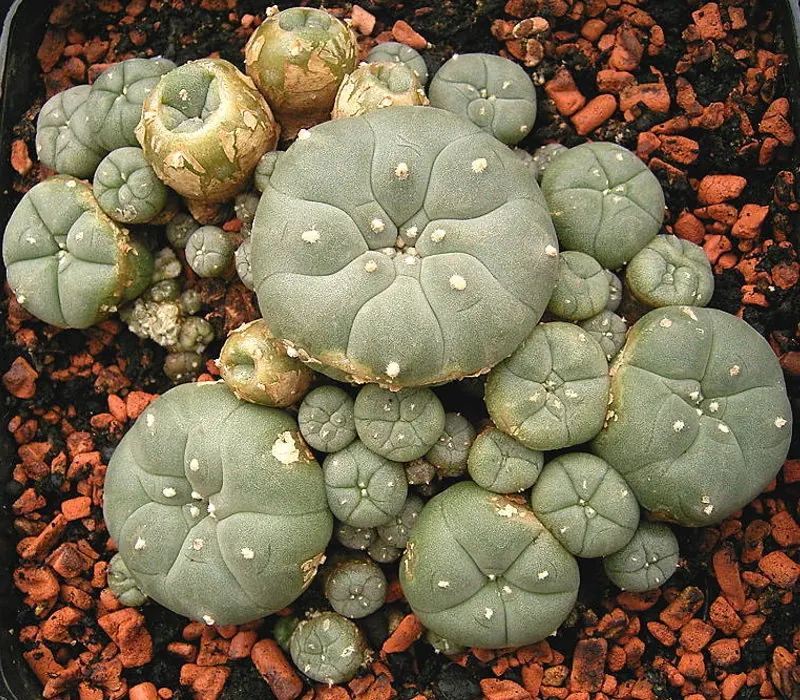
© Frank Vincentz · CC BY-SA 3.0 · Commons
Peyote
CautionPeyote · (Lophophora williamsii)
Cactus family (Cactaceae)
Description
Lophophora williamsii is a small, globular, spineless cactus with a blue-green surface, usually only 2–7 cm tall and 4–12 cm wide. The above-ground crown sits on a turnip-like root and bears small pink to white flowers. The species grows very slowly and occurs in desert scrub and limestone areas of the Chihuahuan Desert in northern Mexico and south Texas. It has held cultural significance for Indigenous peoples for millennia. Its principal active compound is the alkaloid mescaline.
- RawWhole plantInternalTraditional use
The cactus has been used ceremonially by Indigenous peoples for millennia; in the United States, ritual use by members of the Native American Church is legally protected. Its active compound is the hallucinogenic alkaloid mescaline. Cultural-historical information only.