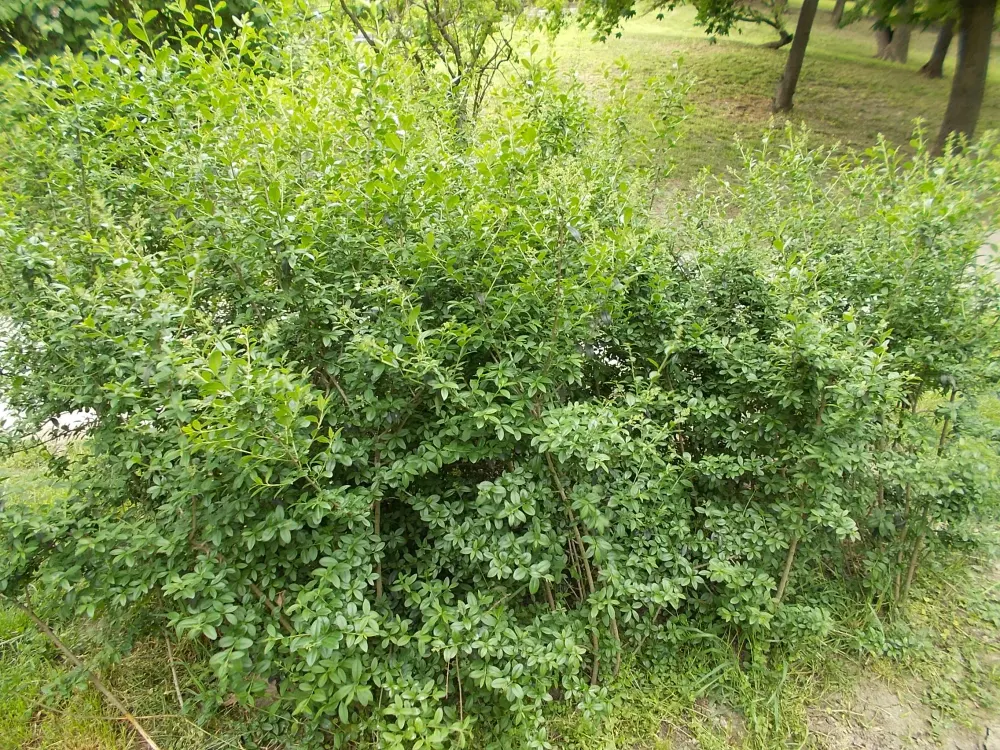
© Globetrotter19 · CC BY-SA 3.0 · Commons
Ligustrum vulgare
Toxic🐾Gewöhnlicher Liguster · (Ligustrum vulgare)
Olive family (Oleaceae)
Description
Ligustrum vulgare is a species of Ligustrum native to central and southern Europe, north Africa and southwestern Asia, from Ireland and southwestern Sweden south to Morocco, and east to Poland and northwestern Iran.
🌿 Risk of confusion — read before wild-harvesting!
TOXIC — berries and leaves. The black, glossy berries of common privet contain secoiridoid glycosides (ligustroside, oleuropein, syringoside, ligustaloside A) and are one of the most frequent plant poisonings in children in central European gardens. As few as 6-10 berries can cause vomiting, abdominal pain, diarrhoea, dizziness and circulatory problems. For consumption of larger quantities: IMMEDIATELY contact poison control. Also toxic to dogs, cats, horses and ruminants. Do not confuse with edible elderberry (Sambucus nigra) or aronia — privet berries hang upright in loose panicles, elderberries in pendulous umbels.
External use only!
This plant must NOT be taken internally. Use only as compress, salve, or bath.
CONTRAINDICATED during pregnancy
No internal use of privet preparations during pregnancy. Safe use during pregnancy is not established; berries are toxic in any case. External use as gargle only with strict avoidance of swallowing.
CONTRAINDICATED during breastfeeding
No internal use during breastfeeding. Data on the transfer of iridoid glycosides into breast milk is lacking; contraindicated due to toxicity.
CONTRAINDICATED for children
Children are particularly sensitive to the berry toxins. The glossy black berries are attractive to children and are regularly seen in emergency departments. Mark plants in family gardens, educate children about the danger, and seek immediate medical help on suspicion of consumption. No privet preparations in children under 12 years — not even as gargle.
- GargleLeafExternalFolk medicine
Folk medicinal use of an infusion of privet leaves as astringent gargle for mouth and throat inflammation. The iridoid glycosides and tannins it contains act constrictively on inflamed mucous membranes. Mouth rinse only, do not swallow — berries and leaves are toxic internally.
Preparation & dosage
Pour boiling water over 1-2 g of dried leaves, steep for 10 minutes, strain and let cool. Gargle only, do not swallow. Limit use to a few days.
- Dry amount
- 1–2 g
- Doses per day
- 3×
[#src_wp_de_ligustrum_vulgare] [#src_pfaf_ligustrum_vulgare]
- CompressLeafExternalFolk medicine
External use of a leaf decoction as compress for minor skin irritations, superficial wounds and inflamed areas. Astringent action of the tannins; purely traditional use without clinical evidence.
Preparation & dosage
Simmer 5-10 g dried leaves in 500 ml water for 15 minutes, strain, soak a clean cloth and apply to the affected area. External use only.
- Dry amount
- 5–10 g
[#src_pfaf_ligustrum_vulgare] [#src_wp_en_ligustrum_vulgare]
- RawFruitExternalFolk medicine
Historical dye use: a violet to bluish dye for inks, textiles and watercolours was traditionally extracted from the ripe, black glossy berries. Ethnobotanical, non-medicinal use. Berries remain toxic — no consumption.
Preparation & dosage
[#src_wp_de_ligustrum_vulgare] [#src_pfaf_ligustrum_vulgare]
- RawFlowerExternalTraditional use
Bee forage: the strongly scented white privet flower panicles appear from May to July and provide nectar and pollen for honey bees and wild bees. The resulting honey has a strongly bitter taste and is rarely harvested as a single-source variety; ecologically important forage plant in hedges.
Preparation & dosage
[#src_wp_de_ligustrum_vulgare] [#src_wp_en_ligustrum_vulgare]
- RawWhole plantExternalTraditional use
Classic hedge plant for privacy and noise screening in gardens and parks. Tolerant of pruning, dense growth habit; semi-evergreen in mild winters. Main ornamental use; ethnobotanically named 'Zaunriegel' (fence bar) and 'Rainweide' (field-edge willow).
Preparation & dosage
[#src_wp_de_ligustrum_vulgare] [#src_pfaf_ligustrum_vulgare]
- RawBarkExternalFolk medicine
Historical use of the tough privet twigs for basketry, ties and simple tools. The old German name 'Beinholz' (bone-wood) refers to the processing of the wood into turnery and small utility items. Ethnobotanical, non-medicinal use.
Preparation & dosage
[#src_wp_de_ligustrum_vulgare] [#src_wikidata_ligustrum_vulgare]