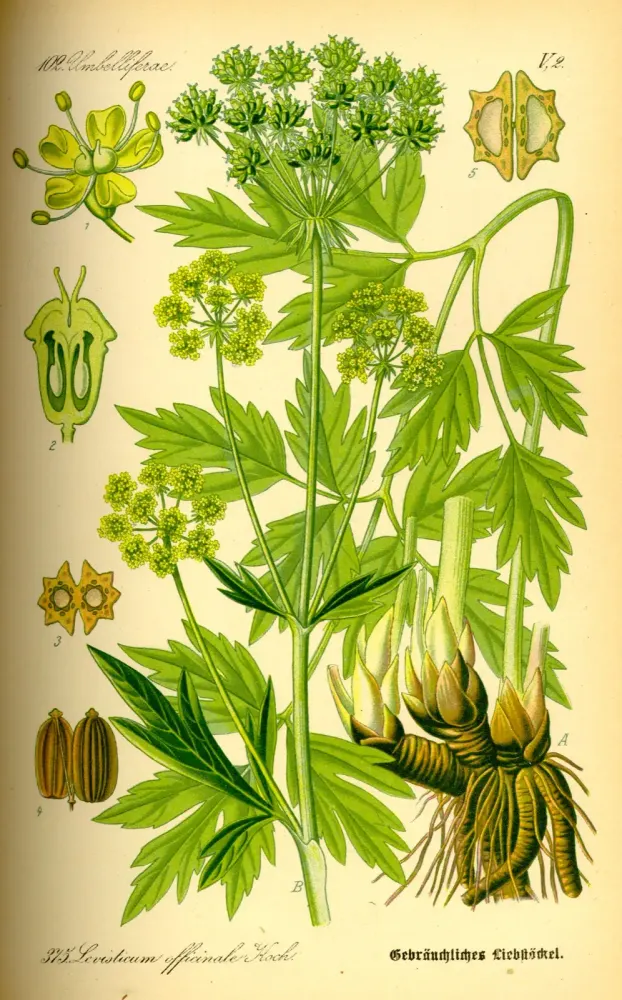
© Unknown (see Commons) · Public domain · Commons
Lovage
CautionLiebstöckel · (Levisticum officinale)
Carrot family (Apiaceae)
Description
Lovage is a perennial plant, the sole species in the genus Levisticum in the family Apiaceae, subfamily Apioideae. It is native to Afghanistan and Iran.
CONTRAINDICATED during pregnancy
Lovage root is CONTRAINDICATED in pregnancy. The essential oil and furanocoumarins may have uterus-stimulating effects (emmenagogue and potentially abortive action of the root is recorded in tradition). EMA/HMPC: not recommended in pregnancy. Culinary use of small amounts of leaf is considered safe, but therapeutic doses of the root must be avoided.
- TeaRootInternalCommission E
Traditional lovage root tea for irrigation therapy of mild urinary tract complaints and prevention of urinary gravel — positively assessed by Kommission E and EMA.
Preparation & dosage
INFUSION (Kommission E / EMA standard use): 2–3 g (approx. 1 tsp) of coarsely cut, dried lovage root (Radix Levistici) in 250 ml boiling water, covered, steep 15 min, strain. Drink 3× daily, fresh, at or between meals. Drink plenty of fluid (min. 1.5–2 l/day) — irrigation therapy requires adequate diuresis. INDICATION (Kommission E positive, EMA traditional use): irrigation therapy of the efferent urinary tract for mild urinary complaints; adjunctive prevention of urinary gravel. CONTRAINDICATION: kidney diseases with oedema formation, cardiac insufficiency with fluid retention — irrigation therapy is then not applicable. Self-medication for max. 4 weeks without medical supervision.
- Dry amount
- 2–3 g
- Doses per day
- 3×
- Max duration
- 4 weeks
⚠ Age restriction: ≥ 18 years — Per EMA/HMPC for adults only — insufficient data for children and adolescents under 18.
[#src_ema_levistici_radix] [#src_kommission_e_levisticum] [#src_escop_levistici_radix]
- TinctureRootInternalTraditional use
Traditional lovage root tincture for mild urinary tract and dyspeptic complaints — alternative to the infusion when ethanol is acceptable.
Preparation & dosage
TINCTURE (DER 1:5 in 60–70 % ethanol): 1–2 ml (~20–40 drops) 3× daily, diluted in water, with meals. Drink plenty of fluid concurrently (min. 1.5–2 l/day) — irrigation effect requires adequate urine output. Traditional use for spasmodic urinary tract complaints and dyspeptic complaints (flatulence, bloating). Not for use in pregnancy or with inflamed kidneys. Due to ethanol content, not for alcohol dependence or liver disease.
- Liquid amount
- 1–2 ml
- Doses per day
- 3×
- Max duration
- 4 weeks
⚠ Age restriction: ≥ 18 years — Adults only. Ethanol content excludes children, pregnant women, those with liver disease and those with alcohol dependency.
[#src_escop_levistici_radix] [#src_wichtl_teedrogen] [#src_ema_levistici_radix]
- TeaRootInternalTraditional use
Traditional lovage root tea for dyspeptic complaints — bitter compound and essential oil activity supports digestion and relieves spasms.
Preparation & dosage
DIGESTIVE TEA: 1.5–3 g dried lovage root in 200 ml boiling water, covered, steep 10 min, strain. 3× daily, 1 cup after meals. Traditional use for digestive complaints with flatulence, bloating and spasmodic gastrointestinal discomfort (dyspeptic syndrome). Bitter compounds and essential oil stimulate gastric and biliary secretions and exert spasmolytic action. Persistent complaints over 3 weeks: seek medical evaluation.
- Dry amount
- 1.5–3 g
- Doses per day
- 3×
- Max duration
- 3 weeks
[#src_kommission_e_levisticum] [#src_wichtl_teedrogen] [#src_escop_levistici_radix]
- BathRootExternalFolk medicine
Folk lovage bath for tired legs and circulatory complaints — caution: phototoxic risk from furanocoumarins after sun exposure.
Preparation & dosage
FOOT OR PARTIAL BATH: 50–100 g dried lovage root, place in 1 l cold water, bring to boil, simmer 20 min, strain and add to bath water (approx. 36–38 °C). Folk use for tired, heavy legs, poor circulation in the feet, and as a diaphoretic foot bath (sweaty feet, cold). Max. 20 min bath; keep warm afterwards. CAUTION: furanocoumarins in the essential oil can cause phototoxic skin reactions when combined with strong UV exposure — avoid direct sunlight on treated skin areas for at least 12 hours after the bath.
- Dry amount
- 50–100 g
- Doses per day
- 1×
- Max duration
- 2 weeks
[#src_pfaf_levisticum] [#src_wichtl_teedrogen] [#src_wp_de_levisticum]
- SpiceLeafInternalFolk medicine
Lovage leaf as a culinary herb ('Maggi herb') — intensely aromatic spice for soups, stews and salads with a celery-like flavour.
Preparation & dosage
KITCHEN / MAGGI HERB: Fresh or dried lovage leaves are used in small quantities as an intensely flavoured herb for soups, stews, potato dishes, egg dishes and mushroom preparations. The aromatic smell and flavour strongly resembles Maggi seasoning (hence the German folk name 'Maggikraut') and celery. Fresh leaves, finely chopped, work well in salads, dressings and herb butter. The long leaf stalks may be braised or steamed like celery. Dried leaves lose much aroma — prefer fresh use or freeze. DOSAGE: Use sparingly — the aroma is very intense; 1–2 fresh leaves per portion is sufficient.
[#src_wp_de_levisticum] [#src_wp_en_lovage] [#src_pfaf_levisticum]
- SpiceSeedInternalFolk medicine
Lovage seeds as a spice — intensely aromatic baking flavour, traditional use as a carminative and digestive tonic.
Preparation & dosage
SEEDS AS SPICE: Dried lovage fruits (double achenes, colloquially 'seeds') are used like fennel or caraway seeds: whole seeds baked into bread, pastries and cheese dishes; ground in spice blends, sprinkled over salads or added to soups. Flavour resembles celery and lovage leaf, more intense and warm. A small amount suffices (½ tsp ground per dish). Folk tradition also attributed flatulence-relieving and stomach-strengthening properties to the seeds.
[#src_pfaf_levisticum] [#src_wp_en_lovage] [#src_wichtl_teedrogen]
- TeaRootInternalFolk medicine
Folk use of lovage root for dysmenorrhoea — emmenagogue action recorded in tradition; absolutely contraindicated in pregnancy.
Preparation & dosage
FOLK WOMEN'S TEA: 1–2 g dried lovage root in 200 ml boiling water, covered, steep 10 min, strain. 2× daily, max. 14 days. Traditionally used for menstrual complaints (dysmenorrhoea, delayed menstruation). CAUTION: emmenagogue action (stimulates menstruation) — therefore absolutely CONTRAINDICATED in pregnancy. Consult a doctor if trying to conceive. No scientific confirmation of menstruation-promoting effect; folk tradition only.
- Dry amount
- 1–2 g
- Doses per day
- 2×
- Max duration
- 2 weeks
[#src_pfaf_levisticum] [#src_madaus_levisticum] [#src_wp_de_levisticum]
- Essential oilRootInternalTraditional use
Lovage essential oil from root — phthalide-rich, diuretic and spasmolytic; phototoxic risk from furanocoumarins, use only under professional supervision.
Preparation & dosage
ESSENTIAL OIL (only under expert guidance): The essential oil obtained by steam distillation of lovage root contains as main components phthalides (ligustilide, butylidenephthalide, E-butylidenephthalide), terpene hydrocarbons and furanocoumarins. It is used as a natural flavouring agent in food (FEMA GRAS) and in perfumery. As a phytotherapeutic, ONLY in standardised form and on medical prescription, as isolated essential oil contains concentrated furanocoumarins — phototoxic risk and skin/mucous membrane irritation with overdose. Do not apply undiluted to skin.
[#src_ema_levistici_radix] [#src_wichtl_teedrogen] [#src_escop_levistici_radix]
Distribution in Europe
🤝 Permaculture Partners
In your garden, this plant acts as:
✨ Best symbiotic partners
- 🌿 Apium graveolens Classic companion-planting partner.
- 🌿 Parsley Classic companion-planting partner.
Source: Helga und Margarete Langerhorst, Mein gesunder Naturgarten (eigene Kuration)