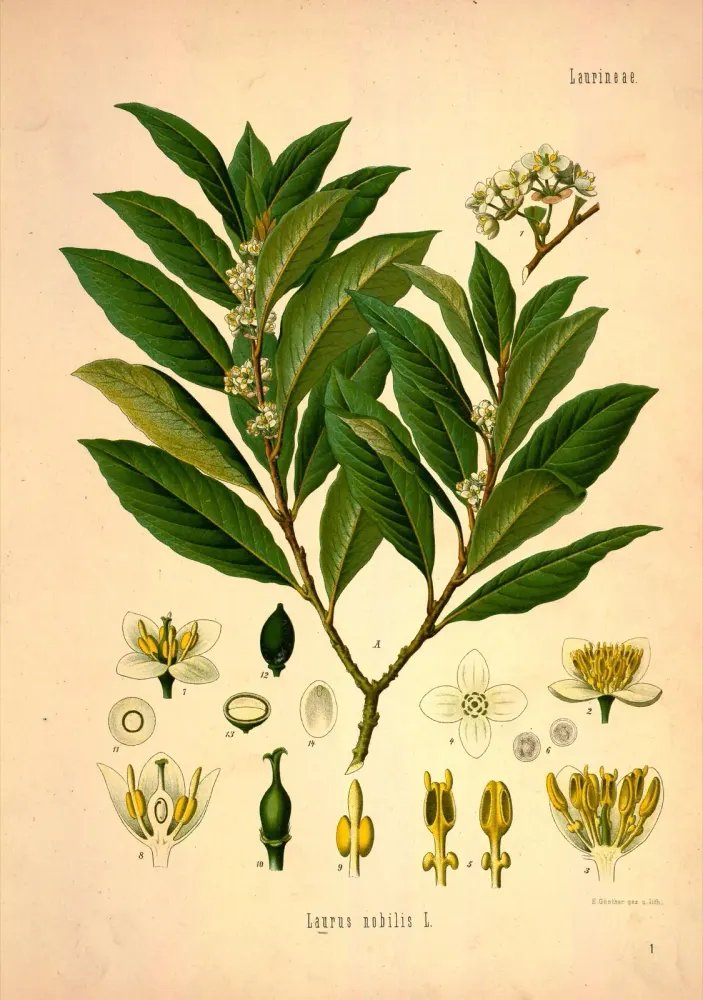
© Brandt, Wilhelm; Gürke, M.; Köhler, F. E.; Pabst, G.; Schellenberg, G.; Vogtherr, Max. · Public domain · Commons
Laurus nobilis
CautionEchter Lorbeer · (Laurus nobilis)
Laurel family (Lauraceae)
Description
Laurus nobilis is an aromatic evergreen tree or large shrub with green, glabrous (smooth) leaves. It is in the flowering plant family Lauraceae. According to Muer, Jahn, & Sauerbier, the stem can be 1 metre in diameter and the tree can be as high as 20 metres.
- SpiceLeafInternalTraditional use
Dried bay leaves are an indispensable spice in Mediterranean cooking: soups, stews, meat and fish dishes, marinades, bouquet garni. The essential oil stimulates gastric glands, acting as an appetite stimulant and digestive aid. Remove before serving — not for eating.
- TeaLeafInternalTraditional use
Infusion of 1–2 dried bay leaves for flatulence, bloating, and mild catarrh of the respiratory tract. The carminative and mildly antiseptic properties of cineole support digestion and relieve bronchial irritation.
Preparation & dosage
Steep 1–2 whole dried leaves (approx. 1–3 g) in boiling water for 10 minutes; remove before drinking.
- Dry amount
- 1–3 g
- Doses per day
- 2×
- Essential oilLeafExternalFolk medicine
Bay laurel oil (expressed from fruits and leaves) for external massage in rheumatic complaints, bruises, and sprains. Known in traditional Mediterranean medicine since antiquity; also used in the production of Aleppo soap.
- CompressLeafExternalFolk medicine
Infusion poultice with bay leaves applied to skin irritations (nettle stings, poison ivy) and poorly healing wounds. Tannins act astringently; sesquiterpene lactones (costunolide) provide anti-inflammatory action.
- TeaLeafInternalFolk medicine
Animal studies show bay leaf supplementation positively alters gut flora: Bifidobacterium and Lactobacillus populations increase, pathogenic clostridia decrease. Relevance for humans not yet confirmed by clinical studies.
- InhalationLeafExternalFolk medicine
Steam inhalation with crushed bay leaves in hot water for bronchial catarrh and colds. The high cineole content of the essential oil supports mucus loosening.
Distribution in Europe
🪴 Grow at home
- ☀ Light
- full sun
- 💧 Water
- weekly
- 🌱 Soil
- Container compost with drainage
- 🪴 Pot
- 30 cm
- ⭐ Difficulty
- ★★☆ intermediate
- 🐾 Pets
- pet-safe
Tips:
- Winter: bright and cool (5-10 °C) — no heated room.
- Marginally hardy — bring indoors below -5 °C.
- Slow-growing — young plants need patience.
Care tips are general indoor-gardening recommendations, not scientific sources.
🤝 Permaculture Partners
In your garden, this plant acts as:
✨ Best symbiotic partners
- 🌿 Rosemary Classic companion-planting partner.
🌟 Neutral neighbours
Source: Helga und Margarete Langerhorst, Mein gesunder Naturgarten (eigene Kuration)