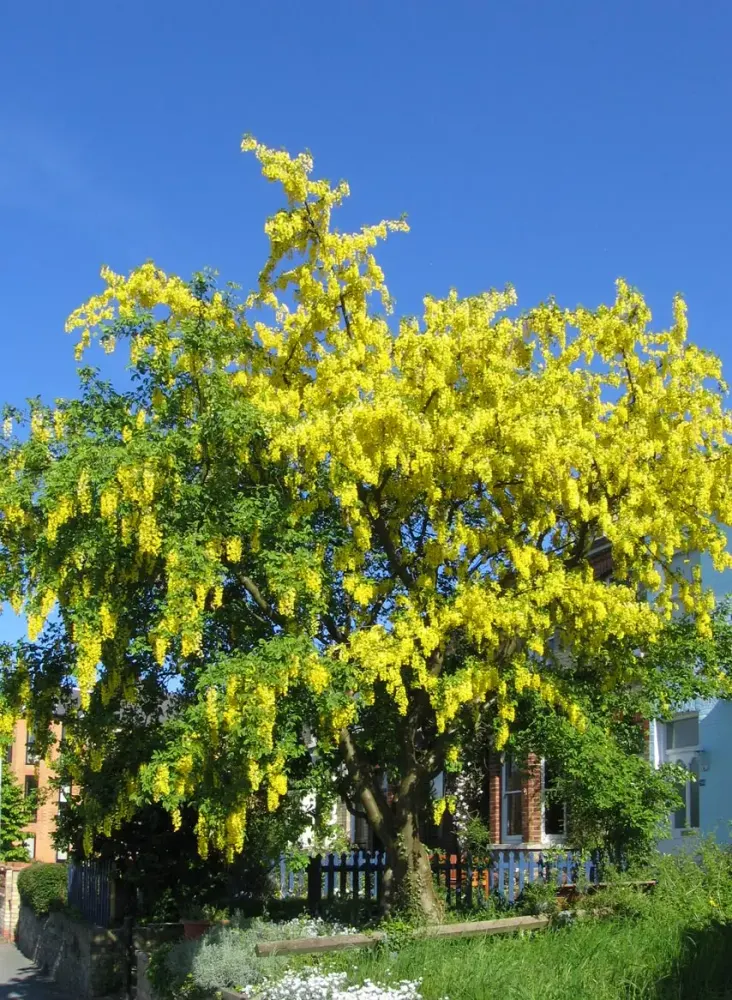
© Unknown · CC BY-SA 2.0 · Commons
Laburnum anagyroides
Toxic🐾Gemeiner Goldregen · (Laburnum anagyroides)
Legume family (Fabaceae)
Description
Laburnum anagyroides, the common laburnum, golden chain or golden rain, is a species of flowering plant in the subfamily Faboideae, and genus Laburnum. Laburnum alpinum is closely related. It is native to Central and Southern Europe.
🌿 Risk of confusion — read before wild-harvesting!
10 flowers are considered potentially fatal; the threshold for children is substantially lower. Fatal poisonings are relatively rare thanks to rapidly setting in emesis but are documented. Risk of confusion: unripe pods may be mistaken by children for pea, bean or black-locust pods.
External use only!
This plant must NOT be taken internally. Use only as compress, salve, or bath.
CONTRAINDICATED during pregnancy
Cytisine is teratogenic according to animal experiments and older human data — it crosses the placental barrier and can cause fetal malformations (skeletal anomalies; the related "crooked calf disease" in cattle, caused by anagyrine, serves as a model). Any oral use of cytisine (including Tabex) as well as any exposure to plant parts during pregnancy is strictly contraindicated.
CONTRAINDICATED during breastfeeding
Cytisine presumably passes into breast milk (lipophilic, low molecular weight) and may induce nicotinic effects (tachycardia, vomiting, seizure tendency) in the infant. Breastfeeding: strictly contraindicated.
CONTRAINDICATED for children
Children are by far the most frequently affected risk group. As few as 2–3 seeds can trigger severe poisoning symptoms in a child, 5–7 seeds can be lethal. Laburnum shrubs in gardens, playgrounds, school yards and parks should — where removal is not possible — be fenced off and labelled. Parents and educators must inform children about the toxicity. If ingestion of seeds or pods is suspected: IMMEDIATELY call poison control.
Critical drug interactions with:
Nikotinersatztherapie (Pflaster, Kaugummi, Lutschtabletten, Inhalator) · Vareniclin (Champix®/Chantix®) · Bupropion (Wellbutrin®/Zyban®)
- RawSeedExternalFolk medicine
Historical external use as botanical insecticide: laburnum seeds were used — analogously to tobacco leaves — as nicotinergic sprays against aphids, bugs and caterpillars (PFAF documents "nicotine-like insecticidal qualities"). No longer recommended today due to percutaneous absorption of cytisine through the user's hands — purely of documentary value.
Preparation & dosage
- RawWhole plantExternalFolk medicine
Folk belief and sympathetic magic: in parts of Central and Southern Europe laburnum was credited with apotropaic ("warding off") magic — branches were hung over stable doors against the "evil eye" or used against witchcraft. Wikipedia (EN) notes: "The plant is believed to have magic properties in some regions." Pure cultural/folklore phenomenon — no medical relevance.
Preparation & dosage
Historical documentation only — do NOT use
These internal applications are historically documented. This plant is highly toxic — self-treatment can cause severe poisoning or death. For documentation only, explicitly NOT a recommendation.
- TinctureSeedInternalClinical trial
Pharmaceutical use of the isolated alkaloid cytisine (NOT the plant itself!) as a smoking cessation aid — marketed as Tabex® by Sopharma (Bulgaria) since 1964. Cytisine acts as a partial agonist at the α4β2 nicotinic acetylcholine receptor (nAChR), analogous to varenicline. The NEJM trial by West et al. (2011) showed a 12-month abstinence rate of 8.4 % with cytisine vs. 2.4 % with placebo; Walker et al. (2014) demonstrated non-inferiority to nicotine replacement therapy. Cytisine is on the WHO List of Essential Medicines (2025). The plant itself is NOT therapeutically usable due to unpredictable alkaloid variability — only the standardized pure alkaloid in 1.5 mg tablets under medical supervision.
Preparation & dosage
[#src_west_2011_laburnum_anagyroides] [#src_walker_2014_laburnum_anagyroides] [#src_wp_cytisine_laburnum_anagyroides]
- TinctureSeedInternalFolk medicine
Historical folk medicinal use of laburnum seeds in highly diluted form for whooping cough (pertussis) and asthma in the 18th and 19th centuries — documented by PFAF and older pharmaceutical literature. The narrow margin between effective and lethal dose (3–4 seeds can be fatal) led to complete abandonment of this application. Today purely of historical-documentary value.
Preparation & dosage
[#src_pfaf_laburnum_anagyroides] [#src_wp_en_laburnum_anagyroides]
- TinctureFlowerInternalFolk medicine
Homeopathic use of Laburnum anagyroides (mother tincture and potencies D6–D30) for exhaustion, headaches and convulsive tendencies in classical homeopathy. From potency D6 onward the preparations contain no pharmacologically active cytisine amount and are considered safe; mother tincture and low potencies remain highly toxic, however.
Preparation & dosage
[#src_pfaf_laburnum_anagyroides] [#src_wp_de_laburnum_anagyroides]
- RawSeedInternalFolk medicine
Wartime emergency use as tobacco substitute: during World War II laburnum seeds were smoked by German and Russian soldiers as a cheap, readily available tobacco substitute — cytisine produces a nicotine-like effect at the same receptor. The unpredictable dose (cytisine content up to 3 % in seeds) made this practice highly risky. Pure cultural phenomenon, no application recommendation.
Preparation & dosage
[#src_wp_cytisine_laburnum_anagyroides] [#src_wp_de_laburnum_anagyroides]