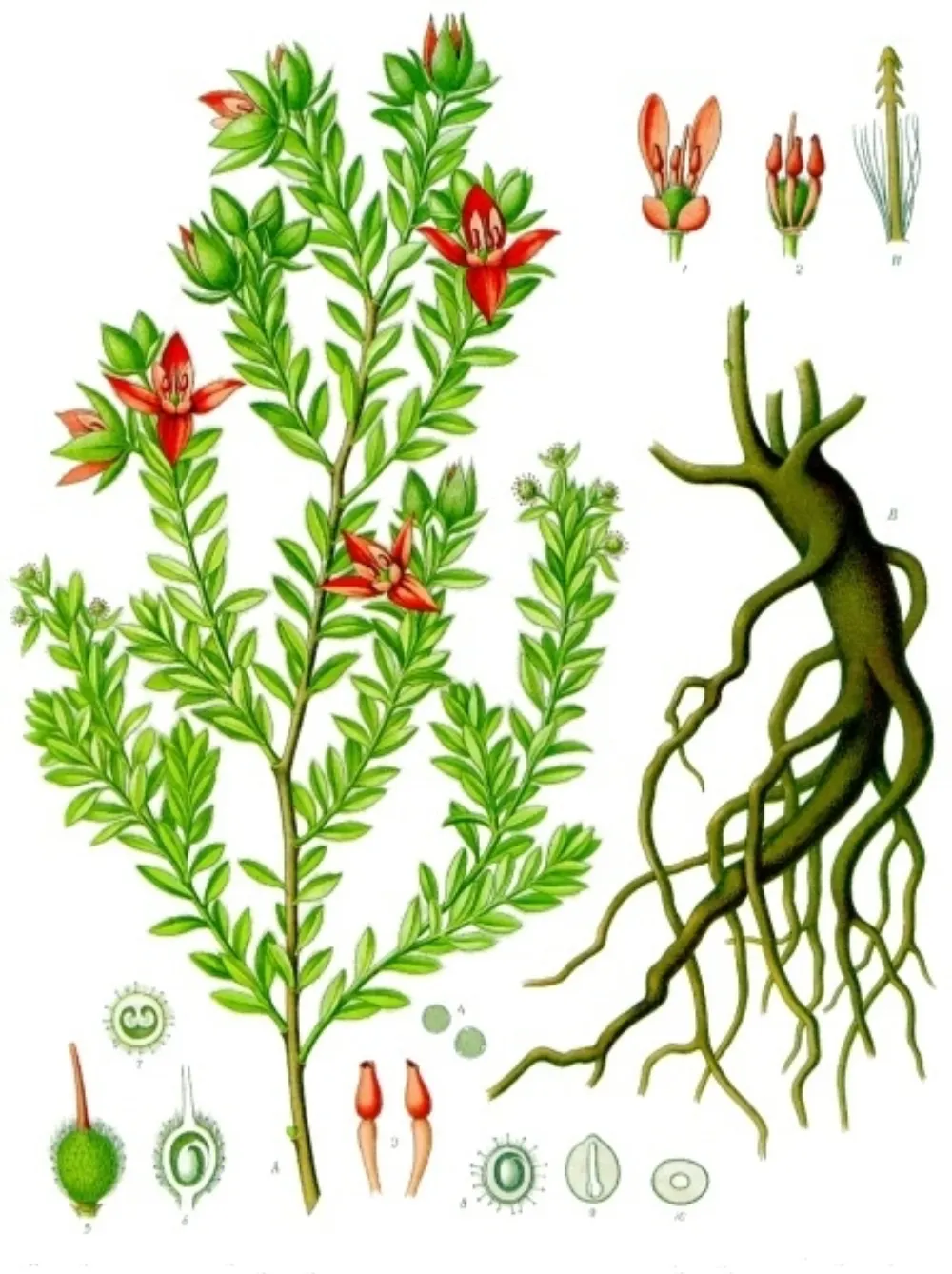
© Franz Eugen Köhler, Köhler's Medizinal-Pflanzen · Public domain · Commons
Rhatany
Ratanhia · (Krameria lappacea)
Rhatany family (Krameriaceae)
Description
Krameria lappacea (synonym: Krameria triandra) is a low woody shrub of the semi-arid Andean region of Peru, Bolivia, Ecuador, northern Chile and north-western Argentina. It grows about 20 to 100 cm tall, bears small grey silky leaves and reddish-purple flowers, and is hemiparasitic, tapping neighbouring host plants through its roots. The medicinal part is the root (Ratanhiae radix): a thick main root with a red-brown, tannin-rich bark. On storage it develops the red pigment 'rhatany red' of the phlobaphene group. Owing to its high content of catechin tannins (proanthocyanidins) the root is strongly astringent and is traditionally used for minor inflammation of the mucosa of the mouth and throat.
External use only!
This plant must NOT be taken internally. Use only as compress, salve, or bath.
- GargleRootExternalTraditional use
Traditionally used as an astringent mouthwash, gargle or gum application for minor inflammation of the mucosa of the mouth and throat, such as gum inflammation (gingivitis), inflammation of the oral mucosa (stomatitis) and inflammation of the throat (pharyngitis). The tannins contract the mucosa and form a protective layer.
Preparation & dosage
For a mouthwash add 5 to 10 drops of rhatany tincture to a glass of lukewarm water and rinse or gargle 2 to 3 times a day; spit out after rinsing, do not swallow. Alternatively dab the undiluted tincture onto inflamed gums with a cotton bud. A decoction of about 1 g of finely cut root in water may also be used as a rinse.
- Doses per day
- 3×
⚠ Age restriction: ≥ 12 years — For adolescents from 12 years and adults. There are insufficient data for children under 12 years; use is not recommended.
🤝 Permaculture Partners
In your garden, this plant acts as: