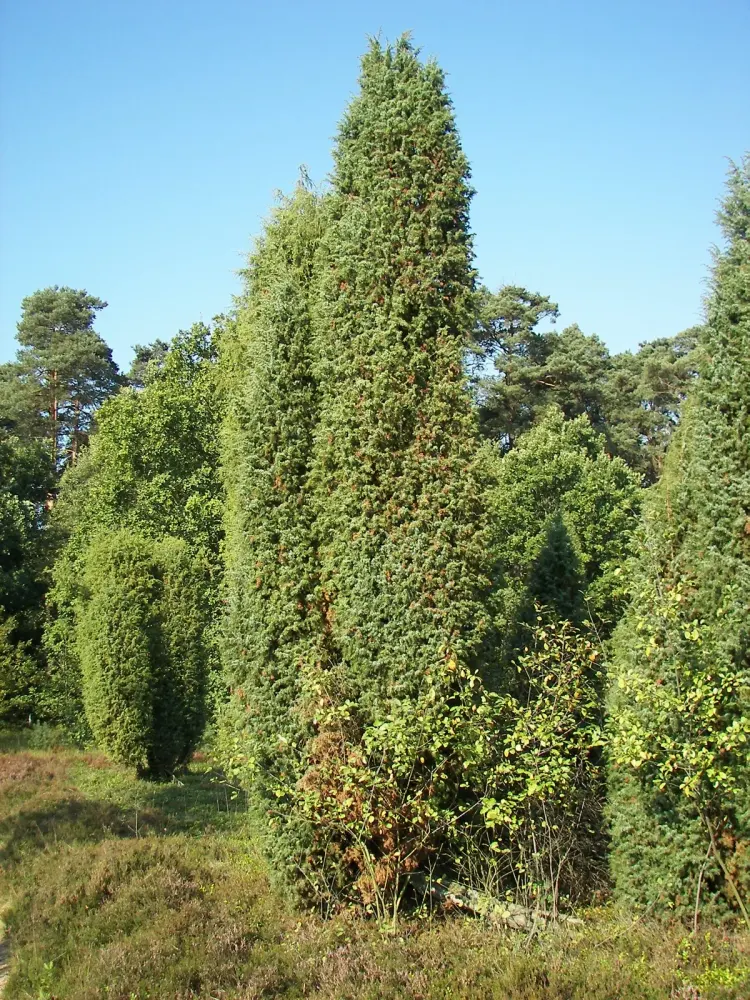
© Nikanos · CC BY-SA 2.5 · Commons
Juniperus communis
Caution🐾Gemeiner Wacholder · (Juniperus communis)
Cypress family (Cupressaceae)
Description
Whether as a pungent game spice or as the flavour that gives gin its name, the blue-black berry cones of common juniper are best known in the kitchen. Medicinally they contain an essential oil rich in monoterpenes along with flavonoids, invert sugars and tannins. An infusion of crushed berries has a positive Kommission E assessment for mild dyspeptic complaints and is traditionally used to support treatment of bladder and urinary tract infections; a juniper berry bath is also folk-medicinally credited with improving circulation in rheumatic complaints. Duration matters here: juniper preparations should not be used for more than four to six weeks without a break, since the terpenes they contain can irritate the kidneys with prolonged use, and the plant is contraindicated in existing kidney disease. If urinary symptoms occur together with fever, flank pain or blood in the urine, medical attention should be sought promptly, as these can signal an infection requiring treatment.
CONTRAINDICATED during pregnancy
Juniper is strictly contraindicated in pregnancy. The monoterpenes (esp. terpinen-4-ol, α-pinene) stimulate the uterus; historically juniper was used as an abortifacient. Also avoid external use (bath, massage oil). Culinary quantities (few berries as spice) are considered safe.
CONTRAINDICATED during breastfeeding
Avoid therapeutic juniper preparations during lactation — the essential oil is lipophilic and may pass into breast milk; data insufficient. Culinary spice quantities are safe.
CONTRAINDICATED for children
Juniper preparations (tea, tincture, essential oil) not for children under 12 — no safety data. Pinene-containing inhalations in children under 6: risk of laryngospasm (absolutely contraindicated). Culinary quantities (spice, 1–2 berries) are safe.
Critical drug interactions with:
Nephrotoxische Arzneimittel (NSAR, Aminoglykoside, Ciclosporin)
Kommission-E-positive infusion of crushed juniper berries for mild dyspeptic complaints and adjunctive irrigation in bladder/urinary tract infections.
Preparation & dosage
INFUSION (Kommission E preparation): 2 g freshly crushed juniper berries (approx. 1 level tsp) in 150 ml boiling water, covered, steep 10 min, strain. 3× daily between meals. Daily dose: 6 g crude drug. Indication: mild dyspeptic complaints (flatulence, bloating, sluggish digestion) and adjunctively for urinary tract infections (irrigation — not antibiotic therapy). Limit use to 4 weeks; seek medical advice for persistent urinary symptoms. Not for inflammatory kidney disease or pregnancy.
- Dry amount
- 2–2 g
- Doses per day
- 3×
- Max duration
- 4 weeks
⚠ Age restriction: ≥ 18 years — Adults only — insufficient data for children/adolescents under 18.
Traditional juniper berry tincture for digestive complaints, flatulence and appetite loss — alternative to tea when ethanol is acceptable.
Preparation & dosage
TINCTURE (1:5 in 40–60 % ethanol): 1–2 ml (~20–40 drops) 3× daily, diluted in water, before meals. Traditional use for digestive complaints, flatulence, loss of appetite. Do not use for more than 4 weeks without medical advice. Contraindicated in kidney disease, pregnancy, or alcohol dependency.
- Liquid amount
- 1–2 ml
- Doses per day
- 3×
- Max duration
- 4 weeks
⚠ Age restriction: ≥ 18 years — Adults only. Due to ethanol content, avoid in alcohol dependency or liver disease.
Folk juniper berry bath additive for external use in rheumatic complaints and to stimulate peripheral circulation.
Preparation & dosage
BATH ADDITIVE: Simmer 20–30 g crushed juniper berries (or 50 ml juniper berry decoction) in 1 litre of water for 20 min, strain and add to bathwater (37–38 °C, max. 20 min bath). Folk external use for rheumatic complaints, tired joints and skin circulation. Not for open wounds, eczema or hypersensitivity to juniper constituents. Do not drink the bath additive.
- Dry amount
- 20–30 g
- Doses per day
- 1×
- Max duration
- 2 weeks
Juniper berry essential oil (Juniperi aetheroleum) — traditionally used internally at medical dose for dyspeptic complaints; externally diluted for massage.
Preparation & dosage
ESSENTIAL OIL (Juniperi aetheroleum): Use only pharmaceutical-grade standardised oil. Traditional internal use: 1–2 drops (~0.02–0.1 g) on a sugar cube or in honey, 3× daily — only at medically recommended dose. Indication: dyspeptic complaints. The oil contains 60–80 % monoterpenes (α-pinene dominant), contributing to secretolytic and aquaretic effect. Do NOT self-medicate with undiluted oil — incorrect dosing is strongly irritating and can damage kidneys. Externally (massage, bath): 1–3 % dilution in carrier oil — avoid on sensitive skin.
- Doses per day
- 3×
- Max duration
- 4 weeks
⚠ Age restriction: ≥ 18 years — Adults only. Never use undiluted essential oil on children — risk of severe irritation.
Juniper berry as classic game spice — the primary flavouring of gin and genever; traditionally used in German and Scandinavian cuisine for sauerkraut and venison dishes.
Preparation & dosage
KITCHEN: Fully ripe blue juniper berries (harvested Oct–Nov, ripened 2–3 years after flowering), lightly crushed and used as spice. Typical uses: game (venison, wild boar), sauerkraut, red cabbage, brines and marinades, dark sauces, Northern European and Scandinavian cuisine. Usual amount: 3–6 berries per serving; do not overdose — aromas are intense. Also the main flavouring of gin, genever and juniper brandy. Do not eat large quantities raw — 6–10 g fresh berries can be toxic (total monoterpene/essential oil load).
Folk inhalation with juniper essential oil for colds and bronchial catarrh — mucolytic action via monoterpenes (α-pinene, sabinene).
Preparation & dosage
INHALATION: Add 1–2 drops of juniper essential oil to hot water (~60–70 °C, not boiling), cover head with towel and inhale steam for 5–10 min. Folk use for colds, bronchial catarrh and to loosen mucus. Keep eyes closed during inhalation — the oil strongly irritates mucous membranes. Do not use for asthma or whooping cough. Menthol/pinene-containing inhalations are generally contraindicated in children under 6 (laryngospasm risk).
Folk needle tea from young juniper shoots — mildly aquaretic and traditionally used for rheumatic complaints; low level of scientific evidence.
Preparation & dosage
NEEDLE TEA (folk): 1–2 tsp fresh juniper needles (young, light-green annual shoots, not old woody twigs) in 200 ml hot water, covered, steep 8–10 min, strain. Max 2× daily, no longer than 2 weeks. Folk use as mildly aquaretic tea and for rheumatic complaints. Considerably less documented phytotherapeutically than berry preparations — no Kommission E approval for needles. Not in pregnancy, kidney disease or for children.
- Dry amount
- 1–2 g
- Doses per day
- 2×
- Max duration
- 2 weeks
IMPORTANT: Juniper berry preparations (tea, tincture, essential oil) must NOT be used for more than 4–6 weeks without a break — prolonged use can irritate the kidneys (juniper essential oil contains terpenes that are nephrotoxic on continuous exposure). Juniper is CONTRAINDICATED in kidney diseases (including pyelonephritis, glomerulonephritis, chronic renal insufficiency). Urinary complaints with fever, flank pain or blood in urine require immediate medical attention — pyelonephritis needs antibiotics, not herbal treatment. Overdose of the essential oil (>1 ml pure oil = ~50 drops) can cause vomiting, seizures and renal failure — emergency situation.
⏱ Max continuous use: 4 weeks
Juniper is strictly contraindicated in pregnancy. The monoterpenes (esp. terpinen-4-ol, α-pinene) stimulate the uterus; historically juniper was used as an abortifacient. Also avoid external use (bath, massage oil). Culinary quantities (few berries as spice) are considered safe.
Avoid therapeutic juniper preparations during lactation — the essential oil is lipophilic and may pass into breast milk; data insufficient. Culinary spice quantities are safe.
Juniper preparations (tea, tincture, essential oil) not for children under 12 — no safety data. Pinene-containing inhalations in children under 6: risk of laryngospasm (absolutely contraindicated). Culinary quantities (spice, 1–2 berries) are safe.
Drug interactions
Diuretika (Schleifendiuretika, Thiazide, Aldosteron-Antagonisten)
Juniper berry preparations have moderate aquaretic activity (terpinen-4-ol, flavonoids). Additive effect with prescription diuretics possible — risk of electrolyte loss (hypokalaemia, hyponatraemia), dehydration and hypotension. Monitor renal function and electrolytes.
Antidiabetika / Insulin
Animal data suggest blood-glucose-lowering activity of juniper extracts (possibly via insulin secretion or glucose uptake). Additive hypoglycaemic effect with antidiabetics or insulin possible. Monitor blood glucose regularly.
Antihypertensiva
The aquaretic and mildly hypotensive effect of juniper may potentiate antihypertensive medications — risk of hypotension and dizziness. Monitor blood pressure.
Nephrotoxische Arzneimittel (NSAR, Aminoglykoside, Ciclosporin)
Juniper essential oil (terpinen-4-ol) is potentially nephrotoxic at long-term or excessive use. Combining with other nephrotoxic substances (NSAIDs, aminoglycosides, ciclosporin) additively increases renal injury risk. Strictly avoid combination.
Contraindications
- Pregnancy — uterine stimulant, historically used as abortifacient; strictly avoid therapeutic doses.
- Inflammatory kidney diseases (glomerulonephritis, pyelonephritis, interstitial nephritis, chronic renal insufficiency) — juniper essential oil can irritate renal tissue and worsen existing inflammation.
- Hypersensitivity to Juniperus communis or other Cupressaceae.
- Children and adolescents under 12 years (tea, tincture, essential oil); inhalation also contraindicated under 6 years.
- Lactation — therapeutic preparations; essential oil may pass into breast milk.
Harvested part: ripe berry cones (autumn)
- Time of day:
- On a dry morning or late morning (9–12), once dew has fully dried. Harvest fully ripe, dark blue to black berries (in their second or third year of ripening) — green same-year berries will be present on the same plant, as Juniperus communis ripens biennially. Wear gloves (needle-like leaves are very sharp). First light frosts improve aroma and sugar content.
- Drying:
- Remove stems, wash and drain berries. Dry in a single layer on screens or cloth in shade, well-ventilated, max. 35 °C — natural drying takes 2–3 weeks. Alternatively use a dehydrator at 35–40 °C for ~24–48 h (slow and gentle to preserve essential oil). Berries are ready when they feel leathery-firm when pressed and still smell aromatic when cut. Drying too fast or hot (>45 °C) destroys the valuable essential oil. Discard shrivelled, odourless or mouldy berries.
- Storage:
- 12 months — In airtight dark glass or metal containers, cool and dry. Before opening, check by aroma whether essential oil is still present. Use within 12 months — active constituent concentration decreases thereafter.
- Time of day:
- Harvest young needle shoots (light-green annual growth) in the morning after dew has dried — essential oil content is highest in young shoots. Sturdy gloves and long sleeves are essential (the leaves/needles cause skin irritation and deep punctures).
- Drying:
- Cut young shoot tips (5–10 cm) from the mother plant. Tie loosely into small bunches and hang upside down in a shady, well-ventilated spot (max. 30–35 °C). Drying time approx. 1–2 weeks. Dried needles are brittle — strip from stems and store in jars. Use 1–2 tsp of needles for tea. Needle drug is of lesser importance than berry preparations — no Ph. Eur. monograph for needles.
- Storage:
- 6 months — In airtight jars, dark and cool; use within 6 months — needles lose their essential oil faster than dried berries.
- Ätherisches Öl (Juniperi aetheroleum) — α-Pinen, β-Pinen, Sabinen, Mycen, Terpinen-4-olEssential oilContent: 0.2-3.4 %Fruit
Main active constituent group of juniper berry. α-Pinene (20–60 %) and sabinene (up to 45 %) dominate the monoterpene pattern; terpinen-4-ol (1–15 %) is considered the lead substance for aquaretic activity (stimulates renal perfusion). The oil is secretolytic, aquaretic and weakly antimicrobial. Content varies strongly with origin and harvest time (EMA: min. 0.2 %; Ph. Eur. requirements apply).
- Flavonoide (Amentoflavon, Hinokiflavon, Quercetin-3-glucosid, Isoquercitrin)FlavonoidContent: 0.5-1.5 %Fruit
Biflavones (amentoflavone, hinokiflavone) are characteristic of Coniferales and contribute to aquaretic and antioxidant activity. Amentoflavone has shown inhibition of COX-1 and COX-2 in studies (anti-inflammatory potential). Quercetin glycosides complement antioxidant capacity.
- Invertzucker und Polysaccharide (Glucose, Fructose, Inulin-artige Oligosaccharide)PolysaccharideContent: 15-30 %Fruit
The high sugar content (mainly invert sugar) explains the slightly sweet note of ripe berries. Inulin-like oligosaccharides have been described as minor components; their clinical relevance for juniper is limited. Sugars contribute to the texture of dried berries and the solubility of water-soluble constituents in tea.
- Diterpensäuren (Isocupressinsäure, Dehydroabietinsäure) und HarzeOtherContent: 1-4 %Fruit
Resin fraction of diterpene acids; responsible for astringent and mildly antiseptic properties. Isocupressic acid (and related abietanes) shows uterine-stimulating/oxytocic activity in animal studies — a key reason for contraindication in pregnancy. Resins also contribute to the characteristic juniper aroma and taste.
- Proanthocyanidine (oligomere und polymere Procyanidine)TanninContent: 0.3-1 %Fruit
Astringent tannin component, similar to other berry fruits. Contribute to antioxidant capacity and a slightly astringent aftertaste. Synergistic contribution to the anti-inflammatory activity of the whole extract.
- Phenolische Säuren (Chlorogensäure, Kaffeesäure, Protocatechusäure)Phenolic acidContent: 0.2-0.8 %Fruit
Accessory compound group with antioxidant and mildly anti-inflammatory properties. Chlorogenic acid is also widely found in other berries and coffee. They synergistically complement the antioxidant effect of the whole extract.
- Catechine und Epicatechin (monomere Flavan-3-ole)TanninContent: 0.1-0.5 %Fruit
Monomeric precursors of proanthocyanidins. Antioxidant, mildly capillary-protective. Present in smaller amounts in juniper berries than in red grapes or hawthorn, but still part of the overall antioxidant profile.
- Sesquiterpene (β-Elemen, Germacren D, Cadinene) — im ätherischen ÖlSesquiterpeneContent: 0.1-2 %Fruit
Minor components of the essential oil (5–15 % of the oil fraction). β-Elemene and germacrene D show in-vitro antimicrobial and antifungal properties. Contribute to the complex aroma profile of juniper oil and to potent secondary activities of the whole oil.
- [1]MonographKommission E — Juniperi fructus (Wacholderbeeren), positive Monographie, BAnz Nr. 228, 1985, und Monographien-Korrektur 1990(accessed: 2026-05-21)
- [2]MonographEMA/HMPC — European Union herbal monograph on Juniperus communis L., pseudo-fructus (Final, EMA/HMPC/321462/2017)(accessed: 2026-05-21)
- [3]MonographESCOP Monographs — Juniperi fructus (Juniper Berry), 2nd edition plus supplement(accessed: 2026-05-21)
- [6]MonographPlants For A Future (PFAF) — Juniperus communis database entry(accessed: 2026-05-21)
- [9]MonographCliniTox Giftpflanzen — Juniperus communis L.s.l.: giftig + (Institut für Veterinärpharmakologie und -toxikologie, Universität Zürich)(accessed: 2026-08-10)
- [4]BookWichtl, M. (Hrsg.) — Teedrogen und Phytopharmaka, 5. Auflage, Wissenschaftliche Verlagsgesellschaft Stuttgart, 2009. Eintrag: Juniperi fructus(accessed: 2026-05-21)
- [5]BookMadaus, Gerhard — Lehrbuch der biologischen Heilmittel, Band II: Juniperus communis (Wacholder), 1938 (Public Domain)(accessed: 2026-05-21)
- [7]WikipediaGemeiner Wacholder (Wikipedia DE)(accessed: 2026-05-21)
- [8]WikipediaJuniperus communis (Wikipedia EN)(accessed: 2026-05-21)