© Brandt, Wilhelm; Gürke, M.; Köhler, F. E.; Pabst, G.; Schellenberg, G.; Vogtherr, Max. · Public domain · Commons
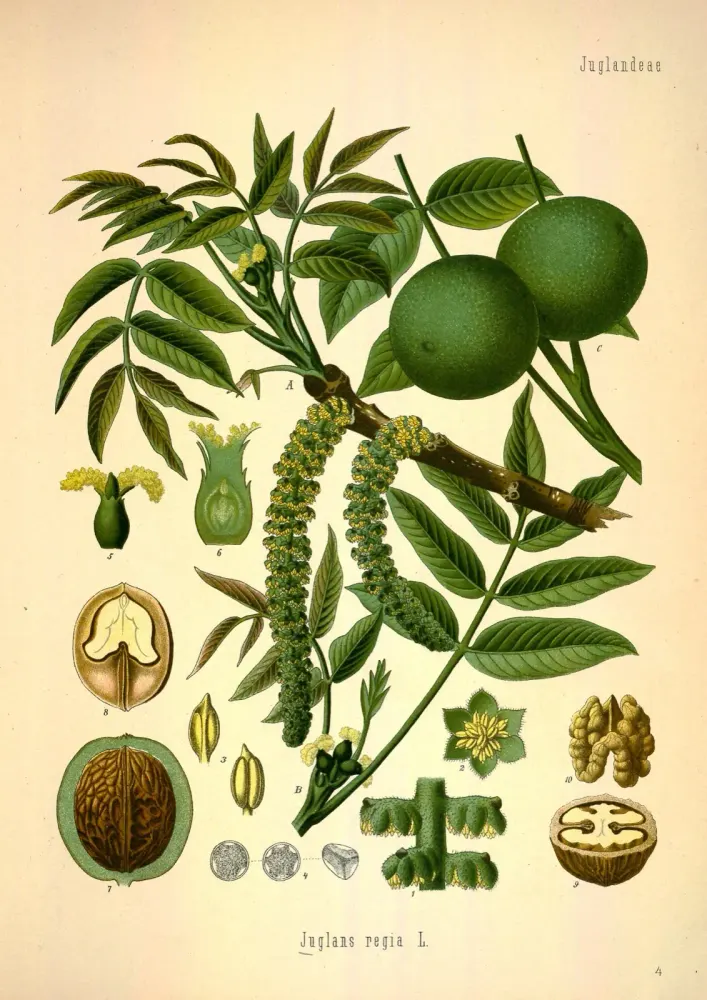
Juglans regia
CautionEchte Walnuss · (Juglans regia)
Walnut family (Juglandaceae)
Description
Juglans regia, known by various common names including the common walnut, English walnut, or Persian walnut amongst other names, is a species of walnut. It is native to Eurasia in at least southwest and central Asia and southeast Europe, but its exact natural area is obscure due to its long history of cultivation.
- BathLeafExternalCommission E
External bath infusion from dried walnut leaves — Kommission E positive monograph for mild superficial skin inflammation and excessive perspiration. Key actives: ellagitannins and tannins.
Preparation & dosage
BATH ADDITIVE (Kommission E positive, external): Pour 1 litre of boiling water over 25–50 g of dried walnut leaves (Folia Juglandis), steep covered 15 min, strain and add to full bath (~37–38 °C, 200–250 litres) or partial bath. Soak 15–20 min. Indications per Kommission E: mild superficial skin inflammation and excessive sweating (hyperhidrosis) of hands and feet. Use daily or every second day; not on open wounds, infected lesions, or extensive skin conditions without medical assessment. High tannin content (ellagitannins, gallotannins) provides astringent and antimicrobial action.
- Dry amount
- 25–50 g
- Doses per day
- 1×
- Max duration
- 4 weeks
[#src_kommission_e_juglandis_folium] [#src_ema_hmpc_juglandis_folium] [#src_escop_juglandis_folium]
- CompressLeafExternalTraditional use
Traditional walnut-leaf compress for minor wound care, insect bites and small-area eczema — astringent and mildly antiseptic tannin action.
Preparation & dosage
COMPRESS: Pour 500 ml boiling water over 10–20 g dried walnut leaves, steep 15 min, strain, cool to body temperature. Dip sterile compress or clean linen cloth, wring lightly, place on affected skin. Leave 10–15 min, repeat twice daily. Traditional use for minor wound care (abrasions, insect bites), mildly inflamed skin and small-area eczema. Do not apply to deep, purulent or infected-appearing wounds.
- Dry amount
- 10–20 g
- Doses per day
- 2×
- Max duration
- 3 weeks
[#src_kommission_e_juglandis_folium] [#src_wichtl_teedrogen] [#src_pfaf_juglans_regia]
- TeaLeafInternalTraditional use
Traditional infusion of dried walnut leaves for mild digestive complaints — short-term only, as juglone content is concerning with long-term use.
Preparation & dosage
INTERNAL INFUSION (traditional, short-term): 1.5–3 g dried, chopped walnut leaves in 250 ml boiling water, covered, steep 10 min, strain. Max 2 cups daily, not longer than 3 weeks without medical consultation. Traditional use for mild digestive complaints (bloating, mild diarrhoea) and as adjunct internal treatment for skin purification. IMPORTANT: juglone content higher in fresh leaves — use only dried drug (Folia Juglandis). Avoid long-term internal use due to juglone. Discontinue at first signs of nausea or gastric discomfort.
- Dry amount
- 1.5–3 g
- Doses per day
- 2×
- Max duration
- 3 weeks
[#src_wichtl_teedrogen] [#src_escop_juglandis_folium] [#src_pfaf_juglans_regia]
- TinctureLeafExternalFolk medicine
Folk tincture from green walnut husks — external use for skin fungi, warts and excessive sweating; juglone stains skin brown (temporary).
Preparation & dosage
GREEN WALNUT HUSK TINCTURE (folk, external): Immature green walnut husks (Pericarpium Juglandis viride, harvested July–August) macerated in 40–60 % ethanol (DER 1:5), steep in dark 4 weeks, filter. Apply diluted (~1:10 in water) to affected skin, twice daily. Folk use for skin fungal infections (ringworm, tinea pedis), warts and excessive sweating. Caution: juglone stains skin dark brown (temporary) — avoid contact with clothing and nails or wear gloves. Do not apply on mucous membranes or large areas.
- Liquid amount
- 2–5 ml
- Doses per day
- 2×
- Max duration
- 4 weeks
[#src_pfaf_juglans_regia] [#src_madaus_juglans] [#src_wp_de_walnuss]
- RawSeedInternalClinical trial
Walnut as food — EFSA-recognised effect on blood lipid levels (ALA/omega-3); clinical evidence for LDL reduction, endothelial function and antioxidant status.
Preparation & dosage
WALNUT AS FOOD (evidence-based nutrition): 30–42 g (approx. one handful, ~7–10 halves) daily, raw or lightly roasted, unsalted, unsweetened. Prefer morning or between meals. EFSA approved health claims for walnuts regarding alpha-linolenic acid (ALA, omega-3) and maintenance of normal blood cholesterol levels (EU Regulation 432/2012). Clinical trials show contribution to normal LDL-cholesterol levels (~5–15 % reduction), vascular endothelial function and antioxidant status. Contains melatonin (sleep-promoting effect of evening intake discussed). Total fat content very high (~65 g/100 g) — consider caloric density.
- Dry amount
- 28–42 g
- Doses per day
- 1×
[#src_efsa_walnuts_ala] [#src_who_nuts_review] [#src_wp_en_walnut]
- TeaLeafInternalFolk medicine
Folk bitter tea from walnut leaves for sluggish digestion and biliary complaints — strictly short-term due to juglone content.
Preparation & dosage
FOLK BITTER TEA (short-term): 1–2 tsp dried walnut leaves in 200 ml boiling water, steep 8 min, strain. 1 cup daily (preferably before meals). Folk tradition for sluggish digestion, biliary complaints and as 'blood purifier'. Bitter-astringent action from juglone, tannins and bitter principles. Strictly limit use to 2 weeks max; then at least 4 weeks break. Not for internal use in children under 12.
- Dry amount
- 1–2 g
- Doses per day
- 1×
- Max duration
- 2 weeks
[#src_madaus_juglans] [#src_pfaf_juglans_regia] [#src_wp_de_walnuss]
- SpiceSeedInternalFolk medicine
Walnuts and cold-pressed walnut oil as food — high ALA/omega-3 and vitamin E content; nut liqueur (Nocino) from green walnuts as traditional folk specialty.
Preparation & dosage
KITCHEN AND WALNUT OIL: Fully ripe dried walnuts are versatile — raw as snack, chopped in bread, salads, pesto, muesli and desserts. Cold-pressed walnut oil (rich in ALA/omega-3 and vitamin E) as salad oil or finishing drizzle (not suitable for high-heat cooking, smoke point ~160 °C). Store walnut oil cool and dark — highly oxidation-sensitive due to high PUFA content, use within 2–3 months. Store dried nuts cool (< 15 °C) in closed containers; up to 1 year under optimal conditions. Unripe green walnuts traditionally made into nut liqueur (Nocino/Walnussgeist): macerated in 40–50 % alcohol with spices for 6–8 weeks.
[#src_wp_en_walnut] [#src_wp_de_walnuss] [#src_pfaf_juglans_regia]