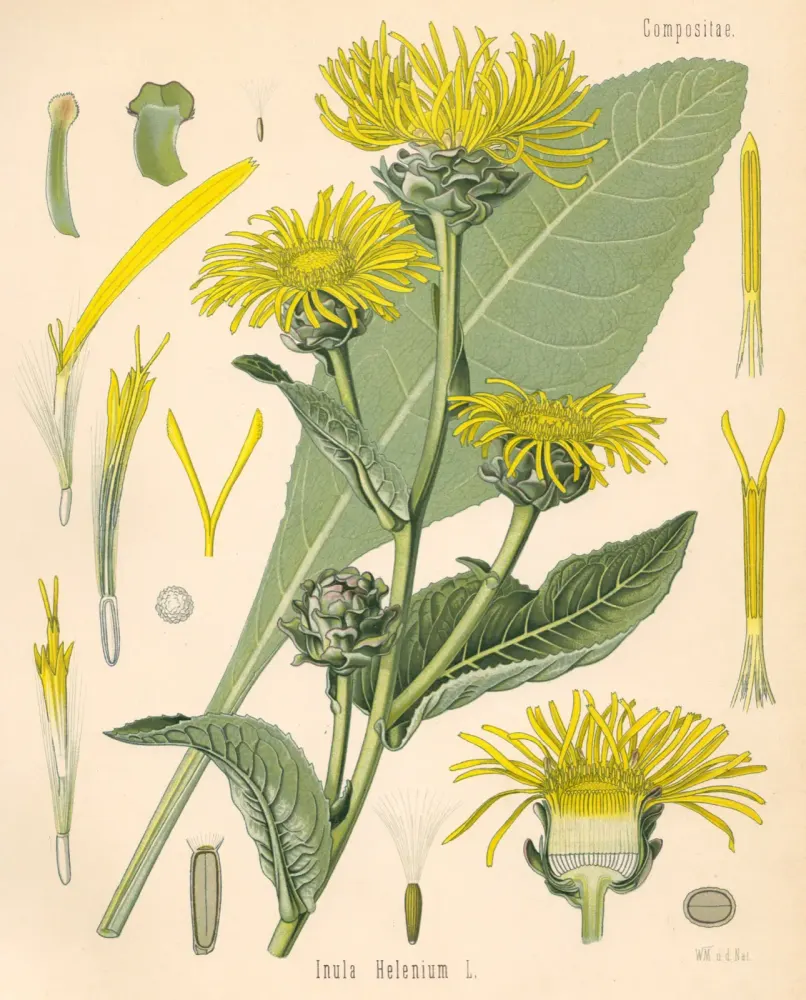
© Köhler's Medizinal-Pflanzen (1887) · Public domain · Commons
Elecampane
CautionAlant · (Inula helenium)
Daisy family (Asteraceae)
Description
True elecampane is a perennial herb up to two metres tall, with large yellow ray flowers and a deeply rooted rhizome. Originally from Asia, it was already cultivated in European monastery gardens during the Middle Ages. Its bitter-aromatic rhizome is the traditional medicinal part, primarily for respiratory complaints.
CONTRAINDICATED during pregnancy
Elecampane root preparations are contraindicated in pregnancy. Sesquiterpene lactones and essential oil may stimulate uterine contractions. Historically used in folk medicine as an emmenagogue and at high doses as an abortifacient — never use during pregnancy.
CONTRAINDICATED during breastfeeding
Safety during lactation is not established. Sesquiterpene lactones may pass into breast milk and cause allergic or toxic reactions in the infant. Use during lactation is therefore contraindicated.
CONTRAINDICATED for children
Elecampane root preparations are not suitable for children and adolescents under 18 — no safety data, high allergy potential of sesquiterpene lactones, risk of gastrointestinal side effects. External use (compresses) is also contraindicated due to risk of contact sensitisation.
- TeaRootInternalTraditional use
Traditional root decoction as expectorant for cough and bronchial catarrh — classic application in European phytotherapy (ESCOP, Wichtl).
Preparation & dosage
DECOCTION: 1–2 g (approx. 1 tsp) of dried, finely cut elecampane root in 250 ml cold water, bring to the boil and simmer 10 minutes over low heat, then strain. 2–3 cups freshly prepared daily, with or after meals (bitters effect). Traditional use: mucolytic and expectorant for acute and chronic cough, tenacious bronchial mucus and catarrhal respiratory complaints. Usual duration 2–4 weeks; if complaints persist or fever develops, seek medical advice. The high inulin content gives the tea a sweetish-bitter-aromatic flavour.
- Dry amount
- 1–2 g
- Doses per day
- 3×
- Max duration
- 4 weeks
[#src_escop_inulae_radix] [#src_wichtl_teedrogen] [#src_pfaf_inula] [#src_wp_de_alant]
- TinctureRootInternalTraditional use
Traditional root tincture for chronic respiratory complaints and digestive weakness — stronger sesquiterpene extraction than tea, be aware of heightened allergy potential.
Preparation & dosage
TINCTURE (DER 1:5 in 40–60 % ethanol): 2–4 ml (~40–80 drops) 3× daily, diluted in water, before or with meals. Traditional use for chronic respiratory complaints, bronchial catarrh and as a bitter-tonic digestive. The ethanol content gives better extraction of sesquiterpene lactones. Due to allergy potential of sesquiterpene lactones (alantolactone), start at the lowest effective dose and discontinue immediately if skin irritation, mucosal symptoms or breathing difficulties occur. Not for Asteraceae allergy.
- Liquid amount
- 2–4 ml
- Doses per day
- 3×
- Max duration
- 4 weeks
[#src_escop_inulae_radix] [#src_wichtl_teedrogen] [#src_haensel_sticher]
- InhalationRootInternalFolk medicine
Folk steam inhalation with elecampane root for chronic sinusitis and tenacious bronchial mucus — contraindicated in asthma and hypersensitivity.
Preparation & dosage
INHALATION: 3–5 g dried elecampane root steeped 5 minutes in 1 litre of boiling water (no further boiling). Drape a towel over head and bowl, close eyes, inhale steam for 5–10 minutes. 1–2× daily for tenacious bronchial mucus and chronic sinusitis. Caution: the essential oil contains alantocamphor — inhalation may trigger bronchospasm in bronchial asthma or hypersensitivity. Discontinue immediately if dyspnoea or irritating cough occurs. Not recommended for children under 12 (apply menthol-analogue rules).
- Dry amount
- 3–5 g
- Doses per day
- 2×
- Max duration
- 2 weeks
- TeaRootInternalFolk medicine
Bitter-choleretic pre-meal tea for dyspepsia, flatulence and sluggish gallbladder — classic bitters use in folk medicine.
Preparation & dosage
BITTER TONIC TEA: 1–1.5 g dried, cut elecampane root in 200 ml cold water, bring to boil, simmer 10 minutes, strain. 1 cup (unsweetened) drunk slowly 20–30 minutes BEFORE meals so the bitters stimulate bile and gastric secretion. Folk use for digestive weakness (dyspepsia), bloating, flatulence, sluggish gallbladder and lack of appetite. Helenalin and bitters from the inulin matrix act choleretically and mildly spasmolytically on smooth muscle of the digestive tract.
- Dry amount
- 1–1.5 g
- Doses per day
- 2×
- Max duration
- 3 weeks
[#src_pfaf_inula] [#src_madaus_inula] [#src_wp_en_elecampane]
- TinctureRootInternalFolk medicine
Folk digestive bitters and aperitif — historical elecampane tincture as a forerunner of Central European herbal liqueurs.
Preparation & dosage
DIGESTIVE BITTERS / APERITIF TINCTURE: 1–2 ml elecampane tincture (1:5 in 45 % ethanol) stirred into 100 ml water or herbal liqueur, drunk 15–30 minutes before meals. Folk use as a digestive bitter, aperitif and to stimulate bile secretion. Elecampane is historically one of the key plants in European herbal liqueurs (a forerunner of the Chartreuse type). Keep dose low due to sesquiterpene lactone allergenicity. Not for Asteraceae allergy.
- Liquid amount
- 1–2 ml
- Doses per day
- 2×
- Max duration
- 3 weeks
[#src_madaus_inula] [#src_wp_en_elecampane] [#src_wp_de_alant]
- CompressRootExternalFolk medicine
External root compress for joint inflammation, poorly healing wounds and skin infections — high contact-allergen potential of sesquiterpene lactones must be observed.
Preparation & dosage
COMPRESS (external): boil 10 g dried elecampane root in 500 ml water for 15 minutes, strain, cool to hand-warm. Soak a clean linen cloth, wring lightly and apply to affected areas (joints, poorly healing wounds, furuncles, scabies). Leave on 15–20 minutes, 2–3× daily. Folk use for inflamed joints (mild arthritis), poorly healing wounds and skin infections. WARNING: sesquiterpene lactones can cause severe contact allergy and sensitisation with prolonged skin contact — perform patch test before extended external use. Discontinue immediately if redness, blistering or itching occurs.
- SpiceRootInternalFolk medicine
Historical culinary use: elecampane root as spice for herbal liqueurs, candied cough remedy and prebiotic vegetable in small amounts.
Preparation & dosage
KITCHEN / LIQUEUR: Fresh or dried elecampane root is used in traditional liqueur production (elecampane liqueur, Ratafiat d'Aunée in France) — root slices macerated with sugar and brandy for 4–6 weeks, then filtered. Historically also candied ('elfwort candy' in England, 'Aulnée sucrée' in France) as a cough sweet and post-meal digestive. Dried root in small amounts as a bitter-aromatic spice for herbal bitters, vermouth and aperitif spirits. Inulins (fructooligosaccharides) make elecampane root a traditional prebiotic food — edible in small amounts cooked as a vegetable; in larger amounts may cause fermentative bloating.
[#src_wp_en_elecampane] [#src_pfaf_inula] [#src_madaus_inula]
- TeaRootInternalFolk medicine
Medieval folk tradition: elecampane mixed-herb tea for colds and febrile infections — in vitro antimicrobial properties, no clinical evidence.
Preparation & dosage
MIXED COLD/FLU TEA: Elecampane root (1–2 g) combined with thyme or ribwort plantain, simmered as a cold and fever infusion (10 minutes, then strained). Drink warm 3× daily for colds, flu-like infections and febrile respiratory illness. Folk tradition in Central and Western Europe — elecampane was regarded as a 'panacea' in the Middle Ages (cf. Hildegard von Bingen, Physica c. 1150 CE). Antibacterial potential of alantolactone described in vitro (incl. against Mycobacterium tuberculosis), but no clinical human trials — traditional evidence only. Not a substitute for medical treatment of severe infections.
- Dry amount
- 1–2 g
- Doses per day
- 3×
- Max duration
- 2 weeks
[#src_madaus_inula] [#src_wp_en_elecampane] [#src_wp_de_alant] [#src_pfaf_inula]
Classical quotes
"Whoever has a weak lung complaint should boil elecampane root in pure wine and drink it warm."