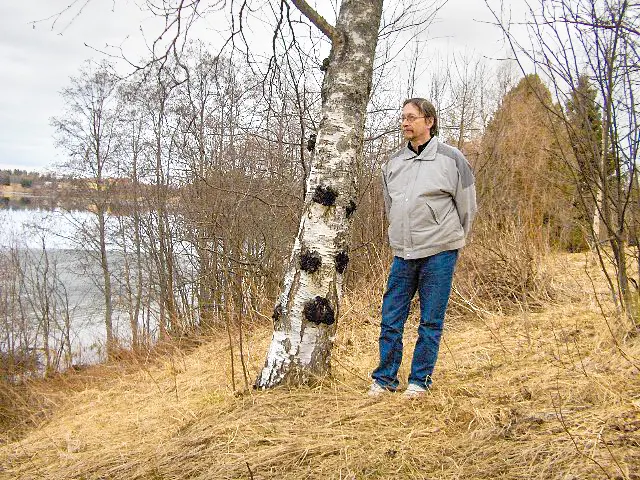
© Höyhens · CC BY-SA 3.0 · Commons
Chaga
CautionSchiefer Schillerporling (Chaga) · (Inonotus obliquus)
Hymenochaetaceae (Hymenochaetaceae)
Description
Chaga (Inonotus obliquus) is a parasitic fungus of the family Hymenochaetaceae with a circumboreal distribution across Russia, Scandinavia, the Baltic region, Asia and North America. Rather than a typical mushroom cap it forms hard, black, cracked sterile masses (sclerotia) up to 40 cm wide on living birch trees (rarely alder, beech or oak); their dark colour comes from a high melanin content, while the interior is cinnamon-brown. These black conks have been used since the 15th–16th century in Russian and Siberian folk medicine, traditionally as a decoction (tea) for gastrointestinal complaints and, in folk tradition, against cancer. The fungus became widely known in the West through Alexander Solzhenitsyn's novel "Cancer Ward". Chaga contains over 200 bioactive substances including polysaccharides (beta-glucans), triterpenes such as betulin and betulinic acid, inotodiol, polyphenols and melanin; robust clinical efficacy in humans has not yet been demonstrated by trials.
- TeaWhole plantInternalTraditional use
Traditionally the crushed black conk is simmered as a long decoction (tea), drunk in Russian and Siberian folk medicine as a remedy for gastrointestinal complaints and as a general tonic.
- TeaWhole plantInternalFolk medicine
Used in Russian folk medicine since the 15th century as a folk remedy against cancer; a curative effect in humans is not scientifically proven.
- TinctureWhole plantInternalFolk medicine
Alcoholic extracts (tinctures) and dual extracts are used as dietary supplements to capture both water- and alcohol-soluble constituents (triterpenes, polyphenols).
- RawWhole plantInternalFolk medicine
Dried, ground sclerotium is sold as powder or capsules as a dietary supplement; quality varies considerably due to inconsistent processing.