© Unknown · Public domain · Commons
Ilex aquifolium
Toxic🐾Europäische Stechpalme · (Ilex aquifolium)
Holly family (Aquifoliaceae)
Description
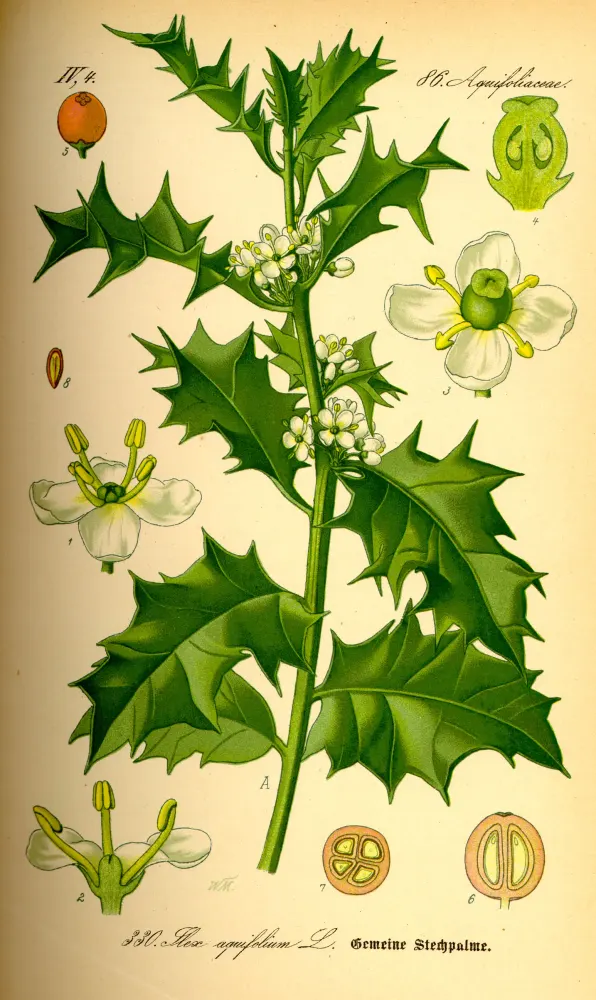
Ilex aquifolium, the holly, common holly, English holly, European holly, or occasionally Christmas holly, is a species of flowering plant in the family Aquifoliaceae, native to western and southern Europe, northwest Africa, and southwest Asia. It is regarded as the type species of the genus Ilex, which by association is also called holly. It is an evergreen tree or shrub found, for example, in shady areas of forests of oak and in beech hedges.
CONTRAINDICATED during pregnancy
Triterpene saponins are uterotonic and mucosally irritant; the emetic action of the berries can trigger vomiting and dehydration. Any self-administration during pregnancy is contraindicated. Strictly avoid wild berries.
CONTRAINDICATED during breastfeeding
Due to saponin toxicity and unknown pharmacokinetics in breast milk, any internal use during lactation should be avoided. In households with breastfeeding mothers, Christmas decorations with berries should be kept out of reach of crawling infants.
CONTRAINDICATED for children
The bright-red berries of Christmas decoration are particularly attractive to small children — Ilex aquifolium is one of the most frequently reported plant poisonings in children in December. As few as 2–3 berries trigger severe vomiting. Advent wreaths, decorative picks and table arrangements with holly berries should be kept out of reach or preferably chosen without berries. If swallowed: IMMEDIATELY call poison control.
Critical drug interactions with:
Veterinärmedizin: Theobromin-empfindliche Tierarten (Hunde, Katzen, Pferde)
- RawBarkExternalFolk medicine
Historical non-medicinal use: until the 19th century, birdlime was made from fermented bark of young holly shoots in the English Lake District, used to trap small birds by sticking them to twigs. Today ethically and legally prohibited; purely ethnographic documentation. Skin contact with the birdlime paste can cause irritant-allergic reactions.
Historical documentation only — do NOT use
These internal applications are historically documented. This plant is highly toxic — self-treatment can cause severe poisoning or death. For documentation only, explicitly NOT a recommendation.
- TeaLeafInternalTraditional use
Historical use of dried holly leaves as an infusion for intermittent fever (malaria), pleurisy, catarrh and bronchitis — per Maud Grieve (1931) the tea acted as 'diaphoretic, expectorant, febrifuge and tonic'. Documented as a Central European household remedy for intermittent fever since the 16th century. In the Black Forest the infusion was also drunk as a tea substitute. Obsolete today — modern antipyretics and antibiotics are safer and more effective; the tea contains saponins and trace methylxanthines, making self-administration unsafe due to emesis/diarrhoea risk and confusion with berries.
Preparation & dosage
[#src_grieve_ilex_aquifolium] [#src_pfaf_ilex_aquifolium] [#src_wp_de_ilex_aquifolium]
- TeaLeafInternalTraditional use
Folk-medicinal use of holly leaf infusions for chronic rheumatism and gout — the triterpenes (ursolic acid, oleanolic acid) and saponins were credited with a weak diuretic and anti-inflammatory action. In the Catalan region of Pallars the leaf tea was used folkloristically for pain relief. Obsolete today — the weak effect is disproportionate to the poisoning risk if berries are confused.
Preparation & dosage
[#src_grieve_ilex_aquifolium] [#src_pfaf_ilex_aquifolium] [#src_wp_en_ilex_aquifolium]
- RawLeafInternalFolk medicine
Folk-medicinal use of pressed juice of fresh holly leaves for jaundice — Maud Grieve documents: 'The juice of the fresh leaves has been successfully used in the treatment of jaundice.' Widespread in English herbalism of the 17th–19th centuries. Not pharmacologically substantiated; obsolete today because jaundice is usually a symptom of an underlying disease requiring treatment.
- RawFruitInternalFolk medicine
Historical use of a few berries as a drastic emetic and purgative, and folk-medicinally for dropsy and 'constipation'. Maud Grieve and PFAF describe the berries as 'violently emetic and purgative'. As few as 2–3 berries cause severe vomiting in children; 5–10 cause marked poisoning symptoms. Strictly obsolete today due to high poisoning risk — pure ethnobotanical documentation.
[#src_grieve_ilex_aquifolium] [#src_pfaf_ilex_aquifolium] [#src_wp_de_ilex_aquifolium]
- TeaRootInternalFolk medicine
Folk-medicinal use of root decoctions as a mild diuretic for dropsy and urinary retention. PFAF rates the diuretic action as weak and cites 'better alternatives'. Obsolete today due to unsystematic data and saponin load.
Preparation & dosage
- TinctureFlowerInternalFolk medicine
Use as Bach flower essence 'Holly' (one of the 38 Bach remedies by Edward Bach, 1930s): recommended for intense negative emotional states such as hatred, jealousy, envy and suspicion. Mother tincture prepared from flowers by the sun or boiling method. Bach essence dilutions contain no pharmacologically active amounts — no toxic risk, but also no scientifically established efficacy. Purely documentation of traditional use.
Preparation & dosage