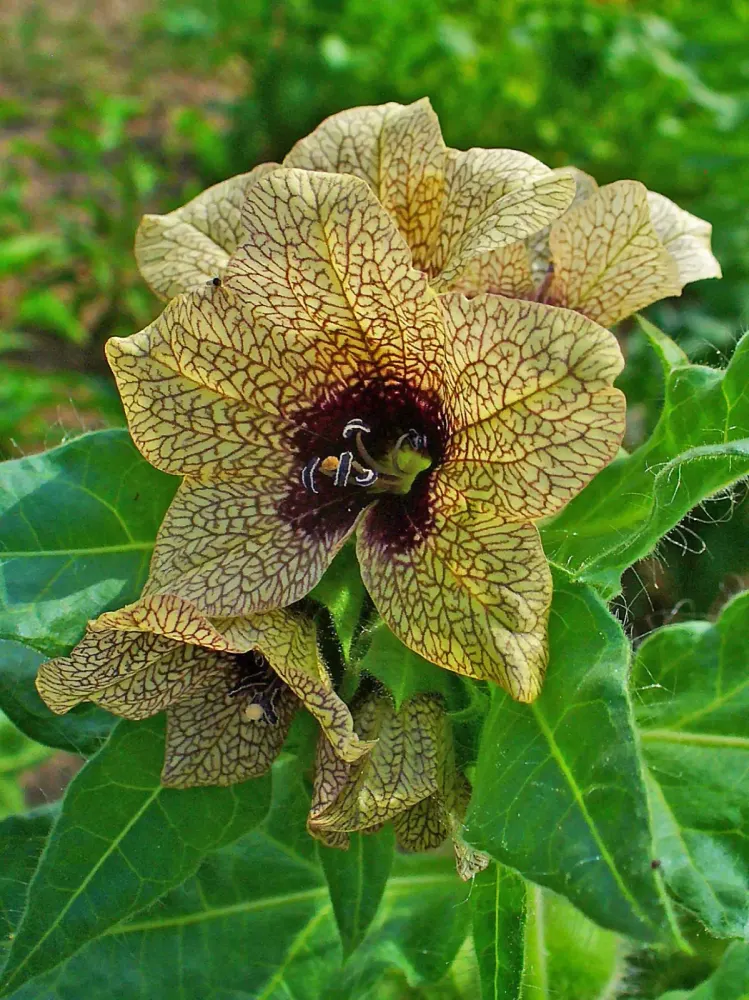
© H. Zell · CC BY-SA 3.0 · Commons
Hyoscyamus niger
Toxic🐾Schwarzes Bilsenkraut · (Hyoscyamus niger)
Nightshade family (Solanaceae)
Description
Feared since antiquity as a powerful intoxicant, black henbane ranks among the most toxic native nightshades. Its leaves and seeds contain tropane alkaloids such as hyoscyamine and scopolamine, which, heavily diluted, were once used as a pre-surgical sedative or applied externally for rheumatic pain; smoked leaves were also historically reputed to ease asthma. Archaeological finds document ritual use of the seeds in northern European and Roman contexts, and before hops became standard, henbane was used as an intoxicating beer additive in medieval brewing. All these uses are obsolete today, though the plant retains pharmaceutical relevance as a source for scopolamine, used for instance in motion-sickness patches. The whole plant is highly toxic — even small amounts can cause dry mouth, rapid heartbeat, hallucinations, seizures and respiratory paralysis. In case of suspected poisoning, call emergency services immediately; growing or consuming the plant is strictly to be avoided.
CONTRAINDICATED during pregnancy
Scopolamine and hyoscyamine cross the placental barrier and can cause fetal tachycardia and CNS damage. Any exposure during pregnancy is strictly contraindicated.
CONTRAINDICATED during breastfeeding
Tropane alkaloids pass into breast milk and can trigger anticholinergic effects in the infant. Breastfeeding: strictly contraindicated.
CONTRAINDICATED for children
Children are extremely sensitive to tropane alkaloids. Any exposure is absolutely contraindicated.
Critical drug interactions with:
Anticholinergika (Tiotropium, Ipratropium, Oxybutynin, Darifenacin)
Folk medicinal external application of henbane oil extracts for rheumatism and neuralgic pain. Seeds were boiled in olive oil and the oil rubbed onto painful joints. This application is documented since antiquity (Dioscorides, Pliny the Elder) and was long considered an analgesic.
Preparation & dosage
Historical documentation only — do NOT use
These internal applications are historically documented. This plant is highly toxic — self-treatment can cause severe poisoning or death. For documentation only, explicitly NOT a recommendation.
Folk medicinal inhalation of henbane smoke for bronchial asthma and whooping cough. Dried leaves were burned on coals and the smoke inhaled. Historically widespread in Europe and the Orient — anticholinergic bronchodilation as the mechanism of action. Now obsolete due to toxicity.
Preparation & dosage
Historical pharmaceutical use of hyoscyamine/scopolamine extracts from henbane as preoperative sedative and to reduce bronchial secretions before anesthesia. Henbane tincture was included in pharmacopoeias until the mid-20th century. Now replaced by pure isolates (scopolamine TTS, atropine injection).
Preparation & dosage
Homeopathic use of Hyoscyamus (D6–C30) for states of agitation and cramps, sleep disorders, and manic-hallucinatory symptom pictures. Pure homeopathic dilutions (from C12) contain no pharmacologically active alkaloid amounts. Widespread in classical homeopathy as a constitutional remedy.
Preparation & dosage
Ethnobotanical and shamanic use: henbane seeds were considered a psychoactive substance in northern European and Middle Eastern rituals. Archaeological finds from the Roman Netherlands (Houten-Castellum, 70–100 CE) document intentional seed collection — likely for ritual or medicinal purposes. Also mentioned in medieval witch craft (flying ointment).
Preparation & dosage
Historical use of henbane in medieval brewing: before the introduction of hops, henbane leaves and seeds were used as intoxicating beer additives (gruit beer). The etymological connection to the city name Pilsen (Plzeň) is debated in scholarship but considered unconfirmed. The Reinheitsgebot (1516) ended this practice in Germany.
Preparation & dosage
Pharmaceutical source for scopolamine isolates: Hyoscyamus niger is, alongside Duboisia spp., one of the commercial source plants for scopolamine production (motion sickness patches, premedication). Hairy-root cultures and bioreactor technology now enable standardized alkaloid production without wild harvesting.
Preparation & dosage
TOXIC — ENTIRE PLANT. Hyoscyamus niger contains toxic tropane alkaloids (hyoscyamine, scopolamine, atropine) in all plant parts. Total alkaloid content in leaves is 0.06–0.17%, in seeds 0.05–0.3%. Even small amounts can cause poisoning: dry mouth, tachycardia, dilated pupils, skin flushing, hallucinations, seizures, respiratory paralysis, coma. Lethal dose for scopolamine: ~50 mg. Intoxications can last several days. In case of suspected poisoning, IMMEDIATELY call emergency services and poison control. No self-medication. No lay use. Protective gloves required for all plant contact.
⏱ Max continuous use: 1 weeks
Scopolamine and hyoscyamine cross the placental barrier and can cause fetal tachycardia and CNS damage. Any exposure during pregnancy is strictly contraindicated.
Tropane alkaloids pass into breast milk and can trigger anticholinergic effects in the infant. Breastfeeding: strictly contraindicated.
Children are extremely sensitive to tropane alkaloids. Any exposure is absolutely contraindicated.
Drug interactions
Anticholinergika (Tiotropium, Ipratropium, Oxybutynin, Darifenacin)
Additive anticholinergic effect: enhanced dry mouth, urinary retention, tachycardia, cognitive impairment up to central anticholinergic syndrome.
Trizyklische Antidepressiva (Amitriptylin, Imipramin, Clomipramin)
Tricyclics have inherent anticholinergic properties; combination with henbane alkaloids substantially potentiates anticholinergic side effects.
MAO-Hemmer (Phenelzin, Tranylcypromin, Moclobemid)
MAO inhibitors may reduce breakdown of tropane alkaloids and increase their toxicity; central nervous system excitation possible.
Antihistaminika der 1. Generation (Diphenhydramin, Promethazin, Hydroxyzin)
First-generation H1 antihistamines have anticholinergic properties; additive effects when combined with henbane alkaloids.
Contraindications
- Narrow-angle glaucoma — scopolamine and hyoscyamine dangerously increase intraocular pressure
- Benign prostatic hyperplasia with voiding disorders — anticholinergic urinary retention
- Tachyarrhythmias — tropane alkaloids further increase heart rate
- Mechanical ileus and megacolon — intestinal paralysis through anticholinergics
- Myasthenia gravis — antagonization of neuromuscular transmission
- Pregnancy and breastfeeding (see warnings)
Harvested part: leaves and seeds
- Time of day:
- Morning hours after dew has dried — highest alkaloid content during flowering
- Drying:
- Dry quickly at 40–50 °C in the shade; slow drying promotes racemization of hyoscyamine to atropine. PROTECTIVE GLOVES MANDATORY.
- Storage:
- 12 months — Dry, protected from light, sealed; separate from foodstuffs; exclude access by children and pets.
- Time of day:
- Daytime with ripening seed capsules — harvest capsules just before opening
- Drying:
- Dry capsules at 35–45 °C; seeds contain 0.05–0.3% total alkaloids. Exclusively for pharmaceutical processing — no lay use.
- Storage:
- 24 months — Light-protected, dry, in sealed containers; comply with toxic plant storage regulations.
- Hyoscyamine (l-Hyoscyamine)AlkaloidContent: 0.04-0.15 %Leaf
Main alkaloid of black henbane; L-enantiomer of atropine; competitive antagonist at muscarinic acetylcholine receptors (M1–M5); antispasmodic, antisecretory, mydriatic. Partially racemizes to atropine during drying and extraction.
- Scopolamine (Hyoscine)AlkaloidContent: 0.01-0.1 %Leaf
Characteristic alkaloid of henbane; epoxide derivative of tropane; more sedating than hyoscyamine; efficiently crosses the blood-brain barrier; antiemetic; medically used as motion sickness patch (TTS). Proportionally higher in henbane than in Atropa belladonna.
- Atropine (dl-Hyoscyamine)AlkaloidContent: Spuren (Artefakt)Aerial parts
Racemic mixture; formed from hyoscyamine through racemization during harvest, drying, and extraction. Present only in traces in the fresh plant.
- CuscohygrineAlkaloidContent: < 0.1 %Root
Non-tropane pyrrolidine alkaloid; biosynthetic precursor of tropane alkaloids; lower pharmacological activity than hyoscyamine or scopolamine.
- ApoatropineAlkaloidContent: < 0.05 %Aerial parts
Dehydration product of atropine; weaker anticholinergic activity; formed during heating or extended storage.
- Flavonoide (Rutin, Quercetin-Glykoside)FlavonoidContent: nicht quantifiziertLeaf
Antioxidant companion substances; no primary role in henbane toxicology; detected in leaf and stem extracts.
- Cumarine (Scopolin, Scopoletin)OtherContent: nicht quantifiziertRoot
Phenolic coumarin compounds; detected in root extracts; weakly anticoagulant; no primary significance for the toxicity profile.
- Riboflavin (Vitamin B2)VitaminContent: < 0.01 %Root
Detected in Hyoscyamus niger root cultures as a by-product of alkaloid biosynthesis; quantitatively without practical significance for nutritional supply.
- [6]MonographEvidence of the intentional use of black henbane (Hyoscyamus niger) in the Roman Netherlands(accessed: 2026-05-24)
- [7]MonographProduction of tropane alkaloids in Hyoscyamus niger (black henbane) hairy roots grown in bubble-column and spray bioreactors(accessed: 2026-05-24)
- [8]MonographDiscrimination of Solanaceae Taxa and Quantification of Scopolamine and Hyoscyamine by ATR-FTIR Spectroscopy(accessed: 2026-05-24)
- [9]MonographInorganic ions in the medium modify tropane alkaloids and riboflavin output in Hyoscyamus niger root cultures(accessed: 2026-05-24)
- [10]MonographTropane alkaloids (hyoscyamine, scopolamine and atropine) from genus Datura: extractions, contents, syntheses and effects(accessed: 2026-05-24)
- [11]MonographCliniTox Giftpflanzen — Hyoscyamus niger L.: sehr stark giftig +++ (Institut für Veterinärpharmakologie und -toxikologie, Universität Zürich)(accessed: 2026-08-10)
- [5]BookPlants for a Future — Hyoscyamus niger(accessed: 2026-05-24)
- [1]WikipediaHyoscyamus niger — Wikipedia (EN)(accessed: 2026-05-24)
- [2]WikipediaSchwarzes Bilsenkraut — Wikipedia (DE)(accessed: 2026-05-24)
- [3]WikipediaScopolamine — Wikipedia (EN)(accessed: 2026-05-24)
- [4]WikidataHyoscyamus niger — Wikidata Q161058(accessed: 2026-05-24)