© Unknown · CC BY-SA 3.0 · Commons
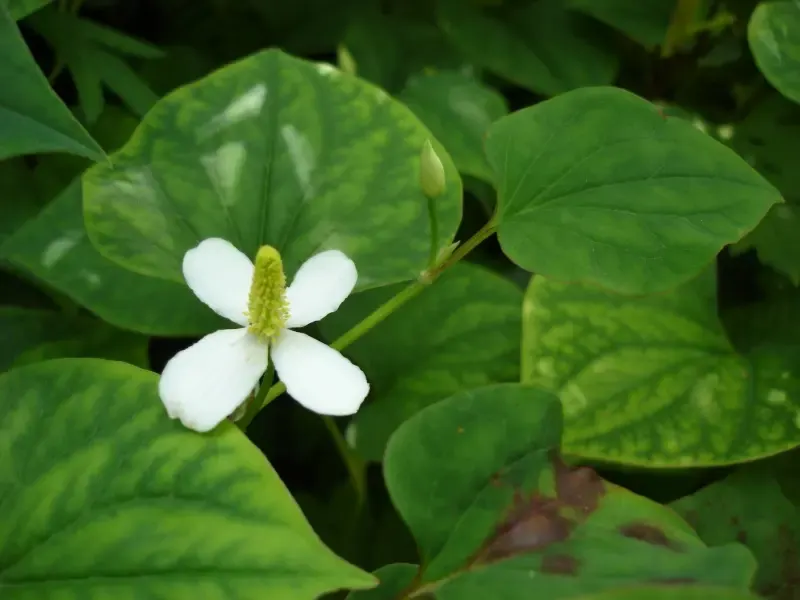
Houttuynia cordata
CautionMolchschwanz · (Houttuynia cordata)
Lizard-tail family (Saururaceae)
Description
Houttuynia cordata, also known as fish mint, fish leaf, rainbow plant, chameleon plant, heart leaf, fish wort, or Chinese lizard tail, is one of two species in the genus Houttuynia. It is a flowering plant native to Southeast Asia. It grows in moist, shady locations.
🌿 Risk of confusion — read before wild-harvesting!
Injectable Houttuynia preparations were regulated in China due to severe anaphylactic reactions (including fatalities) — these warnings do NOT apply to herbal tea or oral tinctures, which are considered significantly safer.
- TeaAerial partsInternalTraditional use
Infusion of dried aerial parts (leaves, stems) is used in Traditional Chinese Medicine (TCM) for upper respiratory tract infections, chronic cough, bronchitis, and pneumonia. The herb is considered lung-clearing (清肺 qīng fèi) and expectorant. Clinical evidence is lacking; use is based on millennia of TCM tradition and preliminary pharmacological studies.
Preparation & dosage
Pour 200 ml boiling water over 3–10 g of dried herb, steep for 10 minutes, strain. Drink up to 3 cups daily. Do not use longer than 4 weeks without a break.
- Dry amount
- 3–10 g
- Doses per day
- 3×
[#src_zhang_dietary_chinese_herbs] [#src_kurmanbaeva_2022] [#src_wiki_houttuynia]
- TeaAerial partsInternalTraditional use
In TCM, Houttuynia (Yu Xing Cao / 鱼腥草) is traditionally used for urinary tract infections and to strengthen immune defences. The diuretic effect is empirically supported; antimicrobial constituents (decanoyl acetaldehyde, quercetin) are discussed as the mechanism.
Preparation & dosage
Steep 5–15 g dried herb in 250 ml hot water for 10 minutes. Drink 2 cups daily with adequate fluid intake.
- Dry amount
- 5–15 g
- Doses per day
- 2×
[#src_zhang_dietary_chinese_herbs] [#src_qu_chemical_constituents] [#src_wiki_houttuynia]
- CompressLeafExternalFolk medicine
Fresh, crushed leaves are applied in Asian folk medicine to inflamed skin areas, boils, snake bites, and poorly healing wounds. Astringent tannins and antibacterial constituents act as surface disinfectants.
- TinctureAerial partsInternalFolk medicine
Alcoholic extract from fresh or dried plant parts as immune tonic. In vitro studies demonstrate antiviral activity against HSV through inhibition of the NF-κB pathway; clinical evidence in humans is lacking. Not equivalent to injectable Houttuynia preparations, which have caused severe hypersensitivity reactions.
Preparation & dosage
Ready-made preparation (1:5 tincture, 40% ethanol) as per manufacturer's instructions. Do not self-prepare without phytopharmaceutical experience. Maximum use: 4 weeks.
- Doses per day
- 2×
- RawLeafInternalFolk medicine
Fresh leaves and rhizomes are eaten in Southeast Asian and southwestern Chinese cuisines as a salad herb, condiment, and side dish (Vietnam: rau diếp cá; Yunnan: zhé'ěrgēn). The characteristic fishy smell comes from decanoyl acetaldehyde. Consumption is considered digestive and mildly anti-inflammatory.
- TeaWhole plantInternalFolk medicine
In Chinese and Vietnamese folk medicine, a strong decoction of the whole plant is used to reduce fever. Antimicrobial flavonoids (quercetin, isoquercitrin) and volatile decanoyl acetaldehyde are regarded as active principles. Not a substitute for medically prescribed therapy in persistent fever.
Preparation & dosage
Simmer 10–30 g fresh or 5–15 g dried plant in 300 ml water for 20 minutes, strain. Drink twice daily. Consult a doctor for fever lasting more than 2 days.
- Dry amount
- 10–30 g
- Doses per day
- 2×
- BathAerial partsExternalFolk medicine
Partial baths and compresses with concentrated Houttuynia infusion are used in folk medicine for eczematous skin conditions, pruritus, and infected skin lesions. The antibacterial and astringent properties are considered effective; controlled studies are lacking.
Distribution in Europe
🪴 Grow at home
- ☀ Light
- partial shade
- 💧 Water
- daily
- 🌱 Soil
- Moist to wet, loamy
- 🪴 Pot
- 20 cm
- ⭐ Difficulty
- ★★☆ intermediate
- 🐾 Pets
- pet-safe
Tips:
- Needs CONSTANTLY moist soil — saucer with water.
- Spreads aggressively — keep in pot, don't plant in garden.
- Strong flavour ("fish mint") — good for Asian cooking.
Care tips are general indoor-gardening recommendations, not scientific sources.