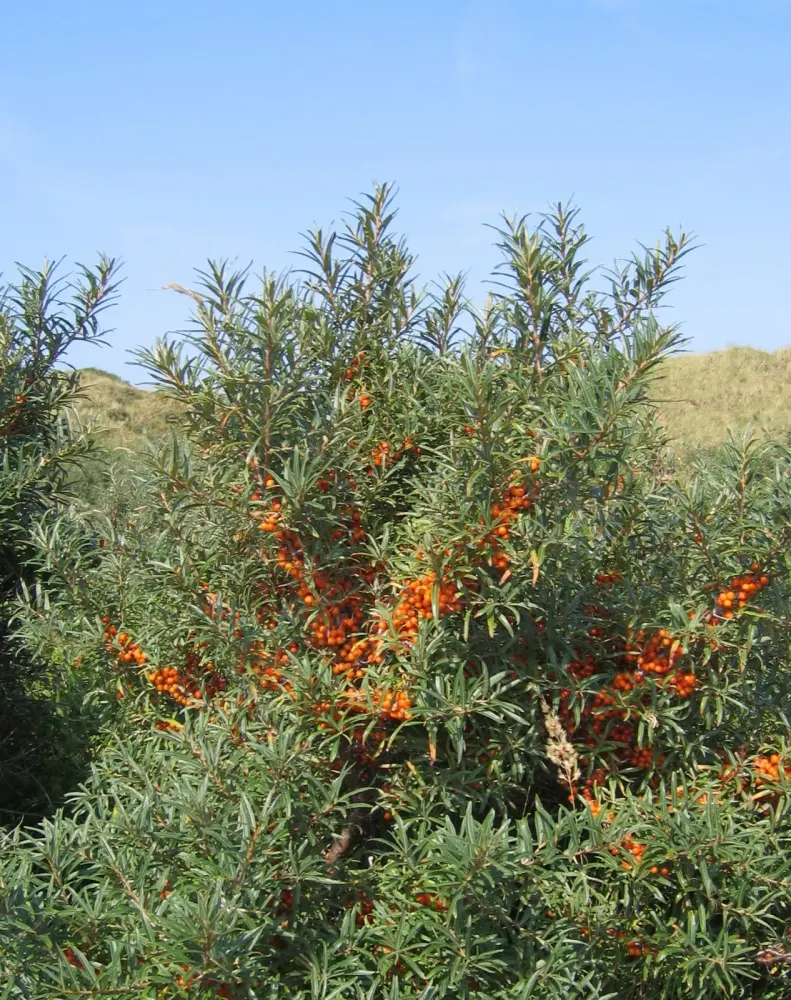
© No machine-readable author provided. Svdmolen assumed (based on copyright claims). · CC BY-SA 3.0 · Commons
Sea buckthorn
CautionSanddorn · (Hippophae rhamnoides)
Oleaster family (Elaeagnaceae)
Description
Sea-buckthorn, also known as sea buckthorn, sandthorn, sallowthorn or seaberry, is a species of flowering plant in the family Elaeagnaceae, native to cold-temperate regions of Eurasia. It is a spiny deciduous shrub. The fruit has culinary uses, while its extracts, including its oil, are used in the cosmetics industry and within traditional medicine.
- RawFruitInternalTraditional use
Fresh berries and pressed juice as an exceptionally vitamin-C-rich food source — traditional immune support in Northern/Central Europe and Central Asia.
Preparation & dosage
RAW / JUICE: Fully ripe orange-red to deep-red berries (Sept–Oct) contain 200–900 mg vitamin C per 100 g depending on variety — among the richest native fruits in vitamin C. Raw, they are intensely sour and astringent; mix with honey, sugar or sweet fruits for direct consumption. More common: pressed juice, undiluted mother juice (10–30 ml daily), or diluted with water and honey as a vitamin-rich cold drink. Do not heat above 60 °C as heat-sensitive vitamins (C, B vitamins) are destroyed. The exceptionally high vitamin C concentration makes sea buckthorn the traditional immune-supporting autumn/winter remedy in Siberia, Central Asia and Northern Europe.
[#src_pfaf_hippophae] [#src_wp_de_sanddorn] [#src_wp_en_seabuckthorn] [#src_wichtl_sanddorn]
- RawSeedExternalTraditional use
Cold-pressed sea buckthorn seed oil for skin regeneration and wound care — rich in essential fatty acids and vitamin E, folk-medicinally for dry, cracked skin and mucous-membrane irritation.
Preparation & dosage
SEA BUCKTHORN SEED OIL (external): Cold-pressed from seeds, rich in mono- and polyunsaturated fatty acids (linoleic acid ~36 %, oleic acid ~15 %, alpha-linolenic acid ~32 %) and tocopherols (vitamin E). Apply undiluted or incorporated in cream/ointment (2–5 %) to clean skin. Traditionally for wound care, dry, brittle and cracked skin, scar regeneration and mucous-membrane irritation (e.g. minor burns, radiation dermatitis — folk medicine). Distinguish deep-yellow to reddish seed oil from pulp oil (even richer in carotenoids, orange): seed oil has a milder odour and less carotene-colouring effect.
- SalveFruitExternalTraditional use
Sea buckthorn pulp oil in salve base for inflamed skin, mucous-membrane inflammation and folk-medicinally for stomach ulcers — high carotenoid profile with regenerative activity.
Preparation & dosage
SEA BUCKTHORN PULP OIL / SALVE: The deep-orange, carotenoid-rich pulp oil (extracted from fruit flesh after de-seeding, C40-carotenoids 30–40 mg/100 g) intensely stains skin orange — apply diluted (3–10 % in neutral base such as shea butter, jojoba oil or beeswax salve). Apply thinly to clean skin, massage briefly. Traditional use for scaly, inflamed skin (dermatitis, psoriasis support), oral and pharyngeal mucous-membrane inflammation, and folk-medicinally for stomach ulcers (oral pulp oil — scientifically insufficiently documented). Stretch-mark prevention in folk medicine of Northern and Eastern Europe.
- TeaFruitInternalFolk medicine
Folk sea buckthorn berry tea as an immune-supporting winter drink in Northern and Eastern Europe — rich in vitamin C and carotenoids.
Preparation & dosage
SEA BUCKTHORN TEA (berries): 2–4 tsp dried, lightly crushed sea buckthorn berries in 250 ml cold water, bring to boil, simmer 8–10 min (decoction), strain and sweeten with honey to taste. 2 cups daily. Folk use as an immune-supporting winter drink in Russia, the Baltic states and Northern Europe — particularly for cold prevention and influenza-like illness. Vitamin C is heat-sensitive: some is lost during boiling but a significant portion remains (better: cold or warm infusion below 60 °C). For warm infusion, crush berries, pour 70–80 °C water over them, steep 15 min.
- Dry amount
- 2–4 g
- Doses per day
- 2×
[#src_wp_de_sanddorn] [#src_pfaf_hippophae] [#src_wp_en_seabuckthorn]
- TinctureFruitInternalFolk medicine
Folk sea buckthorn liqueur as a vitamin boost in the cold season — macerated berries in grain spirit or vodka, traditional household recipe of Northern and Eastern Europe.
Preparation & dosage
SEA BUCKTHORN LIQUEUR / MACERATION (folk): 250 g fresh or frozen sea buckthorn berries with 500 ml grain spirit (38 %) or vodka and 3–4 tbsp honey in a sealed jar, macerate cool and dark for 4–6 weeks, shake daily, filter and bottle. 1–2 tablespoons (10–15 ml) 1–2× daily as a traditional vitamin boost during the cold season. Note: This is a folk household recipe (not a standardised tincture) — moderate ethanol content; not for alcohol dependence, pregnancy, lactation or children.
- Liquid amount
- 5–15 ml
- Doses per day
- 2×
- SpiceFruitInternalFolk medicine
Versatile kitchen ingredient: juice, jam, jelly, sauces, smoothies — highly nutritious, intensely sour; in Mongolian and Tibetan folk medicine also used as a digestive.
Preparation & dosage
KITCHEN: Sea buckthorn berries (fresh, frozen, as mother juice or puree) are used diversely: juice and undiluted mother juice as vitamin-rich drink; cooked into jam, jelly and marmalade (very pectin-rich — gels without added pectin); as fruit sauce with game and cheese; sea buckthorn butter (puree with butter and honey); in smoothies with banana or mango to temper the flavour. In Mongolian and Tibetan folk medicine traditionally as a digestive (berries and leaves) and energy food in high-altitude regions. Intensely sour-astringent — always needs a sweetener (honey, sugar, sweet fruit) in the kitchen.
[#src_wp_de_sanddorn] [#src_wp_en_seabuckthorn] [#src_pfaf_hippophae]
- TeaLeafInternalFolk medicine
Folk leaf tea as a mild antioxidant and tonic — used in Russia and Central Asia for joint complaints and general strengthening.
Preparation & dosage
LEAF TEA: 1–2 tsp dried sea buckthorn leaves in 200 ml boiling water, covered, steep 7–8 min, strain. 2 cups daily. Sea buckthorn leaves contain flavonoids (isorhamnetin, quercetin, kaempferol) and tannins. Folk use in Russia and Central Asia as a general tonic and antioxidant, for joint complaints (rheumatism, gout — folk) and skin support from within. Leaf tea is mild in flavour (slightly astringent), not a potent remedy — use leaves harvested in early summer (May–June), before berry ripening. No EMA or Kommission E monograph.
- Dry amount
- 1–2 g
- Doses per day
- 2×
[#src_pfaf_hippophae] [#src_wp_de_sanddorn] [#src_clinical_flavonoids_leaf]