© Drew Avery · CC BY 2.0 · Commons
Hippeastrum
Toxic🐾Ritterstern_(Gattung) · (Hippeastrum vittatum)
Amaryllis family (Amaryllidaceae)
Description
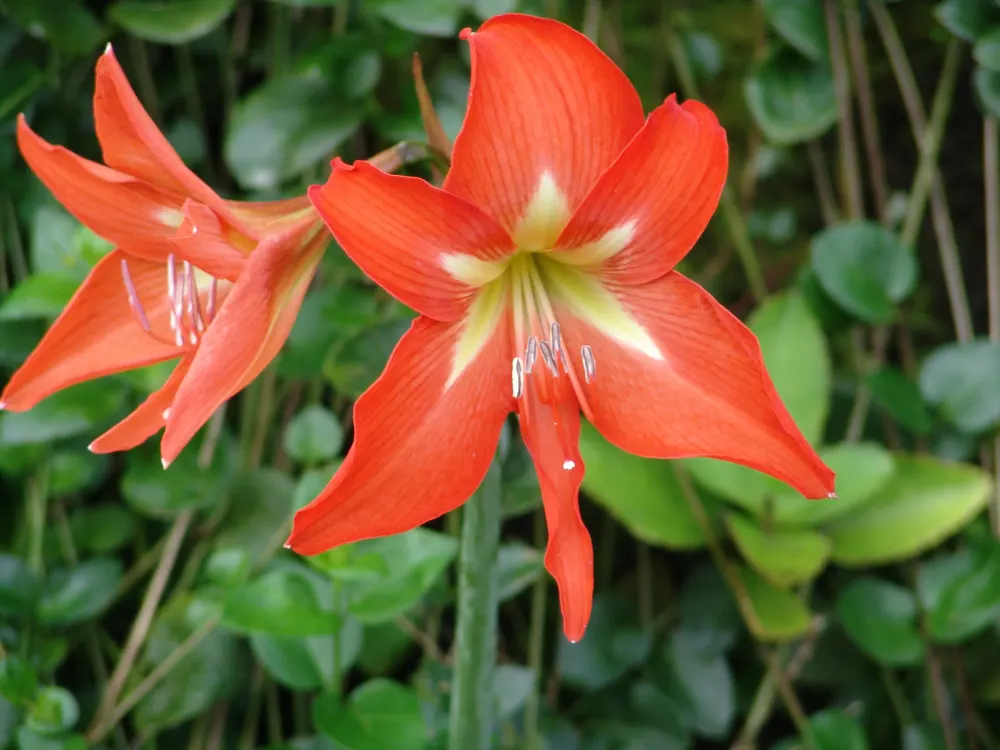
Hippeastrum is a genus of 116 species, and over 600 hybrids and cultivars, of perennial, herbaceous and bulbous plants, native to tropical and subtropical regions of the Americas, from Mexico south to Argentina and on some islands in the Caribbean. The majority have large, fleshy bulbs and tall, broad, strap-like leaves that are (generally) evergreen, and large red or purple flowers. Numerous colors and cultivars have been created over the past hundred years.
🌿 Risk of confusion — read before wild-harvesting!
The classic poisoning occurs — analogous to narcissus — through accidental confusion of the dried bulb with kitchen onion or shallot, particularly after Christmas gifts, when the spent bulbs find their way into kitchens and pantries.
External use only!
This plant must NOT be taken internally. Use only as compress, salve, or bath.
CONTRAINDICATED during pregnancy
Lycorine and other Amaryllidaceae alkaloids inhibit ribosomal protein biosynthesis and are embryotoxic in vitro as well as teratogenic in animal studies. Any oral or high-dose topical application of Hippeastrum material during pregnancy is contraindicated. Skin contact with the plant sap should also be consistently avoided in pregnancy by wearing gloves, since systemic absorption through sensitised or damaged skin cannot be ruled out.
CONTRAINDICATED during breastfeeding
Transfer of Amaryllidaceae alkaloids into breast milk is insufficiently studied; given the acute toxicity (vomiting, seizures) for the infant, any internal use is strictly contraindicated. For purely indoor and gift-plant use, breastfeeding mothers are not at risk provided skin contact with the plant sap is consistently avoided.
CONTRAINDICATED for children
Children classically poison themselves by biting into the large, attractive bulb — as a Christmas gift plant, Hippeastrum vittatum is particularly risky in households with small children. Even a piece of bulb scale can trigger severe vomiting and dehydration. The plant should be placed out of reach of climbing children; after flowering, store the bulb in a sealed container (clearly labelled as 'amaryllis — toxic'). On accidental ingestion: poison control hotline, no self-induced vomiting, present to medical care as quickly as possible. No lay use in children.
Critical drug interactions with:
Cholinesterase-Hemmer (Donepezil, Rivastigmin, Galantamin, Pyridostigmin)
- RawFlowerExternalFolk medicine
The striped Barbados lily (Hippeastrum vittatum) is the classic 'winter amaryllis' of the Central European living room — as a Christmas and Advent gift plant, the forced bulb has been established in Dutch and German floristry since the late 19th century. Between December and February, a large dried bulb sends up a leafless flowering scape within four to six weeks bearing two to six funnel-shaped, red-and-white striped blooms of 12 to 18 centimetres diameter. Important clarification: in everyday language the plant is almost always called 'amaryllis', but botanically it belongs to the genus Hippeastrum (around 80 South American species, indoor forcing culture). The true botanical genus Amaryllis comprises only a single species, Amaryllis belladonna from the South African Cape, which blooms outdoors in late summer. Both genera were frequently confused in the 19th century; the taxonomic separation was definitively settled in 1987 by the International Association for Plant Taxonomy.
- RawFlowerExternalTraditional use
Industrial cut-flower production: Dutch and Brazilian specialist nurseries grow Hippeastrum bulbs over two to three years in open field or tunnel culture, harvest and dry them in summer and ship dried bulbs (calibre 26 to 36 centimetres circumference) to European retail in autumn. In parallel, cut flowering stems with buds are traded during the pre-Christmas and wedding season; with a vase life of two to three weeks they are among the longest-lasting cut flowers. Key production hubs sit in the Netherlands (Hillegom, Lisse) and in the Brazilian states of São Paulo and Rio Grande do Sul. Because of considerable collector value, rare wild Hippeastrum species are threatened in Brazil and regulated under CITES Appendix II (protection applies to wild-collected material, not to the cultivated gift plant H. vittatum).
- RawFlowerExternalFolk medicine
Naming and symbolism: the German common name 'Ritterstern' (knight's star) refers to the star-shaped spread of the bloom and the chivalric red tepals streaked with white — presumably a translation of the Latin genus name Hippeastrum ('horseman's star', from Greek hippeus = horseman and astron = star), introduced by the English plant enthusiast William Herbert in 1837. The common name 'amaryllis' goes back to the eponymous shepherdess Amaryllis from Virgil's Eclogues (pastoral poems, 1st century BCE) and was originally assigned by Linnaeus in 1753 to the whole group, later restricted to the South African Amaryllis belladonna. The purely cultural and linguistic-historical significance — use as a gift and Christmas symbol, wedding flower, symbol of steadfastness in Victorian flower language — far outweighs any medicinal connection.
- Rawuse.plant_part.bulbExternalFolk medicine
South American ethnobotany: indigenous Andean peoples (Quechua, Aymara) as well as tribes in the Brazilian Amazon highlands historically used various Hippeastrum relatives as components of plant-based arrow and spear poisons. The bulbs were crushed, fermented and applied to arrow tips — the contained Amaryllidaceae alkaloids (especially lycorine) act as central nervous system depressants and supported hunting success for small game. There is NO documented indigenous medicinal use of Hippeastrum bulbs — the ethnobotanical connection is purely toxicological-technical for hunting purposes. This entry is purely documentary; due to the acute toxicity (see safety notes) and the danger to modern users, any imitation is expressly warned against. The cultural significance has largely been lost with the disappearance of traditional hunting practices.
- Rawuse.plant_part.bulbExternalFolk medicine
Toxicity warning note — not a remedy: the fresh plant sap contains Amaryllidaceae alkaloids and calcium oxalate raphides which, on repeated skin contact (typically in florists, gardeners and bulb sorters in the Netherlands), trigger an irritant to allergic contact dermatitis — the so-called 'amaryllis dermatitis' or 'Hippeastrum hand'. Symptoms: redness, itching, small vesicles on hands and forearms within hours to days of exposure; sensitised individuals may show acute urticarial reactions. Prevention: nitrile or leather gloves when repotting, cutting and removing spent flower scapes. This is explicitly an ethnobotanical or occupational medicine warning, not a therapeutic indication.
[#src_hv_wiki_en] [#src_hv_aspca] [#src_hv_pubmed_alkaloids]