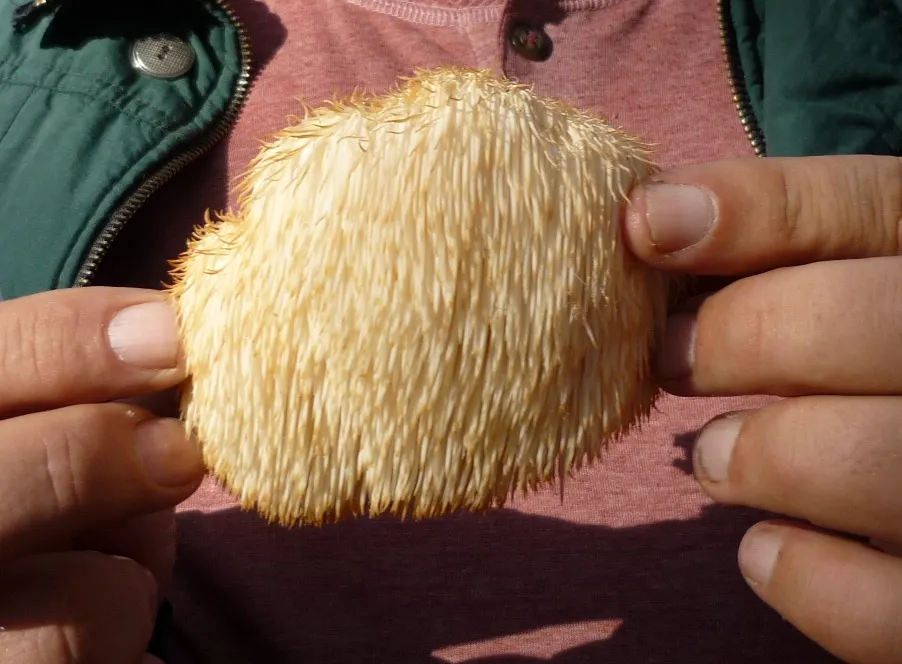
© Властарь (Wikimedia Commons) · CC BY-SA 3.0 · Commons
Lion's Mane
CautionIgel-Stachelbart (Löwenmähne) · (Hericium erinaceus)
Hericium family (Hericiaceae) (Hericiaceae)
Description
Lion's mane (Hericium erinaceus) is a whitish, bulbous tooth fungus in the Hericiaceae family (order Russulales). Instead of a cap it bears crowded, hanging spines 1-5 cm long that give it the look of a lion's mane or monkey head; the fruiting body reaches about 10-25 cm across. It grows as a weak parasite and saprotroph on hardwoods, especially beech and maple, across the temperate Holarctic, and is rare and threatened in much of Europe. In East Asia it has long been eaten as a choice edible (its texture and taste are likened to seafood) and used in traditional Chinese medicine. Modern research focuses on its neuroactive compounds, the hericenones and erinacines.
- TeaWhole plantInternalTraditional use
In traditional Chinese medicine the mushroom is used as a decoction or tonic; it is traditionally associated with supporting the stomach, digestion and general vitality.
- RawWhole plantInternalClinical trial
Dried fruiting-body powder (e.g. as capsules/tablets) is taken to support cognitive function. A small randomized, double-blind, placebo-controlled trial (Mori et al. 2009) found improved cognitive-scale scores over 16 weeks in older adults with mild cognitive impairment; overall the clinical evidence remains limited.
- TinctureWhole plantInternalFolk medicine
In folk practice alcoholic extracts (tinctures) of the fruiting body are also used as a general restorative tonic.