© Unknown · Public domain · Commons
Helleborus niger
Toxic🐾Schneerose · (Helleborus niger)
Buttercup family (Ranunculaceae)
Description
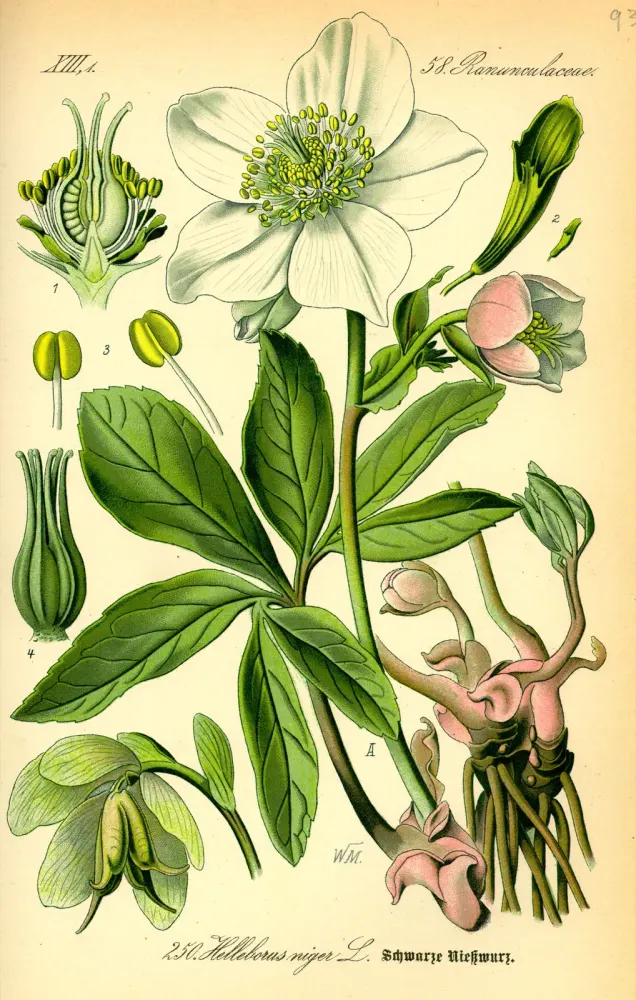
Helleborus niger, commonly called Christmas rose or black hellebore, is an evergreen perennial flowering plant in the buttercup family, Ranunculaceae. It is one of about 20 species from the genus Helleborus. It is a poisonous cottage garden favourite because it flowers in the depths of winter.
CONTRAINDICATED during pregnancy
Cardenolides cross the placental barrier and can trigger foetal cardiac arrhythmias. Protoanemonin is embryotoxic. Any use during pregnancy is strictly contraindicated.
CONTRAINDICATED during breastfeeding
Cardiac glycosides can pass into breast milk and cause cardiotoxic effects in the infant. Internal use during lactation is absolutely contraindicated.
CONTRAINDICATED for children
Children are particularly at risk of poisoning due to lower body mass and more sensitive cardiac physiology. Any internal contact must be absolutely avoided in children. In case of suspicion, contact a poison control centre immediately.
Critical drug interactions with:
Herzglykoside (Digitalis, Digoxin, Digitoxin) · Kaliumverlust-Diuretika (Thiazide, Schleifendiuretika) · Antiarrhythmika (Chinidin, Amiodaron, Verapamil)
- TinctureRootExternalFolk medicine
In medieval and early modern folk medicine, diluted hellebore extract was applied externally to chronic skin diseases (scabies, lichen) and joint pain. The strongly irritant protoanemonin action caused reddening of the skin (rubefacient effect). External use is today considered dangerous (risk of burns, percutaneous absorption of cardenolides).
- RawFlowerExternalFolk medicine
The Christmas rose is today primarily a popular ornamental plant in European gardens. The white flowers, blooming from December/January, symbolise purity and hope (Christmas). Permissible as purely ornamental use without medical context, but caution in households with children and pets — all parts remain toxic.
Historical documentation only — do NOT use
These internal applications are historically documented. This plant is highly toxic — self-treatment can cause severe poisoning or death. For documentation only, explicitly NOT a recommendation.
- TinctureRootInternalFolk medicine
Hippocrates (c. 460–370 BC) and later ancient physicians used black hellebore root extract to treat mental illness (melancholy, mania). The root was considered a powerful purgative that would expel 'black bile'. Dioscorides described its use in 'De Materia Medica' (1st century AD). Due to its high toxicity, this application is today absolutely obsolete and dangerous.
[#src_wiki_helleborus_de] [#src_wiki_helleborus_en] [#src_pfaf_helleborus]
- RawRootInternalFolk medicine
Hildegard of Bingen (1098–1179) mentioned hellebore in her medical writings as a remedy for mental confusion and 'heavy melancholy'. She simultaneously warned of its strong action and the danger of misuse. Medieval medicine also used the root for stubborn fever and dropsy — always in extreme cases and under strict dosing.
- RawRootInternalFolk medicine
Dried root powder of black hellebore was historically blown into the nose as a 'sneezing powder' (sternutatory) to loosen mucus or revive unconscious persons. This use spread across Europe in the 16th–18th centuries and gave the plant its German vernacular name 'Nieswurz' (sneeze-root). No longer practised today due to extreme irritant action and poisoning risk.
- TinctureRootInternalFolk medicine
Homoeopathic preparations of Helleborus niger (mother tincture, C6, C30) are used in homoeopathy for drowsiness, exhaustion, and nervous weakness. Highly diluted homoeopathic preparations are considered safe. Outside the homoeopathic framework the plant is highly toxic; self-medication with plant material is prohibited.
- RawRootInternalFolk medicine
Historically and toxicologically, hellebore is associated with several ancient poisoning cases. An ancient tradition links the death of Alexander the Great (323 BC) to a drink containing hellebore — without confirmed evidence. Similarly, Solon of Athens (c. 600 BC) is attributed with deliberately poisoning the water supply of Kirrha with hellebore during a siege. This historical-toxicological dimension makes the plant an important subject of ancient pharmacy study.