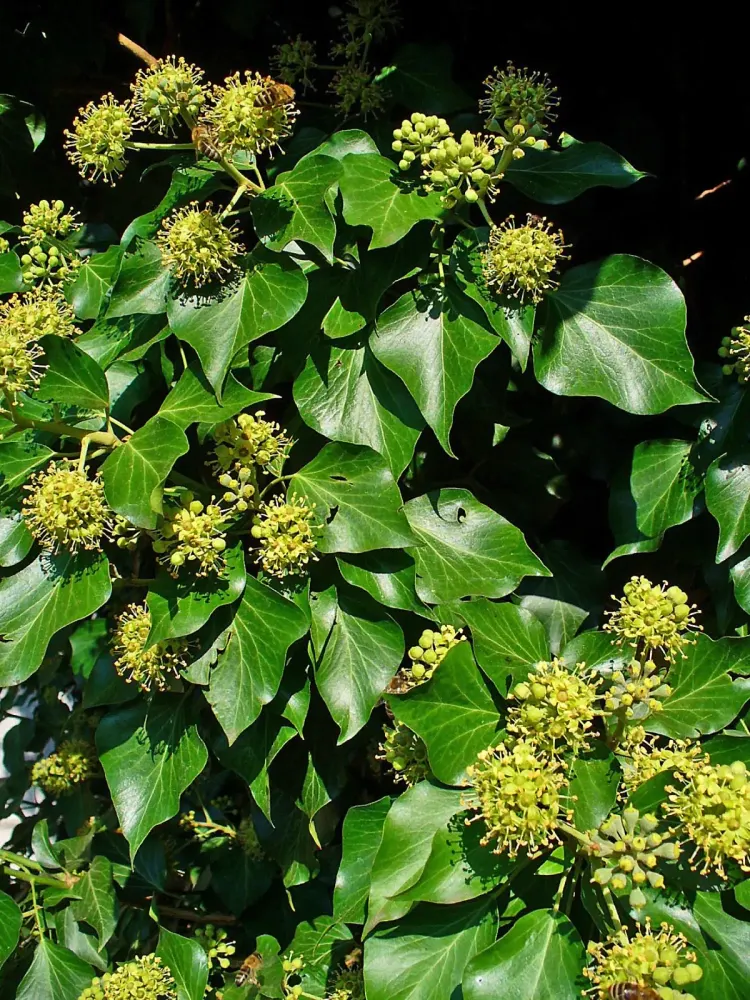
© H. Zell · CC BY-SA 3.0 · Commons
Hedera helix
Toxic🐾Gemeiner Efeu · (Hedera helix)
Ginseng family (Araliaceae)
Description
Hedera helix, simply ivy, or common ivy, English ivy, European ivy, King's choice ivy, is a species of flowering plant in the family Araliaceae. It is native to most of Europe and parts of western Asia. Ivy is a clinging evergreen vine that grows on tree trunks, walls, and fences in gardens, waste spaces, and wild habitats.
CONTRAINDICATED during pregnancy
EMA HMPC: safety in pregnancy not established. Do not use due to lack of data. Avoid external applications (baths, compresses with fresh leaves) as well — systemic absorption of falcarinol and saponins cannot be excluded.
CONTRAINDICATED during breastfeeding
EMA HMPC: safety during breastfeeding not established. Transfer of saponins into breast milk cannot be excluded. Do not use.
Critical drug interactions with:
Antitussiva (Codein, Dextromethorphan, Noscapin)
- TinctureLeafInternalEMA well-established
Expectorant (EMA well-established use) for acute productive cough — triterpene saponins (hederacoside C / alpha-hederin) thin bronchial mucus. One of Germany's best-selling herbal cough remedies, widely used in paediatrics (Prospan).
Preparation & dosage
STANDARDISED EXTRACT (EMA well-established use): Use only as a licensed finished pharmaceutical (cough syrup, drops, effervescent tablet) — e.g. Prospan, Hedelix, Bronchipret. EMA-approved extract types: dry extract DER 4–8:1 (ethanol 24–30 %), DER 6–7:1 (ethanol 40 %), DER 3–6:1 (ethanol 60 %); liquid extract DER 1:1 (ethanol 70 %); soft extract DER 2.2–2.9:1 (ethanol 50 % + propylene glycol). Adults/adolescents ≥ 12: single dose 15–100 mg dry extract, daily 45–300 mg; follow package insert. Max 1 week without medical advice. Dyspnoea, fever, deterioration or purulent sputum require immediate medical attention. NEVER as self-made infusion from garden ivy — fresh leaves are irritant to toxic.
- Liquid amount
- 15–100 ml
- Doses per day
- 3×
- Max duration
- 1 weeks
⚠ Age restriction: ≥ 2 years — Contraindicated under 2 — secretolytics may worsen airway symptoms in infants. Ages 2–5: markedly reduced dose, only on medical advice. Ethanol liquid extracts (DER 1:1, 70 % ethanol) only from age 6.
[#src_ema_hederae_helicis_folium_weu] [#src_escop_hederae_folium] [#src_kommission_e_efeu]
- SalveLeafExternalFolk medicine
Historical folk use as chest and joint compress — not recommended today due to contact allergen risk (falcarinol); prefer standardised pharmaceutical preparations.
Preparation & dosage
FOLK EXTERNAL USE (historical, not recommended): In older folk medicine, crushed fresh ivy leaves were applied as a compress to joints or the chest for rheumatic complaints and bronchitis. NOT RECOMMENDED TODAY: falcarinol in fresh leaves is a known contact allergen — contact dermatitis possible, especially on sensitive skin or in sunlight (phototoxic reaction). If used: patch test first, no open wounds, max 30 min, wash off afterwards. Standardised pharmaceutical salves with controlled-low-falcarinol ivy extract are considerably safer.
- CompressLeafExternalFolk medicine
Ethnobotanically recorded folk wound compress (Madaus 1938) — no clinical evidence and not advisable today due to falcarinol.
Preparation & dosage
COMPRESS (historical, folk): Older sources (incl. Madaus 1938) describe applying fresh ivy leaves to slow-healing wounds, ulcers and burns — reportedly cleansing and anti-inflammatory. NOT RECOMMENDED on wounds: falcarinol and saponins from fresh leaves can irritate tissue; no clinical efficacy evidence. Listed here solely as ethnobotanical record.
- BathLeafExternalFolk medicine
Folk ivy bath for rheumatism and skin irritations — photosensitising and allergenic potential from falcarinol; only use with great caution and brief skin contact today.
Preparation & dosage
IVY BATH / ADDITIVE (folk, very limited): In some European folk traditions, ivy sprigs were used as a bath additive for rheumatism, joint swelling and skin rashes — decoction of ~100 g fresh or 50 g dried leaves in 1 litre water, simmer 15 min, strain, add to bath. IMPORTANT: falcarinol can act transdermally — contact dermatitis possible in sensitive individuals, especially with extended baths. Photosensitisation after exposure. Not recommended for children or pregnant women.
Historical documentation only — do NOT use
These internal applications are historically documented. This plant is highly toxic — self-treatment can cause severe poisoning or death. For documentation only, explicitly NOT a recommendation.
- InhalationLeafInternalTraditional use
Adjunctive inhalation for respiratory infections as licensed pharmaceutical only — not as home preparation from raw ivy leaves.
Preparation & dosage
INHALATION (finished preparation only): Some licensed ivy-based preparations are available as inhalation solution (medical prescription advised). Home steam inhalation with fresh or dried ivy leaves NOT recommended — falcarinol and saponins may irritate mucous membranes. As adjunct in bronchitis, plain saline inhalation (0.9 % NaCl) can complement oral ivy preparations.
[#src_ema_hederae_helicis_folium_weu] [#src_wichtl_teedrogen]
- TinctureLeafInternalCommission E
Kommission E (1988, positive): ivy leaf for catarrh of the airways and as expectorant — basis for today's standardised drops and syrup pharmaceuticals.
Preparation & dosage
TINCTURE / LIQUID EXTRACT (licensed pharmaceutical only): Kommission E positively assessed ivy leaf for catarrh of the airways and as an expectorant in bronchitis. Modern use: standardised finished pharmaceuticals only (drops, syrup). Do not prepare household tincture from fresh or dried ivy leaves — standardisation and falcarinol removal require pharmaceutical extraction.
- Doses per day
- 3×
- Max duration
- 1 weeks
- TeaLeafInternalFolk medicine
Historical folk infusion of dried ivy leaves for cough — not recommended today due to poor saponin water-solubility and falcarinol irritation risk; standardised pharmaceuticals strongly preferred.
Preparation & dosage
HISTORICAL INFUSION (not recommended, ethnobotanical record only): Older folk medicine used 0.5–1 g dried ivy leaves in 200 ml hot water, steeped 5 min, for cough. NOT RECOMMENDED TODAY: (1) triterpene saponins are poorly water-soluble — efficacy far below pharmaceutical ethanol extracts; (2) falcarinol partly passes into infusion, may irritate gastric mucosa and cause contact sensitisation; (3) very bitter taste. EMA and Kommission E recommend only standardised extracts. Products like Prospan far outperform the infusion in both efficacy and safety.
- Dry amount
- 0.5–1 g
- Doses per day
- 2×
- Max duration
- 1 weeks
[#src_madaus_efeu] [#src_wichtl_teedrogen] [#src_pfaf_hedera_helix]
Distribution in Europe
🪴 Grow at home
- ☀ Light
- partial shade
- 💧 Water
- weekly
- 🌱 Soil
- Standard potting compost
- 🪴 Pot
- 18 cm
- ⭐ Difficulty
- ★☆☆ beginner
- 🐾 Pets
- toxic to pets
Tips:
- Robust hanging plant — also in darker corners.
- Cut back regularly for bushy growth.
- TOXIC if eaten (berries!) — keep away from children/pets.
Care tips are general indoor-gardening recommendations, not scientific sources.