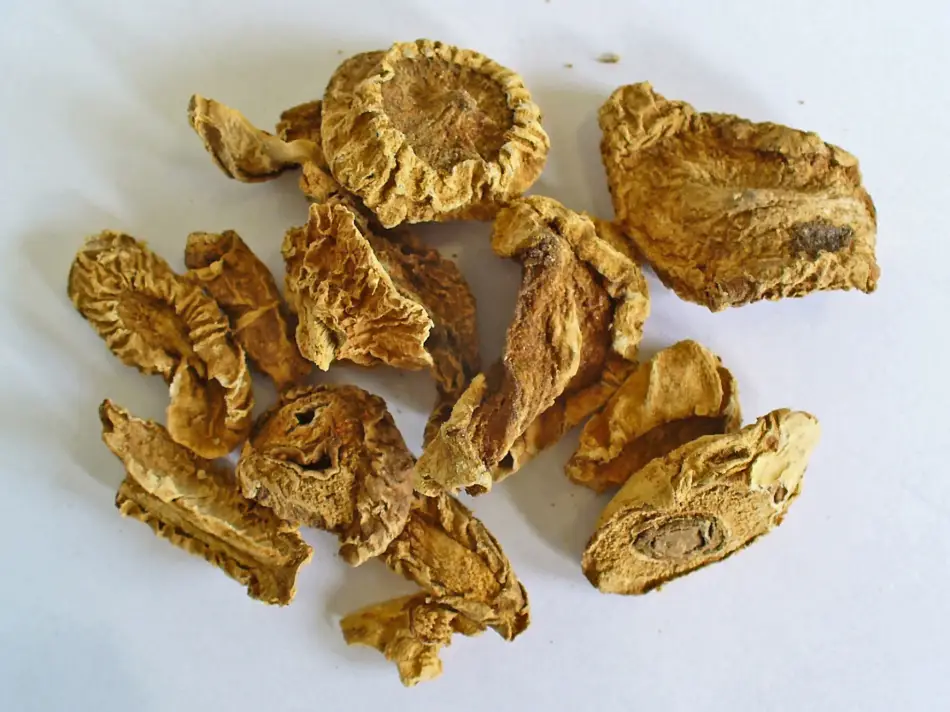
© H. Zell (Wikimedia Commons user Llez) · CC BY-SA 3.0 · Commons
Devil's claw
Afrikanische Teufelskralle · (Harpagophytum procumbens)
Sesame family (Pedaliaceae)
Description
Devil's claw is a prostrate, perennial plant from the semi-deserts and savannas of southern Africa, especially the Kalahari of Namibia, Botswana and South Africa. Its name derives from the woody fruits bearing claw-like, hooked appendages that catch in the fur of passing animals to disperse the seeds. The medicinal part is not the fruit but the fleshy secondary storage tubers (lateral roots) that branch off the deep primary root. They contain the bitter iridoid glycoside harpagoside as their characteristic constituent. Indigenous San and Khoi peoples have used the tuber for centuries against pain and digestive complaints.
CONTRAINDICATED during pregnancy
Do not use during pregnancy; safety is not established due to a lack of data and an oxytocin-like, labour-stimulating effect has been discussed.
Traditional use for the relief of minor joint pain. The EMA classifies this indication as 'traditional use' - effectiveness rests on long-standing experience, not on confirmed clinical trials.
Preparation & dosage
Standardised dry extract of the secondary storage tuber, adjusted to harpagoside (typically about 50-100 mg harpagoside per day), divided into several single doses. The effect builds up over days to weeks. Consult a doctor if pain persists longer than 4 weeks or worsens. Alternatively an infusion/decoction of the comminuted tuber may be used.
- Dry amount
- 1–3 g
- Doses per day
- 3×
- Max duration
- 4 weeks
⚠ Age restriction: ≥ 18 years — Per the EMA monograph, not recommended for children and adolescents under 18 years due to a lack of data.
Traditional use for loss of appetite and mild digestive disorders such as bloating and flatulence. Classified by the EMA as 'traditional use'.
Preparation & dosage
Steep about 1-2 g of comminuted, dried storage tuber in 250 ml of cold water or pour over boiling water, leave covered to infuse and strain. Drink before meals. The marked bitter taste stimulates saliva and gastric juice secretion.
- Dry amount
- 1–2 g
- Doses per day
- 3×
- Max duration
- 2 weeks
⚠ Age restriction: ≥ 18 years — Not recommended for children and adolescents under 18 years due to a lack of data.
The most common side effects are gastrointestinal complaints such as diarrhoea, nausea and abdominal pain. Because the bitter constituents stimulate gastric acid production, caution is advised with active gastric or duodenal ulcer and with gastritis. Use only after medical advice in case of gallstones. Caution in cardiovascular disease and diabetes. Possible interactions with anticoagulants (e.g. warfarin) and antiarrhythmic drugs. Do not use in pregnancy, lactation or in children due to a lack of data.
Do not use during pregnancy; safety is not established due to a lack of data and an oxytocin-like, labour-stimulating effect has been discussed.
Not recommended during lactation due to a lack of data.
Not recommended in children and adolescents under 18 years due to a lack of data.
Drug interactions
Anticoagulants (e.g. warfarin)
Reports of a possible enhancement of the anticoagulant effect; an increased bleeding tendency cannot be excluded.
Magensäure-bezogene/Antazida & Ulkusmittel
The bitter-driven stimulation of gastric acid production may counteract the action of antacids and acid-suppressing ulcer medicines.
Contraindications
- Active gastric or duodenal ulcer
- Gallstones without medical advice
- Hypersensitivity to the active substances
Harvested part: Secondary storage tubers (lateral roots)
- Drying:
- Slice the storage tubers and air-dry them. Sustainability note: the drug is mostly wild-harvested in Namibia, Botswana and South Africa; over-harvesting threatens populations. Gentle harvesting (leaving the primary root, multi-year collection intervals) and certified supply chains are important to protect the wild stocks.
- HarpagosidGlycosideContent: 0.5-3 %Root
Bitter-tasting marker iridoid glycoside; extracts are standardised to this content.
- Harpagid und ProcumbidGlycosideRoot
Further iridoid glycosides of the storage tuber.
- Acteosid (Verbascosid)GlycosideRoot
Phenylethanoid glycoside with antioxidant properties.
- FlavonoideFlavonoidRoot
Including kaempferol and luteolin glycosides.
- PhytosteroleOtherRoot
Including beta-sitosterol.
- StachyoseOtherContent: bis ca. 46 %Root
Tetrasaccharide, the main sugar of the storage tuber.
- [1]MonographEMA - European Union herbal monograph on Harpagophytum procumbens DC. and/or Harpagophytum zeyheri Decne., radix (Rev. 1, adopted 14 Nov 2016)(accessed: 2026-06-12)
- [2]MonographEMA - Final European Union herbal monograph (PDF), Harpagophyti radix(accessed: 2026-06-12)
- [6]MonographOltean H. et al., Herbal medicine for low-back pain, Cochrane Database Syst Rev 2014 (Harpagophytum / devil's claw)(accessed: 2026-06-12)
- [3]WikipediaAfrikanische Teufelskralle - Wikipedia (DE)(accessed: 2026-06-12)
- [4]WikipediaHarpagophytum - Wikipedia (EN)(accessed: 2026-06-12)
- [7]CommonsFile:Harpagophytum procumbens 001.JPG - Wikimedia Commons(accessed: 2026-06-12)
- [5]WikidataHarpagophytum procumbens (Q161525) - Wikidata(accessed: 2026-06-12)
🤝 Permaculture Partners
In your garden, this plant acts as: