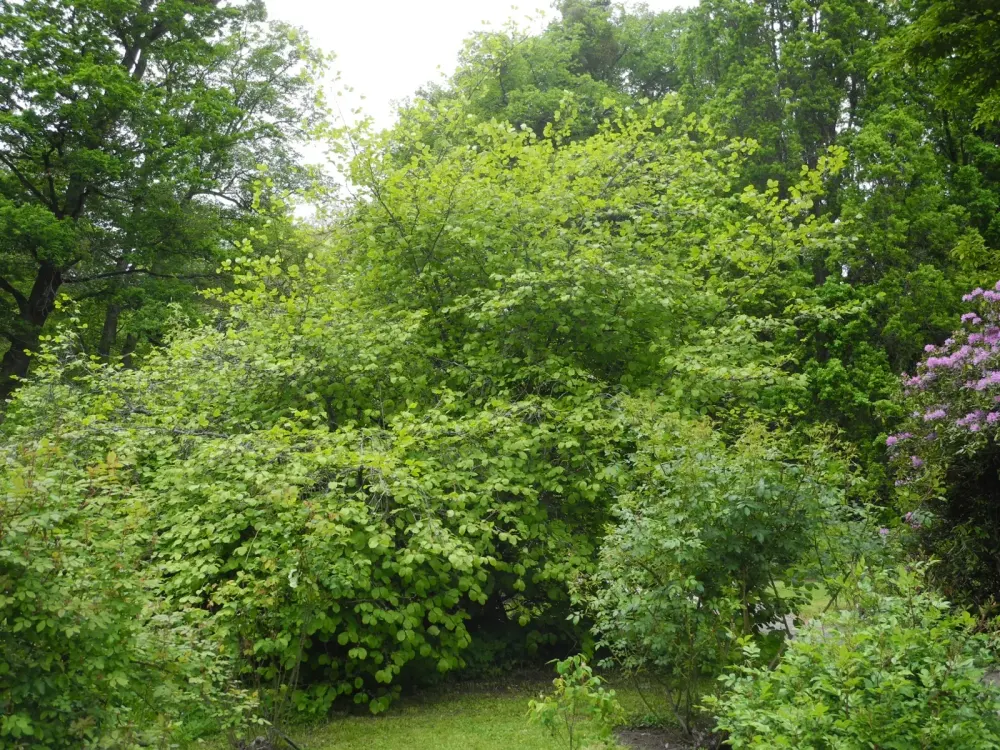
© Baummapper · CC BY-SA 3.0 de · Commons
Hamamelis virginiana
CautionVirginische Zaubernuss · (Hamamelis virginiana)
Witch-hazel family (Hamamelidaceae)
Description
Unusually for a deciduous shrub, witch hazel flowers from September to November, producing slender, spidery yellow petals just as its leaves are turning autumn colours. The bark and leaves are the parts used, rich in hamamelitannins, gallic acid and flavonoids. The Commission E monograph describes external preparations from the leaves and bark as established for mild skin inflammation, minor wounds and supporting venous health, and witch hazel water, creams and ointments rank among the best-known herbal skincare products. Importantly, witch hazel is intended for external use only, on intact skin and externally accessible mucous membranes; internal use is not supported by current monographs and can irritate the stomach because of its high tannin content. Persistent complaints, particularly haemorrhoids, warrant medical evaluation.
External use only!
This plant must NOT be taken internally. Use only as compress, salve, or bath.
Traditional witch hazel leaf compress (EMA-recognised) for minor skin inflammations, bruises and small wounds — astringent action via tannins.
Preparation & dosage
COMPRESS: 2–3 g dried witch hazel leaves in 200 ml boiling water, steep covered 10 min, strain, cool to body temperature. Soak a sterile compress or clean linen cloth, wring lightly, apply to the affected skin area. 2–3× daily for 10–15 min. EMA: Traditional external use for minor skin inflammations, small wounds and bruises. Do not treat open wounds, second-degree burns or deep injuries. Seek medical advice if no improvement within 1 week.
- Dry amount
- 2–3 g
- Doses per day
- 3×
- Max duration
- 4 weeks
Witch hazel leaf tincture (Commission E positive) — external astringent use for skin inflammations, haemorrhoids and mucosal injuries.
Preparation & dosage
TINCTURE / LIQUID EXTRACT (external): Witch hazel leaf tincture (DER 1:5 in 60–70 % ethanol), applied neat or diluted 1:1–1:3 with water. Apply with cotton pad or compress 2–3× daily. Commission E: external use for minor skin and mucous membrane inflammations, haemorrhoids, minor skin/mucous membrane injuries. Do NOT apply to deep wounds or severely inflamed surfaces. Due to ethanol content do not apply neat to sensitive or damaged mucous membranes.
- Liquid amount
- 2–5 ml
- Doses per day
- 3×
- Max duration
- 4 weeks
Traditional witch hazel leaf sitz bath (EMA-recognised) for haemorrhoid discomfort, localised itching and minor skin inflammations.
Preparation & dosage
SITZ BATH / PARTIAL BATH: 5–10 g dried witch hazel leaves in 1 litre boiling water, steep 15 min, strain, add to sitz bath water (approx. 5–10 litres, hand-warm 37–38 °C). Sit for 10–15 min. Once daily. EMA: Traditional use as sitz bath for mild pain and discomfort from haemorrhoids. Also suitable as partial bath for local skin inflammations, itching and mild eczema. Dry thoroughly afterwards. For severe pain, bleeding or mucosal swelling, consult a doctor immediately.
- Dry amount
- 5–10 g
- Doses per day
- 1×
- Max duration
- 4 weeks
Witch hazel bark tincture (Commission E positive) — more pronounced astringency than leaf extract, for skin inflammations, oral/pharyngeal mucosa and haemorrhoids.
Preparation & dosage
BARK TINCTURE (external): Witch hazel bark tincture (DER 1:5 in 45–70 % ethanol) or standardised dry extract (DER 5–7:1, standardised on tannins), applied to skin or mucous membranes 2–3× daily. Commission E positive for bark: external use in minor skin inflammations, minor skin injuries, local inflammations of oral/pharyngeal mucosa and haemorrhoids. Bark contains higher hamamelitannin content than the leaf and is more pronounced in astringency. Do not use longer than 4 weeks without medical supervision.
- Liquid amount
- 2–5 ml
- Doses per day
- 3×
- Max duration
- 4 weeks
Witch hazel gargle / mouth rinse (Commission E) for minor oral and pharyngeal mucosal inflammations — astringent tannins reduce swelling and redness.
Preparation & dosage
GARGLE SOLUTION: 1–2 g dried witch hazel leaves in 200 ml boiling water, steep 10 min, strain, cool to body temperature. Use as mouth rinse or gargle 3× daily for minor oral/pharyngeal mucosal inflammations. Do NOT swallow — astringent tannins can cause stomach upset. Alternative: dilute witch hazel leaf tincture 1:5 with water. Commission E recognises external use for oral and pharyngeal mucosal inflammations.
- Dry amount
- 1–2 g
- Doses per day
- 3×
- Max duration
- 2 weeks
Witch hazel ointment / cream (EMA-recognised) for minor skin inflammations, itching, bruises and haemorrhoid complaints — a classic pharmacy skin remedy.
Preparation & dosage
OINTMENT / CREAM: Ready-made preparations with standardised witch hazel leaf dry extracts (DER 5–7:1, typically 5–10 % extract in base) or bark extract, applied thinly to affected area 2–3× daily. EMA: Traditional external use for minor skin inflammations, itching, minor wounds and bruises. Use appropriate formulations for the perianal region (haemorrhoid ointments). Do NOT apply to weeping eczema, infected wounds or intact mucous membranes of eye/ear. May contain excipients (cetyl alcohol, fragrances) — consult doctor if contact allergy occurs.
- Doses per day
- 3×
- Max duration
- 4 weeks
Traditional witch hazel water (Aqua Hamamelidis, distillate) — folk and cosmetic use for irritated skin, razor burn and insect stings; low in tannins but contains volatile plant constituents.
Preparation & dosage
WITCH HAZEL WATER / DISTILLATE (Aqua Hamamelidis): The common commercial witch hazel water is not a tea infusion but an aqueous distillate of fresh witch hazel twigs (with leaves and bark), typically adjusted to 14 % v/v ethanol. Contains only small amounts of tannins (they do not distil over), but essential oils and other volatile constituents. Apply with a cotton pad or compress, dabbing onto the skin several times daily. Widely used in folk and cosmetic practice for soothing irritated or reddened skin after shaving, insect stings and minor skin irritations. The EMA monograph does not cover the distillate — it is a folk/cosmetic rather than classical phytotherapeutic preparation.
- Liquid amount
- 5–10 ml
- Doses per day
- 3×
- Max duration
- 4 weeks
⚠ External use only
HAMAMELIS FOR EXTERNAL USE ONLY. Internal use of witch hazel preparations (tea, tincture) is not covered by current EMA or Commission E monographs for this indication and may cause gastric irritation due to high tannin content. Use exclusively externally on intact skin and externally accessible mucous membranes (mouth, throat, anal area). Do not apply to eyes, ears or deep wounds. Witch hazel water (distillate) differs fundamentally in chemistry from leaf/bark preparations — contains minimal tannins. For persistent itching, increasing redness, weeping or suspected infection, consult a doctor immediately. Haemorrhoid complaints should always be assessed by a doctor, as serious conditions (carcinoma, inflammatory bowel disease) must be excluded.
External use on intact skin in normal amounts is considered probably safe. Per EMA, there are insufficient data for internal use in pregnancy. Avoid vaginal application or extensive mucosal use during pregnancy. When in doubt, consult a doctor or midwife.
External use on intact skin is generally considered safe. Exercise caution when applying on or near the nipple during breastfeeding — wipe thoroughly before nursing to avoid tannin ingestion by the infant.
Per EMA, insufficient safety data exist for children under 12. External use on small skin areas is considered low risk but should be approached with caution and medical advice. Do not apply to sensitive infant skin (nappy area). Avoid contact with eyes and mucous membranes in young children.
Drug interactions
Orale Antikoagulanzien (Warfarin, Phenprocoumon, Apixaban, Rivaroxaban)
Hamamelitannins and flavonoids may theoretically affect platelet aggregation at high doses. With external use at normal dosage, a systemically relevant interaction is very unlikely (minimal absorption). Monitor coagulation status with very extensive topical application as a precaution.
Topische Kortikosteroide
Simultaneous external use of witch hazel and corticosteroid preparations (e.g. hydrocortisone cream) has been combined in some clinical studies. No antagonistic interactions known — combination may have complementary effects. Apply at staggered times (at least 30 min apart) and seek medical advice.
Contraindications
- Hypersensitivity to Hamamelis virginiana or other plants of the family Hamamelidaceae.
- Contact allergy to constituents (hamamelitannins, safrole derivatives from bark) — discontinue immediately if allergic reactions (redness, swelling, itching) occur.
- Children under 12 years: Do not use without medical recommendation.
- Internal ingestion (oral intake of tea, tincture or extract) is not recommended and may cause gastric discomfort, nausea and vomiting due to high tannin content.
Harvested part: bark and leaves
- Time of day:
- On a dry, clear morning (9–12), once dew has fully evaporated. Choose young to mid-aged leaves from the upper third of the crown — these have higher tannin content than old or shaded leaves. Leaves should be fully unfurled, still fresh green, and without spots or pest damage.
- Drying:
- Spread leaves individually or in loose layers on screens or cloths in a shady, well-ventilated location. Dry at max. 40 °C (dehydrator or drying cabinet) — higher temperatures degrade tannins and flavonoids. Leaves are dry when they sound brittle and crumble cleanly. Harvest bark separately (strip branches of max. 2 cm diameter in late winter/early spring) and dry in small pieces also at max. 40 °C. Drying time: leaves 5–7 days; bark 10–14 days.
- Storage:
- 24 months — Airtight in dark glass or tin containers, dry and cool (below 20 °C). Leaves last up to 2 years with good storage. Discard immediately if browning, musty smell or moisture appears. Bark keeps up to 3 years when stored correctly.
- Time of day:
- Harvest bark in late winter / early spring — before bud break (February to March), when constituents (hamamelitannins) are most concentrated in bark and twigs. Choose young branches (1–2 cm diameter) and strip the outer bark with a sharp knife. Do not strip the main trunk — this permanently damages the shrub.
- Drying:
- Spread bark pieces (2–5 cm length) in a single layer on screens or cardboard — do NOT stack (mould risk). Dry at max. 40 °C in a dehydrator or drying cabinet, or at room temperature (18–22 °C) in a well-ventilated location for 10–14 days. Bark is dry when it breaks cleanly when bent and no longer springs back. Store in dark, airtight glass containers. Shelf life: 2–3 years with correct storage.
- Storage:
- 36 months — Dark, airtight glass or metal containers, dry and cool below 20 °C. Essential oil fractions are volatile — the tighter the seal, the longer the potency is preserved. Check regularly for mould and signs of moisture.
- Hamamelitannine (Hamamelose-Gallotannine, inkl. Hamamelitannin C)TanninContent: 3-10 %Bark
Characteristic lead compound of the genus Hamamelis — hydrolysable gallotannins on a hamamelose base. Up to 10 % in bark, 3–7 % in leaves. Responsible for the pronounced astringent (vasoconstrictive, tissue-toning) effect: protein precipitation in wound and mucosal exudate, reduction of capillary permeability, inhibition of lipid peroxidation and proteolytic enzymes. Wichtl: Hamamelitannins are the primary active substance for many external medicinal applications.
- Gallussäure und GallussäurederivatePhenolic acidContent: 0.5-5 %Leaf
Free gallic acid and bound derivatives are released on hydrolysis of the hamamelitannins. Antioxidant, anti-inflammatory and antimicrobial. Contribute to the overall astringent and anti-inflammatory effect of witch hazel preparations.
- Flavonoide (Quercetin, Kaempferol, Astragalin, Isorhamnetin-3-Glucosid)FlavonoidContent: 0.5-1 %Leaf
Flavonol glycosides and aglycones with vasoprotective, antioxidant and mildly anti-inflammatory effects. Quercetin and kaempferol inhibit histamine and arachidonic acid metabolite release in vitro — possible contribution to antipruritic (itch-relieving) effect. Lower amounts than in classical flavonoid drugs like hawthorn or elderflower.
- Proanthocyanidine (Catechin, Epicatechin, oligomere Procyanidine)TanninContent: 1-3 %Leaf
Condensed (non-hydrolysable) tannins — oligomers of catechin and epicatechin. Complement the effect of hamamelitannins: capillary-protective, antioxidant, anti-inflammatory. Present in witch hazel leaves and bark; similar structures to those in hawthorn (Crataegus) and cranberry (Vaccinium).
- Ätherisches Öl (Safroldervate, alpha-Ionon, Hexenol — Spuren)Essential oilContent: 0.01-0.05 %Bark
Very small amounts of volatile components including safrole (potentially hepatotoxic at high doses, but without relevance for external use at normal amounts), alpha-ionone and cis-3-hexenol. These components distil into witch hazel water (Aqua Hamamelidis) and explain its efficacy despite the absence of tannins. Weak antimicrobial and skin-soothing effect.
- Ellagitannine (Pentagalloylglucose und verwandte Verbindungen)TanninContent: 0.5-2 %Bark
Hydrolysable tannins of the ellagitannin type (structurally related to pentagalloylglucose) alongside the hamamelitannins in the bark. Antiviral (in vitro inhibition of HSV-1), antioxidant and astringent. Contribute to the antimicrobial protective effect in wound applications.
- Saponine (Hamamelisaponine — Spuren)SaponinContent: < 0.5 %Leaf
Small amounts of saponins in leaves and bark. No pharmacologically relevant foam saponin activity at external application. May contribute to skin emulsification and improved penetration of actives in formulations.
- Sterole und Triterpene (beta-Sitosterol, Ursolsäure — Spuren)OtherContent: < 0.5 %Leaf
Plant sterols (beta-sitosterol) and triterpene acids (ursolic acid) in trace amounts. Anti-inflammatory and membrane-stabilising. Contribute in combination with other constituents to the overall effect; pharmacologically of little independent relevance at the concentrations present.
- [1]MonographEMA/HMPC — European Union herbal monograph on Hamamelis virginiana L., folium (EMA/HMPC/228159/2008 rev. 1)(accessed: 2026-05-21)
- [2]MonographKommission E — Hamamelisblätter (Hamamelidis folium) und Hamamelisrinde (Hamamelidis cortex), Monographie positiv, BAnz Nr. 154, 1994(accessed: 2026-05-21)
- [3]MonographESCOP Monographs — Hamamelidis folium et cortex (Witch Hazel Leaf and Bark), 2nd edition 2003 (incl. supplement 2009)(accessed: 2026-05-21)
- [4]MonographWHO Monographs on Selected Medicinal Plants — Volume 2: Cortex Hamamelidis(accessed: 2026-05-21)
- [6]MonographPlants For A Future (PFAF) — Hamamelis virginiana database entry(accessed: 2026-05-21)
- [5]BookWichtl, Max (Hrsg.) — Teedrogen und Phytopharmaka: Ein Handbuch für die Praxis auf wissenschaftlicher Grundlage, 5. Auflage, Wissenschaftliche Verlagsgesellschaft Stuttgart, 2009(accessed: 2026-05-21)
- [7]WikipediaHamamelis virginiana (Wikipedia EN)(accessed: 2026-05-21)