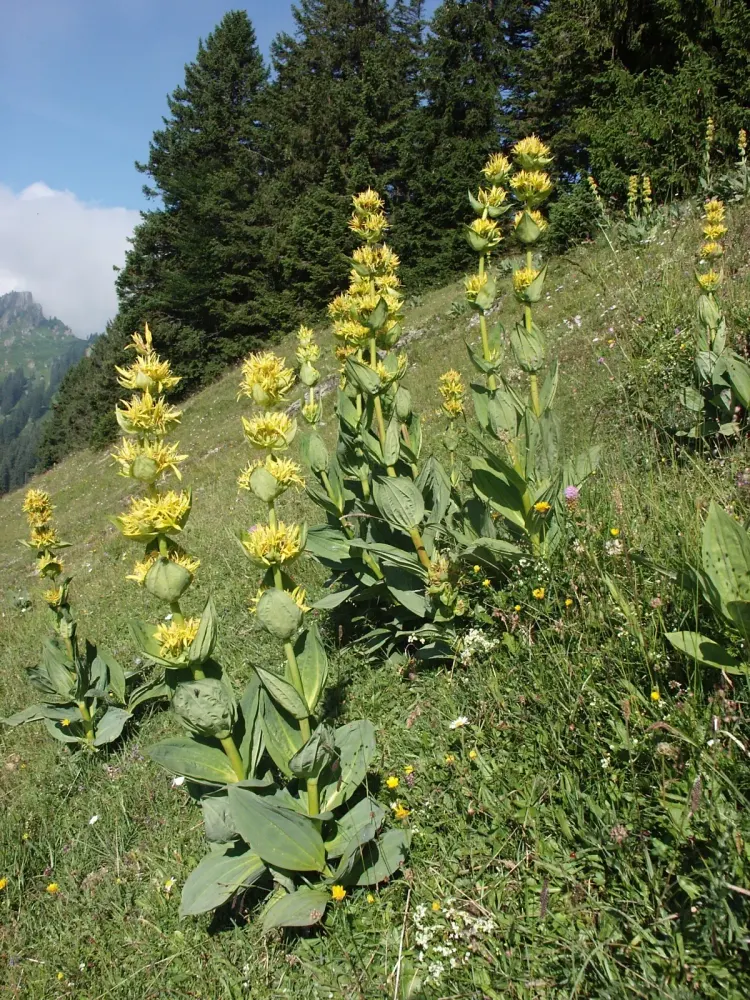
© Bernd Haynold · CC BY-SA 2.5 · Commons
Gentiana lutea
CautionGelber Enzian · (Gentiana lutea)
Gentian family (Gentianaceae)
Description
Gentiana lutea, the great yellow gentian, is a species of gentian native to the mountains of central and southern Europe, including the Alps, the Carpathians, the Pyrenees, the Apennines, and the mountains of the Balkan Peninsula. It is the type species of the genus Gentiana.
CONTRAINDICATED during pregnancy
Gentian root is contraindicated in pregnancy. Per EMA and ESCOP, sufficient safety data are lacking; experimental hints of uterine-stimulating activity from the bitters. WHO also recommends avoidance during pregnancy. Even culinary amounts in liqueurs or bitters should be avoided in pregnancy.
CONTRAINDICATED for children
Gentian root medicinal preparations are not for children and adolescents under 18 per EMA — insufficient safety data. Historically used in folk medicine in children, but this does not meet modern safety standards. Even small amounts of tincture (ethanol content) must be strictly avoided in children.
Critical drug interactions with:
Protonenpumpenhemmer (Omeprazol, Pantoprazol, Esomeprazol) · H2-Antihistaminika (Ranitidin, Famotidin) und Antazida
- TinctureRootInternalCommission E
Standardised gentian root tincture (positively assessed by Commission E) for reflex stimulation of gastric secretion in loss of appetite and dyspeptic complaints.
Preparation & dosage
TINCTURE (Commission E / EMA traditional use): Gentian root tincture (Gentianae radix), DER 1:5 in 40–60 % ethanol. 1–2 ml (~20–40 drops) undiluted or in a small amount of water, taken 15–30 minutes BEFORE meals — the bitter reflex works best through direct contact with oral mucosa. Daily dose: 1–4 g drug equivalent. Per EMA, use up to 4 weeks without medical supervision. Indication: loss of appetite (anorexia) and dyspeptic complaints (bloating, flatulence, mild gastro-intestinal discomfort). Mechanism: reflex stimulation of gastric secretion and bile production via bitter receptors in mouth and stomach. Do NOT use in gastric or duodenal ulcer.
- Liquid amount
- 1–2 ml
- Doses per day
- 3×
- Max duration
- 4 weeks
⚠ Age restriction: ≥ 18 years — Per EMA, adults 18+ only — insufficient safety data for children and adolescents.
[#src_ema_gentianae_radix] [#src_kommission_e_gentiana] [#src_escop_gentianae_radix]
- TeaRootInternalCommission E
Bitter gentian root infusion (positively assessed by Commission E) for appetite stimulation and digestive secretion — unsweetened, before meals.
Preparation & dosage
BITTER INFUSION (Commission E / EMA traditional use): 0.5–1 g finely cut or coarsely powdered gentian root in 250 ml boiling water, covered, steep 5–10 min, strain. Drink unsweetened and without milk 15–30 minutes BEFORE meals — the bitter taste is pharmacologically essential; sweetening negates the effect. 2–3 cups daily, daily dose 0.5–2 g drug. The intense bitterness (amarogentin: one of the bitterest natural compounds, bitter value > 58 million) stimulates peristalsis, gastric and bile secretion via oral and gastric bitter receptors. Do NOT use in gastric ulcer or acid reflux.
- Dry amount
- 0.5–1 g
- Doses per day
- 3×
- Max duration
- 4 weeks
⚠ Age restriction: ≥ 18 years — Per EMA, adults only.
[#src_ema_gentianae_radix] [#src_kommission_e_gentiana] [#src_escop_gentianae_radix] [#src_wichtl_teedrogen]
- TinctureRootInternalTraditional use
Traditional bitter tincture and aperitif use in gentian liqueurs and digestive bitters — stomachic, hepatic, tonic.
Preparation & dosage
BITTER TINCTURE (traditional use): Gentian tincture 1:5 (ethanol 40 %) in bitters and digestive liqueurs (e.g. Enzianschnaps, gentian bitters). 0.5–1 ml as pre-dinner aperitif. Traditional use as stomachic, hepatic tonic and general tonic in appetite loss, post-illness recovery and convalescence. Also an ingredient in classical herbal stomach liqueur recipes (Amarus composita). Note: high-proof gentian spirits (e.g. Tyrolean/Bavarian Enzianschnaps) are not standardised therapeutics — they are traditional food products.
- Liquid amount
- 0.5–1 ml
- Doses per day
- 3×
- Max duration
- 4 weeks
[#src_escop_gentianae_radix] [#src_who_gentianae_radix] [#src_pfaf_gentiana_lutea]
- TinctureRootInternalFolk medicine
Historical folk use as bitter tonic in fever and debility ('fever root') — no proven antipyretic effect.
Preparation & dosage
FOLK ANTIPYRETIC USE: 1–2 ml gentian tincture in water, twice daily. Historical folk use in febrile illness, general debility and as a general tonic (hence folk name 'fever root'). Found in herbal books of the 16th–19th centuries (Lonicerus, Tabernaemontanus). Scientific evidence for antipyretic effect is lacking — folk use as 'strengthening bitter' to support convalescence. Not a substitute for medical fever treatment.
- Liquid amount
- 1–2 ml
- Doses per day
- 2×
- Max duration
- 2 weeks
[#src_madaus_1938_gentiana] [#src_wp_de_gentiana] [#src_pfaf_gentiana_lutea]
- TeaRootInternalCommission E
Kommission-E-approved stomach tea from gentian root for appetite loss and dyspeptic complaints — cold or hot preparation, always unsweetened before meals.
Preparation & dosage
STOMACH TEA PER KOMMISSION E: 0.5–2 g coarsely powdered gentian root as cold macerate (steep 30 min in cold water then briefly boil) or as hot infusion with 250 ml boiling water, steep 5 min, strain. 3× daily before meals, unsweetened. Kommission E (BfArM, 1991): positive vote for indications loss of appetite and dyspeptic complaints. Cold macerate preserves volatile components; hot infusion more intense and practical. Daily dose: 2–4 g gentian root. Not in gastric or duodenal ulcer or hyperacidity.
- Dry amount
- 0.5–2 g
- Doses per day
- 3×
- Max duration
- 4 weeks
[#src_kommission_e_gentiana] [#src_wichtl_teedrogen] [#src_escop_gentianae_radix]
- SpiceRootInternalFolk medicine
Bitter component in traditional liqueurs (Suze, amara bitters, Enzianschnaps) and herbal teas — EU-approved flavouring; only cultivated material permitted in Germany.
Preparation & dosage
CULINARY USE: Dried, finely powdered gentian root is used as the bitter component in traditional herbal liqueurs, digestive bitters (amara) and herbal spirits — including Suze (France), as a base bitter in Aperol-type aperitifs, Angostura-style bitters and various alpine Enzianschnaps recipes. As a spice in small amounts (< 0.5 g) in herbal tea blends as a flavour component. In the EU, Gentiana lutea root is approved as a flavouring substance for food and beverages (EU Flavouring Regulation). Note: the plant is strictly protected in Germany (§ 44 BNatSchG) — only cultivated commercial material may be processed.
[#src_pfaf_gentiana_lutea] [#src_wp_de_gentiana] [#src_wp_en_gentiana]
- TinctureRootInternalTraditional use
Traditional compound bitter elixir application (Amara composita) — gentian root as the lead drug in monastery bitters, Swedish-bitters-type composites and digestive bitters.
Preparation & dosage
COMPOUND BITTERS / BITTER ELIXIR: Gentian tincture as the main component (~30–40 %) in classical bitter elixirs, combined with valerian root, calamus root, peppermint, wormwood or angelica root. 1–3 ml total mixture in water, 3× daily before meals. These compound preparations have been used in German phytotherapy tradition (e.g. Swedish bitters-type formulas, monastery bitters) for centuries. Effect potentiated by combining multiple amara drugs. Use only standardised commercial preparations or pharmacy-compounded preparations.
- Liquid amount
- 1–3 ml
- Doses per day
- 3×
- Max duration
- 4 weeks
[#src_wichtl_teedrogen] [#src_escop_gentianae_radix] [#src_madaus_1938_gentiana]
- TeaRootInternalTraditional use
Traditional cold macerate ('bitter water') — gentler alternative to hot infusion with milder activity profile, used in folk medicine as stomach water.
Preparation & dosage
COLD MACERATE (traditional alternative preparation): 0.5–1 g cut gentian root steeped overnight (minimum 6–8 hours) in 200 ml cold water, strain — do NOT heat. Drink cold 1–2× daily before meals. Cold maceration is said to better preserve volatile constituents and be gentler than hot infusion. Traditionally also called 'stomach water' or 'bitter water'. Milder effect than hot infusion. Not suitable for sensitive stomachs or gastritis.
- Dry amount
- 0.5–1 g
- Doses per day
- 2×
- Max duration
- 3 weeks