© Unknown (see Commons) · CC BY-SA 3.0 · Commons
Galium aparine
CautionKletten-Labkraut · (Galium aparine)
Madder family (Rubiaceae)
Description
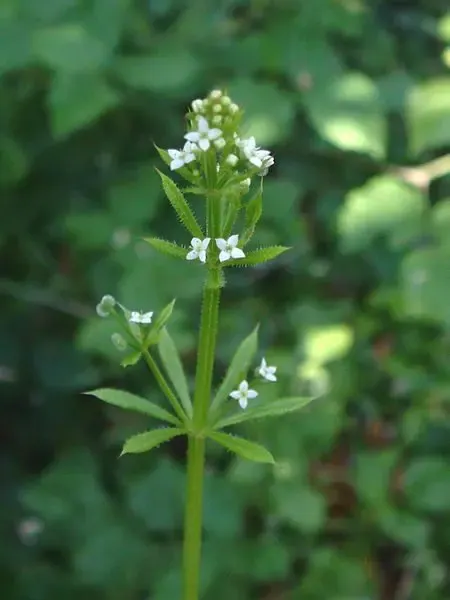
Galium aparine, with common names including cleavers, clivers, catchweed, robin-run-the-hedge, goosegrass, and sticky willy, is an annual, herbaceous plant of the family Rubiaceae.
- TeaAerial partsInternalFolk medicine
An infusion of fresh or dried herb is traditionally used as a diuretic and lymph-supporting remedy. In European folk medicine, cleavers was regarded as a spring tonic to support the excretory organs.
Preparation & dosage
- Dry amount
- 2–4 g
- Doses per day
- 3×
- CompressAerial partsExternalFolk medicine
Fresh plant juice or a poultice of the bruised herb was traditionally applied to wounds, minor burns, and skin inflammations. In vitro studies show enhanced cell migration in wound-healing assays.
Preparation & dosage
- SalveAerial partsExternalFolk medicine
Traditionally, an ointment-like preparation of fresh plant juice and butter was used for scalds, swellings, and skin rashes. Folk medicine also employs it for eczema and psoriasis.
Preparation & dosage
- TeaAerial partsInternalFolk medicine
As a diaphoretic, cleavers tea was used in fever conditions. Pliny the Elder already mentioned the plant against fever states and skin ailments.
Preparation & dosage
- Dry amount
- 2–3 g
- Doses per day
- 2×
- RawAerial partsInternalFolk medicine
Young shoots can be cooked as a leaf vegetable in spring, if harvested before the fruits harden. Dried and roasted fruits have been used as a low-caffeine coffee substitute.
- TinctureAerial partsInternalFolk medicine
Ethanolic extracts of cleavers showed immunomodulatory effects in vitro by stimulating lymphocyte proliferation. In naturopathy, the tincture is traditionally used for swollen lymph nodes.